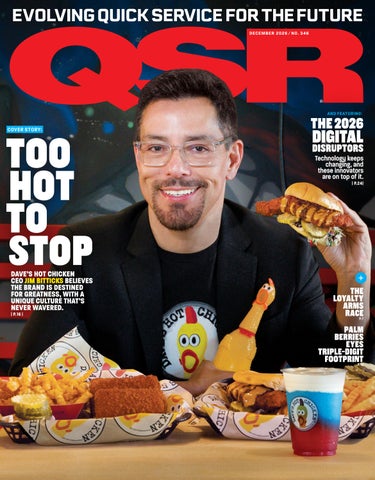
EVOLVING QUICK SERVICE FOR THE FUTURE DECEMBER 2026 ⁄ NO. 3 4 6
® AND FEATURING:
COVER STORY:
TOO HOT TO STOP DAVE’S HOT CHICKEN CEO JIM BITTICKS BELIEVES THE BRAND IS DESTINED FOR GREATNESS, WITH A UNIQUE CULTURE THAT’S NEVER WAVERED. | P. 16 |
THE 2026
DIGITAL
DISRUPTORS
Technology keeps changing, and these innovators are on top of it. | P. 24|
+ THE LOYALTY ARMS RACE P. 7
PALM BERRIES EYES TRIPLE-DIGIT FOOTPRINT
P. 10
Fries. Crowds love them. And with our upsell strategies, your bottom line will love them too.
© 2026 Simplot Global Food, LLC.
DECEMBER TA BL E OF CON T EN T S / #3 4 6
/ The Digital Disruptors Issue
2 WHAT’S HAPPENING AT QSR 4 EDITOR’S LETTER
5 BEHIND THE COUNTER 38 ADVERTISER INDEX
INSIGHT
7 FRESH IDEAS
Earning the Return
Brands continue to leverage data and find the best way to message guests. BY SAM DANLEY
10 ONES TO WATCH
Palm Berries
This better-for-you chain is preparing for some aggressive growth plans. BY BEN COLEY
FE AT URE S
16
A Global Force with a Rebel Soul
12 WOMEN IN LEADERSHIP
Kasia Bednarz Takes FARE to the Finish Line
BY BEN COLEY
Dave’s Hot Chicken is taking its parking-lot spirit worldwide, fueled by franchisee success, smarter technology, and an uncompromising commitment to its food.
NEWS
24
37
QSR’s Digital Disruptors BY QSR STAFF
Meet the innovators pushing restaurant technology into new territory.
The founder is championing a seed-oil-free fast casual. BY SATYNE DONER
40 S TART TO FINISH
Daniel Windon
The Fractured Prune Donuts CEO draws lessons from his career and what’s next for the brand.
FRANCHISE FORWARD
A Neighborhood Sweet Spot
These 16 Handles franchisees are finding major success in South Florida communities. BY BEN COLEY
ON THE COVER
Dave’s Hot Chicken CEO Jim Bitticks leads one of the fastest-growing fast casuals in the country.
DAVE'S HOT CHICKEN
PHOTOGR APHY: DAVE’S HOT CHICKEN
QSR is a registered trademark of Arrowfly. QSR is copyright © 2026 Arrowfly. All rights reserved. The opinions of columnists are their own. Publication of their writing does not imply endorsement by Arrowfly. Subscriptions (919) 945-0704. www.qsrmagazine.com/subscribe. QSR is provided without charge upon request to individuals residing in the U.S. meeting subscription criteria as set forth by the publisher. AAM member. All rights reserved. No part of this magazine may be reproduced in any fashion without the express written consent of Arrowfly. QSR (ISSN 1093-7994), USPS PUBLICATION #20387 is published monthly by Arrowfly, 1111 Superior Avenue Suite 1120, Cleveland, OH 44114. Periodicals postage paid at Cleveland, OH and at additional mailing offices. POSTMASTER: Send address changes to Arrowfly, 1111 Superior Avenue Suite 1120, Cleveland, OH 44114.
www.qsrmagazine.com | QSR | DECEMBER 2026
1
WHAT’S HAPPENING AT QSR EDITORIAL V P, EDITOR I A L - FOOD, R E TA IL , & HOSPITA LIT Y
Danny Klein
dklein@arrowfly.com
ADOBE STOCK / FIZKES
CONVERSATIONS AT QSR+
QSR EDITOR
Ben Coley
bcoley@arrowfly.com
Restaurant leaders are talking about AI, dirty sodas, GLP-1s, and other pressing issues in our first operator community. Request your invite today to join the discussion. No vendors. No hard sells. All collaboration.
FSR EDITOR
Callie Evergreen
cevergreen@arrowfly.com AS SOCI ATE EDITOR
Sam Danley
sdanley@arrowfly.com SENIOR EDITOR , WIR L
Satyne Doner
sdoner@wthwmedia.com CONTENT STUDIO V P, CONTENT S T UDIO
Peggy Carouthers
QSR UNCUT
pcarouthers@arrowfly.com W R ITER , CONTENT S T UDIO
Drew Filipski
dfilipski@arrowfly.com
Talking Leadership, History, and Building a Growth Brand, with Dave’s Hot Chicken CEO Jim Bitticks The Story of Outback Steakhouse and the Bloomin’ Onion, with Cofounder Tim Gannon Outback Steakhouse cofounder Tim Gannon arrived in Tampa with just $37 and a book of recipes. How did he turn that humble beginning into a global restaurant powerhouse? Gannon joins QSR Uncut to share the untold story behind Outback’s rise, the creation of the legendary Bloomin’ Onion, and the entrepreneurial grit that transformed a struggling dream into an iconic brand.
Dave’s Hot Chicken has become one of the fastest-growing restaurant franchises in industry history. CEO Jim Bitticks joins QSR Uncut to explore the brand’s meteoric rise, his personal leadership journey, and the challenges of scaling at breakneck speed. From building a strong company culture to maintaining momentum, Bitticks shares what it takes to grow with purpose while keeping Dave’s identity intact.
The Enduring Story of Wienerschnitzel, and What’s Still to Come, with CEO J.R. Galardi Founded in 1961, Wienerschnitzel has grown into the world’s largest hot dog chain. CEO J.R. Galardi joins QSR Uncut to discuss carrying forward his family’s legacy while preparing the iconic brand for its next chapter. From AI and restaurant innovation to expansion opportunities, Galardi shares how Wienerschnitzel is balancing decades of tradition with a forward-thinking approach to growth and modernization.
W R ITER , CONTENT S T UDIO
Ya’el McLoud
ymcloud@arrowfly.com W R ITER , CONTENT S T UDIO
Davina van Buren
dvanburen@arrowfly.com ART & PRODUCTION SENIOR A R T DIR ECTOR
Tory Bartelt
tbartelt@arrowfly.com V P, CR E ATI V E DIR ECTOR
Matt Claney
mclaney@arrowfly.com SALES & BUSINESS DEVELOPMENT SV P, S A LES & S TR ATEGY
Matt Waddell
mwaddell@arrowfly.com 312-961-6840 V P, BU SINES S DE V ELOPMENT
Amber Dobsovic
adobsovic@arrowfly.com 757-637-8673 S A LES DIR ECTOR
Patrick McIntyre
pmcintyre@arrowfly.com 216-372-8112 S A LES M A N AGER
Guy Norcott
gnorcott@arrowfly.com 854-200-5864 K E Y ACCOUNT M A N AGER
John Petersen
jpetersen@arrowfly.com 216-346-8790 N ATION A L S A LES M A N AGER
Tom Boyles
tboyles@arrowfly.com 662-607-5249 S A LES DIR ECTOR
Tony Bolla
tbolla@arrowfly.com 773-859-1107 S A LES DIR ECTOR
Susan Shepherd
sshepherd@arrowfly.com 404-386-1709
54 minutes
53 minutes
45 minutes
ACCOUNT M A N AGER
Tanner Hartwick
thartwick@arrowfly.com 571-596-0375 CU S TOMER SERV ICE R EPR ESENTATI V E
KEYNOTES ANNOUNCED FOR WOMEN IN RESTAURANT LEADERSHIP SUMMIT!
Tracy Willingham
twillingham@arrowfly.com 919-945-0704 CU S TOMER SERV ICE R EPR ESENTATI V E
Brandy Pinion
bpinion@arrowfly.com 216-952-0877
AMY DURINI , chief marketing and strategy officer for Taco Bell International, and NIVERA WALLANI , chief development officer for KFC Global, will serve as the headlining keynotes at WiRL 2027.
ADMINISTRATION CEO
Matt Logan
mlogan@arrowfly.com
AMY DURINI
NIVERA WALLANI
The Women in Restaurant Leadership (WiRL) conference returns February 6–9, 2027, at the Grand Hyatt Scottsdale Resort in Scottsdale, Arizona.
Registration is available through January 1, 2027, at $599 for operators
of quick-service and full-service restaurants. 2
DECEMBER 2026 | QSR | www.qsrmagazine.com
919-945-0704 www.qsrmagazine.com/subscribe FOUNDER
Webb C. Howell QSR is provided without charge upon request to individuals residing in the U.S. who meet subscription criteria as set forth by the publisher. Sponsored content in this magazine is provided to the represented company for a fee. Such content is written to be informational and non-promotional. Comments welcomed at sponsoredcontent@qsrmagazine.com.
MAKE YOUR PORTFOLIO A LITTLE MORE Badass! 44
TOTAL OPERATING UNITS
19%
INCREASE IN AVERAGE NET SALES YOY*
17
NEW FRANCHISE LOCATIONS OPENED IN 2025*
44%
FRANCHISE UNITS THAT EXCEEDED AVERAGE NET SALES*
*SOURCE: 2026 BAD ASS COFFEE OF HAWAII FDD
MEET ALLEN STANCZAK
Multi-Unit, Multi-Brand Franchise Owner SCALING MULTI-UNIT SUCCESS WITH BAD ASS COFFEE OF HAWAII A highly strategic decision for scaling a multi-unit franchise operation. Strong brand identity, proven business model, and growing market presence. Franchisor support reduces operational friction and accelerates growth. Resonates with communities, driving loyalty and long-term revenue stability.
Badass FUTURE! JOIN OUR ‘Ohana! MAKE IT A
"Beyond the numbers, the most compelling aspect of this investment is the strength of the franchisor’s support system. From leadership to operations, they demonstrate a high level of authenticity, industry expertise, and commitment to franchisee success, reducing operational friction and accelerating growth." Allen Stanczak, St. Augustine, FL
FRANCHISE@ROYALALOHA.COM 833.205.2224 BADASSCOFFEE.COM
EDITOR’S LETTER
The Next Big Thing Isn’t Always the Right Thing
A S R E S TA U R A N T S R A C E T O E M B R A C E A I , A U T O M AT I O N , A N D E X PA N S I O N , T H E B I G G E S T C O M P E T I T I V E A D V A N T A G E M AY B E K N O W I N G W H E N T O S AY N O .
T
BCOLEY@ARROWFLY.COM QSR MAGAZINE
SCAN THIS CODE TO SUBSCRIBE TO
QSR’S E-NEWSLETTERS!
4
DECEMBER 2026 | QSR | www.qsrmagazine.com
here’s a moment in nearly every conversation about restaurant technology when someone starts talking about what’s possible. AI can take orders, predict demand, personalize marketing, and identify operational problems before anyone notices them. Robots can deliver food. Software can make decisions that once required years of restaurant experience. It’s fascinating stuff. And, frankly, it’s hard not to get caught up in it. But after spending the past several months talking with restaurant operators and technology innovators, I’ve become more interested in a different question. Just because a restaurant can do something, should it? That question came up repeatedly in our conversations for this issue, particularly in our cover story on Dave’s Hot Chicken. The brand recently surpassed 500 restaurants worldwide, with plans to open roughly 140 locations this year and another 150 in 2027. It’s expanding internationally, testing new technology, and building a franchise system with more than 700 domestic commitments still waiting to be developed. There’s no shortage of ambition. But CEO Jim Bitticks is also keenly aware of what could go wrong. Take speed of service. Dave’s could prepare chicken earlier and hold it under heat lamps to move customers through the line faster. It might even increase sales. But Bitticks isn’t willing to sacrifice the food that made the brand successful in the first place. The company has taken a similar stance on technology. Dave’s tested AI voice ordering at the drive-thru, and the system completed orders at a relatively high rate. Employees appreciated the
help. Customers, however, didn’t like the experience. So Dave’s pulled the plug. I find that decision just as interesting as any successful technology rollout. There’s a tendency in this industry to treat innovation as an inevitable march forward, where every new capability deserves a place in the restaurant. Dave’s offers a reminder that knowing when to say no can be just as valuable. That same tension runs through our annual Digital Disruptors feature, which introduces professionals working on everything from autonomous delivery and AI-powered marketing to smarter restaurant operations and connected technology platforms. Some envision a future where customers order meals through AI assistants instead of restaurant apps. Others are developing systems that help managers identify problems in minutes instead of days. And several believe the industry’s biggest opportunity isn’t adding another tool, but getting existing ones to work together. What struck me most was how often the conversation returned to people. The best technology should make employees’ jobs easier, give operators better information, and create a more convenient experience for guests. It shouldn’t introduce complexity simply because the capability exists. That’s relevant as we close out 2026. Restaurants are still dealing with cost pressures, cautious consumers, and the challenge of protecting margins. Every investment needs to earn its place. The industry will have plenty of new technology to consider in 2027.
Ben Coley EDITOR
BEHIND THE COUNTER
Why the Best Employees Stay
Leaders from Swig and Dave’s Hot Chicken unpack the culture, leadership, and career opportunities that turn restaurant jobs into lasting careers.
ADOBE STOCK / LIGHTFIELD STUDIOS
THIS YEAR, SWIG AND DAVE’S HOT CHICKEN WERE BOTH ON QSR MAGAZINE’S BEST BRANDS TO WORK FOR LIST.
Scan the QR Code to watch the webinar.
Building a great restaurant brand requires more than attracting customers. It also means creating an environment where employees feel valued, supported, and motivated to build long-term careers. That was the focus of QSR magazine’s Best Brands to Work For webinar, held December 1, featuring Swig CEO Alex Dunn and Dave’s Hot Chicken cofounder and chief brand officer Arman Oganesyan. Moderated by QSR editor Ben Coley, the discussion explored the leadership strategies behind strong workplace cultures and how restaurant operators can attract, develop, and retain talent in an increasingly competitive industry. The conversation centered on the importance of turning company values into everyday actions. For restaurant brands, a positive workplace culture goes beyond mission statements and employee benefits. It requires consistent leadership, meaningful engagement, and a commitment to helping team members succeed. Recruiting and retention were also major themes. As restaurant operators continue to compete for talent, understanding what motivates employees to join a company—and what encourages them to stay—remains essential to building stable, high-performing teams. Another focus was career development. Training and advancement opportunities can help employees envision a future within an organization rather than viewing restaurant jobs as temporary positions. Drawing on their experiences growing two rapidly expanding restaurant concepts, Dunn and Oganesyan offered perspectives on the relationship between workplace culture and long-term business success. The overarching message was clear. Becoming a great place to work requires intentional investment in people at every level of the organization.
www.qsrmagazine.com | QSR | DECEMBER 2026
5
BEHIND THE COUNTER
Quality and Operational Technology
ACQUIRING
EXISTING FRANCHISE RESTAURANTS
COULD BECOME MORE ATTRACTIVE
THAN BUILDING NEW LOCATIONS
Homegrown’s Brick & Mortar 2036 Report, authored by founder and CEO Michael Davis, identifies 11 trends expected to transform restaurants and other brick -and-mortar businesses over the next decade.
• AI agents are expected to become essential operational tools, helping restaurants automate inventory tracking, purchasing, labor scheduling, invoice processing, and financial forecasting. • Homegrown projects that AI-driven operational improvements could create a 300–500-basis-point difference in prime costs between otherwwise comparable restaurant brands. • Companies such as Kintow, Square, Owner.com, and Thanx are already developing AI-powered systems that give smaller operators access to capabilities traditionally reserved for large chains.
Restaurant Leadership and Employee Ownership
Franchising and Smarter Restaurant Development
•G eneral managers will become more valuable as businesses prioritize recruiting, developing, and retaining operators capable of driving individual restaurant performance.
• Synthetic equity programs, including phantom stock and store-level profit sharing, could become standard tools for improving employee retention and aligning incentives with business performance.
• Franchising is expected to become a more accessible entrepreneurial pathway, particularly among younger operators seeking established business models, training, and operational support.
• Homegrown predicts that top-performing GMs at high-volume locations could earn more than $250,000 annually through compensation packages that include performance incentives and profit participation.
• The report points to Texas Roadhouse, Chick-fil-A, Chipotle, and Teamshares as examples of organizations using financial incentives, structured development programs, or ownership opportunities to attract and retain talent.
• A cquiring existing franchise restaurants could become more attractive than building new locations, with the report citing a typical QSR resale price of approximately $115,000 compared with development costs that can approach $900,000.
• R estaurants will increasingly prioritize their own digital ordering channels, customer databases, and hyperlocal marketing campaigns to reduce dependence on third-party platforms charging commissions of 20–30 percent.
• S ubscription and membership programs are expected to become more common as restaurants seek predictable recurring revenue and higher visit frequency, following examples from Panera Bread, Pret A Manger, and Sweetgreen.
• AI-powered marketing tools will allow smaller brands to execute targeted campaigns, analyze customer behavior, and build stronger relationships with consumers in their immediate neighborhoods.
• I n-store automation could significantly improve restaurant economics, with the report citing Sweetgreen’s Infinite Kitchen, which achieved a 31 percent restaurant-level margin and 45 percent lower employee turnover during its first year.
DECEMBER 2026 | QSR | www.qsrmagazine.com
• Smaller restaurant footprints and lower construction costs will become increasingly important, with Homegrown forecasting greater interest in 800–2,000-square-foot locations, buildouts below $500,000, and payback periods of 12–24 months. • S trategic co-tenancy with complementary businesses, such as restaurants near fitness studios or coffee shops near coworking spaces, could help operators share customer traffic, improve site economics, and increase sales opportunities.
Real Estate Economics and New Financing Models • R ising construction expenses will make tenant improvement allowances an increasingly important component of restaurant development, with operators negotiating landlord contributions against rent, lease duration, and other financial terms. • S econd-generation restaurant spaces will become especially valuable because existing kitchens, ventilation systems, and other infrastructure can substantially reduce opening costs.
• R evenue-based financing, royalty arrangements, and community crowdfunding are expected to help emerging brands fund expansion between their first few locations and the point when traditional institutional financing becomes available. •H omegrown predicts that successful emerging brands will increasingly combine founder equity, community investment, and revenue-sharing agreements to finance growth without surrendering significant ownership stakes.
ADOBE STOCK / ANTIKWAR1
Marketing, Customer Loyalty, and Automation
6
• The report predicts that businesses delivering exceptional product quality, consistent execution, and distinctive customer experiences will outperform competitors relying primarily on convenience or price.
fresh ideas D E C E M B E R
2 0 2 6
M E N U
T R E N D S
EARNING
THE RETURN In the loyalty arms race, the right rewards matter more than more rewards. BY SAM DANLEY
PANERA REVAMPED ITS REWARDS PROGRAM THIS YEAR AS PART OF AN OVERALL TURNAROUND PLAN.
A
for nearly three quarters of transactions. But all three are working through a version of the same question: Once guests sign up, what gives them a reason to keep engaging? Their answers suggest the loyalty arms race isn’t simply about offering more. It’s about making the payoff easier to understand and figuring out what makes the program useful to different guests. For Panera, that’s meant reconsidering a familiar approach. The brand moved MyPanera from a surprise-and-delight model to a points-based program this summer after hearing that guests
PANERA
ngry Chickz had an enthusiastic following before it had a loyalty program. But getting those fans to make room for another restaurant app required more than counting on their affection for the brand. “We are strong believers that you must give guests a reason to allow you to not only take up a moment of their time, but also take up space on their phone,” says president Peter Tremblay. That challenge looks different at Panera, with more than 70 million MyPanera members, and Dutch Bros, where rewards account
www.qsrmagazine.com | QSR | DECEMBER 2026
7
M E N U
T R E N D S
wanted more transparency and choice. stories involving the brand’s chicken char“Surprise and delight can be a great way acter are intended to give them something to create moments of excitement, but it can else to engage with. also leave guests wondering what they’re “When guests find some down time in going to get and when,” says CMO Andy their day, if they’re feeling bored or sad, we Rebhun. “We wanted to take the guesswant them to turn to us for a moment of joy,” work out of loyalty.” he says. “Phase 2 is going to create those Members now earn 10 points per dolorganic moments for us.” Dutch Bros, meanwhile, is building on an lar spent. An additional tier, MyPanera+, already substantial level of participation. Its unlocks benefits for guests who spend $300 annually. The structure gives memnext priorities include strengthening personalbers a clearer understanding of what ization and segmentation, a natural extension PANERA RECENTLY SWITCHED TO A POINTS SYSTEM. they’re working toward, while recognizing of a menu built around customization, with that customers use Panera differently. more than 40 flavors and a range of toppings The redesign also reflects a practical conand mix-ins. sideration for brands trying to make rewards “Someone who starts their morning with more compelling: Complexity can undermine a Golden Eagle might be looking for a Rebel or Myst Energy Refresher in the afternoon,” the value they’re offering. “If a guest has to work too hard to undersays Jason Seeley, vice president of digital stand your loyalty program, you’ve already marketing. created friction,” Rebhun says. The company is seeing customers mix it Panera is encouraged by early feedup more, whether that’s coffee one day and energy or lemonade the next. back, and Rebhun says the ongoing work is listening, testing, and learning what drives “That’s where personalization becomes engagement. really interesting for us,” Seeley says. “We “One thing I believe strongly is that launchcan use what we’re learning to help customing a loyalty program isn’t the finish line. It’s ers discover new drinks and create rewards that reflect their individual preferences.” really the starting point,” he says. “The real opportunity comes from what you learn about That appetite for experimentation has your guests over time and how you use those helped shape the menu. Poppin’ Boba and insights to make the experience better.” Myst Energy Refreshers were inspired by At Angry Chickz, which implemented the customer feedback and became permanent first phase of its program this summer, the additions following a strong response. distance between a guest and their next The enthusiasm also extends beyond bevreward has become an important considerages. Merch and sticker drops, mystery cup eration. sleeves, and collectible straw toppers give Members earn $5 when they reach 75 fans something to anticipate. Dutch Bros points, with the flexibility to apply that reward wants to bring more of that excitement into its rewards program going forward. to anything on the menu. Tremblay says guests respond best to challenges lasting one All three leaders agree that having a proto seven days. The brand has observed that gram guests simply belong to isn’t enough. participants in challenges offering 30 points The real challenge is giving them an ongoing return within the following week. reason to use it. That requires clarity about the “Guests see they are only a visit away reward, attention to the behavior surroundfrom earning $5, so they return quickly as a ing it, and a willingness to keep adjusting. result,” he says. “Ultimately, success isn’t just about how It’s an example of how the path to a many members we have,” Rebhun says. “It’s reward can matter alongside the reward about whether we’re building stronger relaitself. Guests have a visible goal and a reationships, driving incremental visits, and son to act soon. giving guests more reasons to make Panera DUTCH BROS HAS STEADILY GROWN ITS RETremblay’s longer-term ambition stretches part of their routine.” WARDS PROGRAM OVER THE YEARS. beyond ordering. Angry Chickz wants guests opening the app several times a week, including when they aren’t Sam Danley is the associate editor of QSR. He can be reached at sdanley@ wthwmedia.com. planning a purchase. Planned personalization, gamification, and
8
DECEMBER 2026 | QSR | www.qsrmagazine.com
PANERA, DUTCH BROS (2)
fresh ideas
O N E S T O WAT C H
Palm Berries
A better-for-you concept has dreams of reaching 100 locations via franchising. BY BEN COLEY FOUNDER: Noor Mehmood and Ahsan Mehmood, brother and sister duo HEADQUARTERS: Denver, North Carolina UNIT COUNT: 19; 8 corporate locations, 11 franchised YEAR FOUNDED: 2019; began franchising in 2023 ANNUAL SALES: AUV $705,000
P
10
DECEMBER 2026 | QSR | www.qsrmagazine.com
PALM BERRIES EARNS $705,000 IN AUV.
funded construction using proceeds from the food trailer. Ahsan helped complete the buildout himself, including grinding floors and constructing counters. That experience pushed them to create efficient kitchen layouts, minimize unnecessary construction expenses, and operate with small teams. Palm Berries now estimates its restaurant opening costs at approximately $200,000 to $250,000. “We had to get really creative and intentional about the layout, and how the kitchen layout is going to look like and how the store is going to look like,” Mehmood says. The brand’s menu follows a similar strategy. Palm Berries offers fewer than 10 smoothies, six specialty bowls, and customizable options. Mehmood says the
company has resisted adding items such as avocado toast, preferring to concentrate on its core products. The streamlined operation has helped support average unit volumes of approximately $705,000, with some locations exceeding $1 million in annual sales. Mehmood credits site selection as the biggest factor separating top-performing restaurants from the rest of the system. The Hickory, North Carolina, location, which surpassed $1 million in revenue within its first three years, serves as a benchmark when evaluating new markets. Palm Berries has also developed a preference for suburban communities, a strategy that emerged almost accidentally. The siblings origi- [CONTINUED ON PAGE 38]
PALM BERRIES
alm Berries CEO Noor Mehmood never planned to build a national restaurant chain. The business began as a food trailer in Denver, North Carolina, where she and her brother, Ahsan, hoped to earn enough money to support their family. They had little experience marketing a restaurant and no long-term expansion strategy. But customers began lining up for the brand’s acai bowls and smoothies, traveling from neighboring towns and waiting outside even during the winter. The response convinced the siblings they had something worth expanding. “We only did this to support our family financially, and just to see where it will take us,” Mehmood says. “We did not really think about the journey or what the next five years are going to look like or the next 10 years.” Today, Palm Berries operates 19 locations, including 11 franchised and eight company-owned restaurants, with plans to reach 100 by 2029. The chain opened seven restaurants this year and is building the infrastructure to support a much larger footprint. The company’s early financial constraints helped establish an operating model that Mehmood believes gives it an advantage in attracting franchisees. When the siblings opened their first brick-and-mortar restaurant in 2020, they
STOP FRYING YOUR PROFITS TE.
AS LESS OIL W
. K R O W S S LE D
E BETTER FRI FOOD
. Y T I L A U Q
P TO
SAVE U
ING OIL
ON FRY
COSTS
DISCOVER VITO FRYFILTER www.vitofryfilter.com +1 (407) 377-7769
Kasia Bednarz Takes FARE to the Finish Line The FARE founder grew up on simple, home-cooked food. Now she’s scaling a seed-oil-free fast-casual without cutting corners. / BY SATYNE DONER
KASIA BEDNARZ FOUNDED FARE IN 2018.
E
ating clean was never a trendy “wellness” conversation for Kasia Bednarz. A first-generation Polish American raised in Chicago, she grew up with young parents in blue-collar jobs: Her mother worked three jobs, and her father was a truck driver who was always on the road. The family cooked what it could afford, even if that meant just vegetables for dinner. “What I do remember, though, is that the food was always really simple,” Bed-
12
DECEMBER 2026 | QSR | www.qsrmagazine.com
narz says. “Everything was made with care because it was made by the people who love you.” Bednarz started working at a roller-skating rink at 14, then became a cocktail server at Chicago’s Gibsons Restaurant Group, where she rose to host, manager, director, and eventually partner. Juggling work and college, she relied on fast food and kept running into the same problem. Food marketed as healthy either sacrificed flavor or hid sugars, oils, and ingredients she couldn’t pronounce. “I just realized how difficult it was to find food that was so simple like that in a convenient format,” she says. “You can go to restaurants, and you can sit down and have this elaborate meal, but if I wanted to just grab a very simple vegetable-forward lunch, that wasn’t available. And if it was, it didn’t necessarily taste good.” She opened FARE in 2018 with a small counter at a downtown Chicago food hall.
She wasn’t trying to build a national restaurant brand. She wanted real, craveable food that people could, in her words, “eat on repeat.” “Having that immigrant background, I wanted to work for myself. I wanted to do something bigger than myself,” she says. “It was never the idea that it was going to be in restaurants and going to be huge. I was just trying to solve a problem that I personally had.” FARE’s menu grew out of how Bednarz grew up eating: scratch-made recipes, no seed oils, no refined sugar. The backlash against seed oils has pushed plenty of chains toward “cleaner” menus lately, but Bednarz says FARE was built that way from the start. “It definitely makes it more difficult in terms of sourcing, recipe development, and operations, but that’s just the whole point,” she says. “These aren’t marketing decisions for us. These are really true to who we are as a brand. That takes extra work, but we’re willing to put that in because we think there’s so much value in it.” Her rule of thumb is simple: “If I won’t eat it or if I won’t feed it to my family, we just don’t have it.” FARE recently replaced its alternative milks, which contained gums and listed sunflower oil as a top ingredient. Its oat milk is now made with organic oats, filtered water, and salt. As GLP-1 drugs change how Americans eat, Bednarz says FARE isn’t chasing trends. Its seasonal menu lets guests eat in whatever way works for them. “To some people, that may mean you’re getting the kids’ plate instead of getting the full plate because you’re just not as hungry anymore, but you’re still getting that real, nourishing food,” she says. In eight years, Bednarz has grown FARE to 10 Chicago-area locations, and two restaurants are on the way in Charlotte, North Carolina, the brand’s first market outside its hometown. Even as FARE has grown, Bednarz has stayed hands-on. She still develops every recipe on the menu herself. The company has also made the Inc. 5000 list of America’s fastest-growing private companies three years running, most recently ranking No. 393 in 2026 with [CONTINUED ON PAGE 38]
FARE (2) ALISHA TOVA, STEPHEN WEINERT JR
WOMEN IN LEADERSHIP
Imagine Your Brand in Every Bite! Your flavors are unforgettable — your packaging should be too.
PACKAGING FOR CATERING, TAKEOUT & DELIVERY Made All Under One Roof in the USA 100% Recyclable Quality Acceptance Rate of 99.98% Secondary Food Packaging In-House Structural Design Expertise Ships Competitively Nationwide
NEW! DOUBLE-SIDED LITHO CAPABILITIES
(973) 345-2000 | SALES@ACCURATEBOX.COM | ACCURATEBOX.COM
ADVERTISMENT
The Speed-to-Profit Engine: Rethinking QSR Drive-Thru Performance In the QSR industry, your drive-thru isn’t just a convenience – it’s your primary revenue driver.
A headset failure during peak lunch rush or a malfunctioning timer isn’t a minor nuisance; it’s a direct hit to your bottom line. Every minute an order stalls, customer satisfaction drops, accuracy plummets and potential revenue drives right past your window. Peak operational excellence demands a seamlessly integrated tech ecosystem that powers performance behind the scenes.
Eliminating Audio and Operational Friction
Maintaining maximum throughput comes down to these core operational pillars:
Audio clarity directly dictates order speed. Our noise-canceling headsets deliver crystal-clear sound from your employee directly out to the car in the lane. Noise reduction reduces inbound drive-thru noise and outbound kitchen noise for a smooth customer experience. Paired with fast 24-hour turnaround on headset repairs and free inbound shipping, clear communication turns bottlenecked lanes back into high-throughput profit centers without delay.
Real-Time Speed Metrics:
Beyond tracking time, the TEMPO timer actively drives margins through live lane tracking, color-coded cues and cloudbased analytics via the RFT Portal. With automated reporting, performance alerts and live store leaderboards to engage crews, managers gain total visibility to maximize speed and profitability.
Smart Surveillance & Oversight: Go beyond basic footage.
NDAA-compliant 4K camera systems paired with integrated drive-thru audio protect assets while giving managers complete operational visibility.
Modernized Guest Experiences: Dynamic digital menu
boards and licensed background audio elevate guest perception, boost ticket sizes and create a unified brand environment.
The Power of Single-Source Support: Managing separate vendors
for hardware, field service, surveillance and digital media creates friction and extends costly downtime. Partnering with a single-source technology provider ensures rapid troubleshooting, expert system design, seamless installation and nationwide support – whether you run a single location or manage a multi-unit portfolio.
When technical friction is eliminated, your crew can focus on what matters most: serving great food, fast. 14
DECEMBER 2026 | QSR | www.qsrmagazine.com
R.F. TECHNOLOGIES, INC.
Drive-Thru Performance:
KEEP YOUR DRIVE-THRU MOVING. KEEP YOUR PROFITS GROWING. Save money. Solve problems fast. Keep your QSR running at full speed.
LOWER COSTS. LESS DOWNTIME. BETTER PERFORMANCE. Join tens of thousands of restaurants in North America that trust R.F. Technologies, Inc. When your drive-thru slows, we keep you moving with fast repairs, upgrades and installations – minimizing downtime, boosting performance and keeping sales, service and satisfaction on track.
Big Dog Surveillance® Systems Protect people, property and profits with reliable, NDAA-compliant 4K camera surveillance.
Professional Design Services We offer suggested camera placements.
Big Dog Voice Add drive-thru audio to your video.
AI & POS Integration Available
SURVEILLANCE
Free Tech Support Included
DRIVE-THRU Headset Repairs All brands. Expert fixes. Restore your equipment – fast.
Integrated Technology Solutions Modernize your operation with: • Digital menu boards • Self-service kiosks • Music Solutions – Pandora CloudCover
INTEGRATED TECHNOLOGY
SOLUTIONS
– SiriusXM for Business – ioBusinessMusic
Field Service Reliable support that shows up. Quick troubleshooting and real on-site solutions.
Drive-Thru Systems & Installations Single sites to national rollouts. Drive-thru systems built to perform.
Speed-of-Service Timers Master your drive-thru. Real-time tracking, instant metrics and automated daily reports.
PRO ON-SITE SERVICE AND INSTALLATION FOR DRIVE-THRU, SURVEILLANCE AND MUSIC – DONE FAST, DONE SMART. Don’t let equipment issues slow you down. Get fast solutions and real savings today. 800-598-2370 | Sales@RFDriveThru.com | RFDriveThru.com CHICAGO • LOS ANGELES • NEW ENGLAND • ST. LOUIS • TORONTO ©2026 R.F. Technologies, Inc. All brand and product names are trademarks or registered trademarks of their respective companies. All rights reserved.
BRAND GROWTH
A GLOBAL FORCE WITH A
Rebel Soul Dave’s Hot Chicken is taking its parking-lot spirit worldwide, fueled by franchisee success, smarter technology, and an uncompromising commitment to its food. /
BY BEN COLEY
DAVE’S HOT CHICKEN BEGAN WITH HUMBLE BEGINNINGS. BUT NOW IT’S A GLOBAL FORCE. DAVE’S HOT CHICKEN
16
DECEMBER 2026 | QSR | www.qsrmagazine.com
BRAND GROWTH
www.qsrmagazine.com | QSR | DECEMBER 2026
17
BRAND GROWTH
Jim Bitticks has heard the argument plenty of times. If Dave’s Hot Chicken could move customers through its restaurants faster, the chain could sell more food. Consultants have offered projections. Franchisees have pushed for speed. Even his business partner has pressed the issue inside their own drive-thru restaurant. The CEO understands the temptation. A growing chicken brand with lines of hungry customers has an obvious incentive to shorten the wait. But Bitticks sees another calculation taking place inside the kitchen. To have more chicken ready, crews could cook it earlier. To keep it available, they could hold it under a heat lamp. The ticket would filled faster, but the customer receives a different meal. That trade carries a cost the stopwatch cannot capture. “Our number one focus has been on and continues to be on the quality of the chicken,” Bitticks says. “We talk about mind-blowing quality, but we really mean mind-blowing chicken. Eighty-one percent of our orders is chicken. It’s literally the reason the brand launched from the very beginning.” He traces that conviction to the parking lot where the concept got its start. An Eater LA blogger tried the chicken and wrote the article that helped launch the business. The next day, Bitticks says, 100 people were waiting to eat. The fries have changed since those early days. The obligation to deliver fresh, hot chicken has not. Nine years into the brand’s life, the stakes attached to that obligation are considerably larger. Dave’s is a global franchise system, a Roark portfolio company, and a restaurant brand with millions of social followers and one that surpassed 500 restaurants systemwide. Bitticks expects roughly 140 openings in 2026 and approximately 150 in 2027, followed by a similar pace the following year. Chief development officer Carolyn Canady says more than 700 domestic commitments still need to be built. The company has plenty of places to go. The harder work is deciding how to get there without weakening the reasons customers showed up in the first place. That question runs through the business, from the distance between restaurants to the artwork on their walls. It determines which technology survives a test, which products reach the menu, and which franchisees receive development rights. Dave’s can add countries, 18
DECEMBER 2026 | QSR | www.qsrmagazine.com
JIM BITTICKS JOINED DAVE’S HOT CHICKEN IN JULY 2020.
BRAND GROWTH
channels, and ordering tools. It still has to deliver a meal that earns another visit. CMO Brandon Rhoten has a compact way of describing the assignment. “We want to grow without growing up,” he says.
DAVE’S HOT CHICKEN (4)
More Stores, Smarter Growth
Dave’s expansion starts with a specific kind of franchisee. The company selects experienced, well-capitalized operators with multiple restaurants and other brands in their portfolios. They must know the markets they will develop and live in the areas where they are building. The chain wants partners who already have the local infrastructure to open restaurants and the operating experience to run them. Bitticks counts roughly 85 franchise groups working on development. Most are expected to
open two restaurants a year. More than half the system has signed for additional territory or restaurant commitments in recent years, he says, giving the company an expansion engine fueled by operators who have already experienced the business. The chain operates only 10 company restaurants. It does not need a large corporate restaurant operation to carry its development plan. The franchise model distributes that work across groups with their own people, capital, and local relationships. Canady sees the existing commitments as substantial runway. Her pipeline includes 150–200 restaurants annually over the coming years. Traditional domestic opportunities are effectively spoken for, with new operator recruitment concentrated in international markets and nontraditional venues. Securing commitments, however, is only the beginning. The restaurants must produce returns that make operators want to keep building. An early experience in Orange County made the distinction impossible to ignore. Dave’s had a restaurant producing roughly $4.5 million to $5 million annually, Bitticks recalls. Over an approximately 18-month stretch, the market expanded to 11 restaurants. Average volumes fell to roughly $2 million. On the franchisor’s ledger, more units meant a larger pool of sales on which to collect royalties. At the time, the royalty rate was 5 percent. The franchisees faced a different reality. They had joined expecting volumes above $3 million and found themselves operating in a market where nearby openings were dividing the business. “That wasn’t a good situation for them or for us,” Bitticks says. Dave’s paused Orange County development and changed its spacing standards. Canady says the company learned to protect roughly seven to 10 miles and a year between nearby openings. Her team examines operating restaurants and planned sites before accepting a new location, and it turns down opportunities that could damage an existing unit. Sitewise adds another layer to that decision through forecasts of potential cannibalization. The technology helps assess the consequences of an opening before a franchisee spends the money to build it. For Dave’s, a desirable address is not automatically a desirable addition to the system. That discipline also affects the search for real estate. Dave’s is using new capabilities from Sitewise to identify areas it may not have considered previously. Brand recognition has made the concept attractive to landlords and developers since its early years, Canady says, but it still competes with other fast casuals for many of the same spaces. Standalone restaurants and endcaps typically deliver the highest volumes. Inline locations can succeed with a strong trade area, suitable neighboring businesses, visibility, and parking. Demographic characteristics such as age, income, and education vary across successful restaurants. Canady finds more consistency in the practical attributes of the site. The company is also expanding its view of what size restaurant can work. Locations near 1,800 square feet have www.qsrmagazine.com | QSR | DECEMBER 2026
19
performed well, creating opportunities in smaller spaces. Second-generation restaurants can improve the investment equation, and the team continually evaluates less expensive materials that preserve the look of the brand. Drive-thrus account for roughly 25–30 percent of the system, according to Canady. They offer convenience, but Dave’s does not instruct franchisees to chase a drive-thru at the expense of the right location. Restaurants without one can perform just as well. “If you can get a drive-thru and the economics work, great, do it because convenience plays well with the consumer,” Canady says. Exterior branding is another consideration. Canady says the company has data connecting its artwork outside a restaurant with higher sales. Bitticks, a franchisee himself, has seen that in his own business. Painting the exterior of his first franchise location two years after opening produced a 10 percent sales lift, he says. Nearly every Dave’s restaurant has been painted or created by the same group responsible for its first permanent location. The artwork is hand-painted, and franchisees have sought cheaper substitutes, including wallpaper or local artists. Bitticks has resisted replacing a recognizable part of the experience with a lower-cost imitation. DAVE’S HOT CHICKEN LOCATIONS ARE FULL The same scrutiny applies to music. The OF UNIQUE ARTWORK AND CHARACTER. playlist still draws from the feel and artists the founders selected in the parking lot. The founders wanted a welcoming atmosphere, and that objective continues to govern the soundtrack. rials. The company now uses station training videos with an interactive, humorous style to keep younger employees engaged. The goal is to make operating standards easier to Trust Fuels the Engine absorb and carry out during a shift. Chief restaurant officer Juan Lopez sees the benefits of franThe relationship with franchisees gives Lopez another chise selection when he looks at the best-performing locations. way to understand what is happening. Several people at the Successful operators often bring trusted people from other corporate level are investors or franchisees themselves, so businesses into their Dave’s restaurants. They have a net- conversations over food costs, capital spending, and operwork of experienced restaurant workers and managers they ating challenges are grounded in experience from their own can draw from, giving a new opening something more useful restaurants. than a stack of applications. Lopez says franchisees are concerned with unit economics That staffing advantage matters after the opening excite- and keeping costs under control. As the chain grows, operament subsides. A restaurant can have the right tools and tors expect vendor partners to grow with it and revisit pricing. a popular product and still struggle if the people running it Protecting the product does not remove the need to improve cannot execute consistently. When Lopez investigates a per- the financial equation around it. The company maintains recurring calls with franchisees sistent operating problem, he looks at the person in charge and employee turnover, along with the process and equip- and holds two franchise conferences each year. Those meetment involved. ings provide updates, direct contact, and an opportunity to Dave’s has updated its training to fit the people doing that explain what the company is doing. Lopez connects that transwork. In 2020, instruction relied on PDFs and printed mate- parency with operators’ willingness to continue development. 20
DECEMBER 2026 | QSR | www.qsrmagazine.com
DAVE’S HOT CHICKEN
BRAND GROWTH
BRAND GROWTH
Customer feedback supplies a separate daily check. Dave’s uses Ovation and Birdeye, along with public reviews, to understand the experience in individual restaurants. Franchisees and restaurants receive emails with their scores and the previous day’s comments. Bitticks wants operators to use the information to improve service and address problems. At the time of his interview, Bitticks cited an Ovation score of 4.5 and a Google rating of 4.7, with some days reaching 4.8. He is pushing for a 4.8 Google rating, keeping customer satisfaction in view even as the development calendar fills up. Lopez adds monthly mystery-shopper reviews to that feedback. Sales tell the company whether people are coming. Reviews and restaurant visits help explain what they receive once they arrive. “That’s really the true driver of growth and that’s what sustains it,” Lopez says of the guest experience and food quality.
No Free Pass for Tech
When chief technology officer Leon Davoyan joined Dave’s near the 50-store mark, he did not expect to replace its restaurant technology. The existing point-of-sale system soon made the decision for him. It had carried the chain through its early growth, but cracks were appearing as the demands on it increased. A restaurant POS now has to accommodate third-party delivery, digital orders, mobile apps, and kiosks. Davoyan needed a modern, cloud-based foundation capable of supporting hundreds of locations. Dave’s replaced the POS and its kitchen display system, then added order status boards, kiosks, and a custom mobile app. Those investments established the infrastructure for what the company calls Dave’s of the Future. The program is a continuing series of tests and additions, with tools earning their way into the system through a measurable benefit. Davoyan does not build the return calculation around eliminating labor hours. In his experience, managers move those hours to other tasks, making projected labor reductions unreliable. He wants technology to add transactions, raise average checks, or help an existing team fulfill more orders. A location in Northridge, California, illustrates the opportunity. Its late-night business can become so busy that quoted waits reach 45 minutes or more. A hungry customer may choose another restaurant before placing an order. Improving the kitchen’s capacity can recover a sale that otherwise never happens. “It needs to fit into our ecosystem, and the team at the store needs to use it,” Davoyan says. “Cause oftentimes, you can have good technology, but the team votes that they’re not using it because they don’t like it, or it makes their job harder. So they need to use it and it needs to do something in the system to pay for itself, especially in a franchising system. It’s really hard to roll something out unless there’s a benefit to the franchisee.” Dave’s is testing dynamic quote times that account for kitchen activity and predict when an order will be ready.
Davoyan says the system has been accurate within roughly one to three minutes and is helping add transactions. Customers with a short window between work and home can make a more informed decision instead of assuming a Dave’s pickup will involve an unpredictable wait. The prediction system also considers local events and compares them with previous traffic patterns. That information can adjust the expected workload during a meal period, giving the quoted time a closer connection to the restaurant’s actual circumstances. Inside the store, Dave’s is developing kiosk recommendations using a customer’s previous orders and similar orders from other guests. The suggestions arrive near checkout, limiting interruptions during the ordering process. If the system proves useful, Davoyan wants to extend it to the mobile app and first-party ordering. Order completion is another opportunity. A customer can receive a text when an employee finishes the order, or check an in-store status board if they do not want messages. Those tools take uncertainty out of the handoff without changing how the food is prepared. Davoyan has also spent nearly four years pursuing computer vision for order accuracy. He wants a camera to read the label on a box and verify the contents, including sides and modifications such as omitted pickles. Earlier systems could work under controlled conditions but became confused when a busy restaurant moved food around. Recovering from those errors was difficult. He is evaluating another provider, with testing still ahead. The objective is straightforward. Catch a mistake before the box reaches the customer, using a tool that can survive the movement and pace of a real kitchen. Other experiments have delivered a clear answer in the opposite direction. Dave’s tested voice AI at the drive-thru and achieved order completion in the high 80 percent range, Davoyan says. Employees liked having the system handle order entry so they could focus on preparing food. However, customer sentiment deteriorated. The equipment’s performance did not compensate for people’s dislike of the interaction, and Dave’s shut the test down. “We literally killed the order AI system that day, that minute,” Davoyan says. He is open to reconsidering voice AI if customers become more comfortable with it. For now, the test established that technical success and customer acceptance are separate requirements. Dave’s wants people available in the dining room and behind the counter for customers who want to speak with them. Automation in food production presents a different opportunity. Dave’s has tested robots at the French fry station, where smaller, more frequent batches can improve the product. Connecting that equipment with demand forecasting could support production timed to the orders coming in. Chicken adds complexity because Dave’s tenders are not frozen. A machine needs to handle the tender, bread it, and place it in the fryer. Davoyan sees more capability once the www.qsrmagazine.com | QSR | DECEMBER 2026
21
The company is also building its ability to measure advertising attribution. As spending grows, it needs a better understanding of which channels bring customers in and where additional investment can make a difference. Bitticks says Dave’s has spent more than franchisee contributions alone would support. He expects cumulative advertising fund spending above collected contributions to reach roughly $8 million by the end of 2026, with the company covering the difference from its own earnings. Investments have included a drone show, a threedimensional Los Angeles billboard, and Super Bowl advertising in Los Angeles and New York. Customer-created content has supplied material for campaigns, with Dave’s paying for the right to use posts DAVE’S HOT CHICKEN IS NO STRANGER TO USING TECHNOLOGY IN THE BACK OF HOUSE. people had already made. Recognizable music can be the expensive component. Bitticks describes campaigns product reaches the oil, but the preparation steps still require where song licensing cost far more than production or payprogress. ments to the customers whose videos appeared. The aim is to extend the energy of actual customer reacDelivery is another active testing ground. Davoyan described plans for drone delivery in Northridge, a Zipline test in Dal- tions into channels with more predictable reach. Rhoten applies las, and work with DoorDash’s autonomous delivery program. similar restraint to celebrity relationships. Investors such as He is also watching other providers. Dave’s wants to partic- Drake, LeBron James, Samuel L. Jackson, and Usher create ipate where the technology can deliver reliably and fit the attention, but Dave’s does not automatically turn every relarestaurant’s needs. tionship into a conventional endorsement ad. “It just produces headlines naturally,” Rhoten says. The future he envisions has more automated production and delivery, supported by AI that helps employees perform The customer base is evolving as the footprint grows. Gen their jobs. The chain’s investment decisions still begin with Z supplies the core audience, with a slight tilt toward men. the food and the person receiving it. Rhoten has seen more older Gen Z customers and younger millennials, a shift he connects with scale and economic conditions favoring people more established in their careers. Building Recognizable Branding The loyalty database now exceeds 4.5 million people. RhoRhoten arrived at Dave’s with an advantage he had needed ten says repeat visits are a strength once customers have to build elsewhere. The brand already understood digital cul- tried Dave’s several times. The marketing challenge is getture. Cofounder Arman Oganesyan had established a social ting additional people through the door after the first rush presence capable of attracting attention and traveling into of a new opening. markets ahead of the restaurants themselves. Hot chicken can create hesitation for someone who assumes Dave’s Instagram has 2.5 million followers, and its TikTok every meal will be an endurance test. Dave’s offers heat levaudience is 5.8 million. Rhoten sees that reach as a power- els that let customers choose a milder experience or chicken ful opening invitation, including in international markets. A without spice. The Reaper option is available for those who new restaurant can arrive in a city where potential custom- want it, but the menu does not require customers to pursue ers already recognize the name. extreme heat. But recognition is not a reliable quarterly sales plan. RhoThat flexibility also matters to value. Rhoten points to a ten is adding paid reach to the activity that already works, slider and fries priced around $9.99 or $10.49, depending on using connected television, paid social, billboards, and enter- the market, as an accessible meal with a substantial portion. tainment collaborations. Dave’s has worked with Disney+ on App offers can help customers add fries, shakes, or other items “X-Men ’97” and Amazon Prime on “Fallout,” selecting pro- at a discount. A limited two-for-$22 promotion provides two grams that fit the audience it wants to reach. combos with a slider, fries, and drink in each. 22
DECEMBER 2026 | QSR | www.qsrmagazine.com
DAVE’S HOT CHICKEN
BRAND GROWTH
BRAND GROWTH
The company is testing which offers attract attention and encourage another visit, with Rhoten acknowledging that the economy has complicated the calculation. Dave’s wants reasonable entry prices and targeted offers that fit the quality customers expect.
Too Hot to Keep in Stock
Menu innovation has to meet that same standard. Dave’s looks for additions that share the characteristics of its existing food or use ingredients already familiar to customers and crews. A mac-and-cheese-loaded slider draws from a request customers made in the original parking lot. New products can create a reason to return without requiring a restaurant to learn an entirely different business. Rhoten has worked at brands where the number of limited-time offers needed to be reduced. Frequent launches can overwhelm operations and make it difficult to establish a consistent base. Dave’s has room for experiments, including several planned for 2027, but he does not want a calendar built on constant novelty. “You get a lot of brands that are running four or five LTOs a month,” Rhoten says. The launch of Dave’s Hot Mozz exposed another challenge of scale. The mozzarella product was originally planned for June 2026. Facing sales pressure, the company moved it to March. Bitticks says the team planned for twice the demand seen in testing, a projection consistent with the lift Dave’s normally experiences when a product expands. Demand reached four or five times the test level. The chain consumed two months of projected inventory in two weeks and ran out for approximately a month. McCain Foods worked to replenish supply, but producing enough for a chain of hundreds of restaurants required time. The organization could decide quickly. Its supply chain could not instantly absorb the consequences. Bitticks sees that tension in future product planning as well. At the time of his interview, the company was discussing a January launch requiring a 15-week production window. Shelf life allowed it to order only eight weeks of inventory. A breakout hit could leave a gap before another production run arrived. Former CEO Bill Phelps offered encouragement after Hot Mozz took off, telling Bitticks that scarcity could create more demand. The new CEO still had to confront an operational reality that came with the success. “Does it still count as a win when I tell you that we’re going to be out of product in a week?” Bitticks recalls asking. That episode captures the work Dave’s faces as it expands. The company can preserve the speed and creativity of a smaller business, but each decision now involves a network of suppliers and operators carrying it into hundreds of restaurants.
New Countries, Same Dave’s
Roark has helped the company think through those demands, Bitticks says. The relationship started years before the acqui-
sition, with repeated contact and offers of resources. Since the transaction, he describes support on international planning, nontraditional growth, and whether Dave’s has enough people to execute its ambitions. Airports are proof of collaboration. Bitticks, Canady, and Roark worked through the operating requirements of that format, including the need to streamline execution. Dave’s now has airport restaurants in Las Vegas and Boston. Breakfast items were added to meet airport requirements, and Canady sees campuses and military bases as additional possibilities. International development has often started with a prospective partner coming to Dave’s. Canady says the company was not actively seeking expansion into Canada, the Middle East, or the U.K. when those relationships began. Experienced operators with the right capabilities persuaded the company to proceed. The selection criteria resemble those used domestically. The brand needs partners with capital, infrastructure, and a record of operating restaurants. Canady is evaluating opportunities in Europe, India, Australia, and parts of Asia, with much of her time now devoted to international work. Bitticks expects the U.K. partner to have 20 restaurants open by early December, two years after its first London opening. He also points to roughly 20 locations across Qatar, Saudi Arabia, and the UAE, and approximately 18 in Canada. Agreements in Mexico and Egypt add more potential development. A Puerto Rico deal extends the company’s reach into another U.S. market. The social audience helps introduce the brand. The franchisee must make the actual visit worth repeating. Dave’s can draw a line around a new restaurant with years of accumulated digital attention, but the return trip depends on the team serving the meal. For Bitticks, the opportunities created by that work are personal. He started in restaurants at 15, working at a Jack in the Box franchise in Tempe, Arizona. He recalls the excitement when the owner was coming to visit, before he even understood that an individual could own a franchised restaurant. Today, he is a franchisee and the CEO of a business whose sale changed employees’ financial lives. Bitticks says the Roark transaction made 19 people millionaires and provided every employee in the corporate support office with a bonus worth at least a year’s salary. Team members used the money for weddings and home purchases, including in Southern California’s expensive housing market. His measure of success includes keeping that opportunity alive for restaurant workers, franchisees, vendors, and the people building the company. The original founders have already seen an idea turn into something that changed their families’ lives. Bitticks wants more people connected to Dave’s to experience that kind of possibility. “I think the restaurant industry itself is maybe the last one or one of the last industries where you can start as a frontline employee,” Bitticks says. Ben Coley is the editor of QSR. He can be reached at bcoley@arrowfly.com.
www.qsrmagazine.com | QSR | DECEMBER 2026
23
DIGITAL DISRUPTORS
DIGITAL > QSR’s
DISRUPTORS
MEET THE INNOVATORS PUSHING RESTAURANT TECHNOLOGY INTO NEW TERRITORY. /
24
B Y Q S R S TA F F
DECEMBER 2026 | QSR | www.qsrmagazine.com
THE RESTAURANT INDUSTRY’S TECHNOLOGY REVOLUTION IS REACHING A TURNING POINT. After years of adding digital ordering channels, loyalty programs, automation, and data platforms, the conversation is shifting from what technology can do to what it can actually deliver. AI is accelerating that transition, opening possibilities that seemed distant just a few years ago. Drive-thrus can take orders without an employee on the headset. Restaurant managers can uncover operational problems in minutes instead of days. Marketing campaigns can respond to individual preferences, and autonomous vehicles could eventually change how food reaches customers. But innovation is creating new questions, too. What happens when AI assistants become the primary gateway to ordering? Who controls the customer relationship? How much technology is too much? And can restaurants simplify operations without sacrificing the personal connections that make hospitality matter? Those questions run throughout QSR’s 2026 Digital Disruptors, a collection of industry professionals working to change how restaurants operate, compete, and serve their guests.
DIGITAL DISRUPTORS
ANDY
ROBIN
GRINDSTAFF
VIRTUAL DINING CONCEPTS
GLOBAL PAYMENTS, INC.
DATA CENTER: ADOBE STOCK / MICHELLE
ADAM ROBIN
VIRTUAL DINING CONCEPTS (VDC) has spent the past several years proving that virtual restaurant brands can become profitable businesses, not simply another source of delivery orders. Since joining VDC as COO in 2022, Adam Robin has worked to turn a business with substantial sales but limited profitability into a more disciplined operation. Previous roles at REEF Technology and Everybody Eats by C3/ SBE provided experience in the intersection of foodservice and technology, building on more than two decades in hospitality. The work has included developing and acquiring virtual concepts such as Man vs Fries and Mukbang Burger, then preparing them for national expansion. That required improvements in packaging, supply chains, food costs, marketing, and relationships with restaurant partners. Now VDC is bringing its technology infrastructure directly to those operators. Its single sign-on platform gives restaurant partners access to financial data, training resources, culinary verification, and operational performance dashboards. It also opens tools for AI-powered marketing, automated reconciliation, smart pricing, and recovering lost sales. Robin sees a significant competitive threat emerging from delivery platforms themselves. DoorDash products such as GEM, SmartScales, and DashOS could absorb functions currently handled by independent restaurant technology vendors. That would leave specialized software providers competing against a platform with direct access to the restaurants, transactions, and delivery infrastructure they depend on.
ANDY GRINDSTAFF BELIEVES the most successful restaurant technology might be the kind customers barely notice. As head of product at Global Payments, Grindstaff oversees Genius, the company’s flagship point-of-sale ecosystem serving major chains and complex foodservice operations, including stadiums, theme parks, and college campuses. His career has taken him from marketing and brand agencies to restaurant technology, including a stint at Jack in the Box, where he helped advance mobile ordering, loyalty, thirdparty delivery, and new restaurant formats. Over the past decade, he’s worked to bring Global Payments’ next-generation platform to market. Now, Grindstaff sees an opportunity to connect the many technologies restaurants already use through AI-powered agents. Genius brings together POS systems, kitchen technology, digital menu boards, kiosks, back-office tools, and camera-based drive-thru timing. Grindstaff envisions AI helping employees and system administrators navigate those connected tools, reducing the manual work required to keep restaurants running.
g
ANDY GRINDSTAFF
But his prediction for the industry’s next major technological opportunity has little to do with AI. It’s payments. Chains have invested extensively in making ordering faster, but the final step of a transaction can still create friction. Drive-thru employees continue handing payment devices through windows, and customers must complete
MIKE
MacLENNAN
COFOUNDER AND CO-CEO
ARC
g
GLOBAL PAYMENTS, INC.
g
HEAD OF PRODUCT
VIRTUAL DINING CONCEPTS
COO
additional steps before receiving their food. Grindstaff believes eliminating those interruptions could unlock meaningful improvements in restaurant throughput. He foresees a future in which ordering, paying, and receiving food becomes so seamless that customers barely think of the technology involved.
MIKE MacLENNAN
ARC
ADAM
MIKE MACLENNAN SEES an untapped opportunity in one of quick service’s oldest technologies. The drive-thru speaker. As cofounder and co-CEO of Arc, MacLennan is bringing voice AI to a channel that accounts for the majority of QSR revenue but still relies on technology developed decades ago. His background includes leading hardware at Square, where he helped deploy millions of payment and point-of-sale products, and earlier roles in private equity and product development at Bain Capital. Those experiences gave him firsthand knowledge of what it takes to introduce technology across large, complex operations. Arc’s voice AI handles drive-thru orders, delivers personalized upsell suggestions, and collects operational data that restaurants previously struggled to capture. MacLennan says restaurant partners are seeing average tickets increase 3–7 percent through more consistent, contextually relevant upselling. The company recently introduced a dashboard tracking order accuracy, guest sentiment, upsell performance, and unfulfilled menu requests. MacLennan believes the next breakthrough in voice AI will have less to do with taking orders and more to do with brand identity. He envisions restaurants customizing their drive-thru voices by region, season, or
www.qsrmagazine.com | QSR | DECEMBER 2026
25
DIGITAL DISRUPTORS
Wiens wants to make that personalization accessible to independent operators without dedicated marketing teams. His longer-term prediction takes the concept further. He believes restaurant software will eventually adapt to individual operators instead of requiring restaurants to change their workflows to fit predetermined systems. An owner could describe a catering deposit policy or request a customized POS screen, then have AI build the workflow for approval. The potential payoff is greater control over restaurant technology without needing the technical expertise to build it.
CHRISTIAN
WIENS
TRISH
HEUSEL
FOUNDER AND CEO
LOMAN AI A RINGING PHONE might seem like a minor
VP OF INNOVATION
inconvenience during a busy restaurant shift. Christian Wiens sees it as a missed sale, a potential service problem, and an opportunity for artificial intelligence to make a difference.
Wiens is the founder and CEO of Loman AI, which handles incoming calls, orders, and reservations through integrations with existing restaurant systems. The company now serves more than 1,750 restaurants, with customers reporting a 26 percent increase in phone order revenue. His interest in the problem comes from firsthand experience. Wiens began his career working front of house before spending more than a decade growing software companies, including serving as the first growth hire at two AI businesses and building an e-commerce company to $5 million in revenue. Now he’s looking to connect more pieces of the guest experience. Loman is developing technology that allows phone conversations, online orders, reservations, and messages to share customer information. With permission, a restaurant could recognize a regular’s ordering habits, simplify repeat purchases, or automatically follow up on catering inquiries. 26
DECEMBER 2026 | QSR | www.qsrmagazine.com
THE FUTURE OF restaurant technology isn’t necessarily another piece of equipment or software. Trish Heusel believes the bigger opportunity lies in making existing systems smarter, more connected, and easier for employees to use. Heusel, vice president of innovation at Little Caesars, is helping the pizza chain explore artificial intelligence, automation, and robotics to improve operations and the customer experience. Her career has included senior positions at Carhartt, Domino’s, and GfK, giving her experience across foodservice, retail, and CPG. That background has informed her interest in technology that solves everyday business problems instead of simply introducing something new. Little Caesars is already testing some of those possibilities. The company has explored ChatGPT ordering integration and
JOE
YETTER
PRESIDENT OF RESTAURANT
PAR TECHNOLOGY JOE YETTER HAS seen restaurant technology from the other side of the counter. Before becoming president of restaurants at PAR Technology, he worked at Restaurant Brands International, overseeing Burger King
g
g
TRISH HEUSEL
autonomous delivery through Coco Robotics, examining how emerging tools could create practical benefits for customers and restau-
LITTLE CAESARS
CHRISTIAN WIENS
LITTLE CAESARS
LOMAN AI
g
rant teams. Heusel is particularly interested in reducing repetitive tasks, improving operational consistency, and giving employees better information when making decisions during a shift. Looking ahead, she expects the industry’s attention to shift from individual technologies to the intelligence connecting them. AI-powered systems could eventually identify operational problems before they occur, recognize opportunities to improve performance, and recommend specific actions in real time. That would change the relationship between employees and their technology. Instead of spending time interpreting information across disconnected platforms, operators could use intelligent systems to make faster, better-informed decisions. Heusel sees the greatest potential in technology that complements human judgment, giving restaurant teams more time to concentrate on customers and the work that matters most.
JOE YETTER
franchise operations across multiple international markets. That experience exposed him to the consequences of unreliable systems, disconnected technology, and digital investments that failed to deliver meaningful results. Yetter oversees PAR’s restaurant business across point-of-sale, loyalty, ordering, payments, and back-office technology. His cur-
PAR TECHNOLOGY
marketing campaign. A chain could even use the same recognizable voice featured in its national advertising. The concept has already attracted interest from the entertainment industry, including an Arc investor affiliated with United Talent Agency. MacLennan sees a future where the drive-thru speaker becomes another creative marketing channel, not simply a tool for collecting orders.
DIGITAL DISRUPTORS
\
AS ROBOTS AND DRONES BECOME VIABLE DELIVERY OPTIONS, SOFTWARE NEEDS TO DETERMINE WHETHER AN ORDER PHYSICALLY FITS INSIDE A VEHICLE.
CARTWHEEL
• ALEX
g VASILKIN ALEX VASILKIN KNOWS the chaos of a
Friday night delivery rush firsthand. Long before becoming the cofounder and CEO of Cartwheel, he was running a popular Los Angeles delivery restaurant, juggling incoming orders, available drivers, and the constant pressure to get food to customers on time. That experience ultimately became the foundation of Cartwheel. Founded in 2012, the company evolved from a restaurant operation into a delivery orchestration platform after Vasilkin and his team built software to solve problems existing technology couldn’t address. Cartwheel helps brands such as Portillo’s, P.F. Chang’s, Jason’s Deli, and Potbelly coordinate their own drivers, third-party delivery services, and catering orders through a single system. Pizza has become a major growth opportunity, with Hungry Howie’s rolling out Cartwheel’s
COFOUNDER AND CEO CART WHEEL
Hybrid Delivery technology across nearly 500 locations. Vasilkin’s latest project tackles a problem most restaurant dispatch systems weren’t built to solve. As robots and drones become viable delivery options, software needs to determine whether an order physically fits inside a vehicle. Cartwheel is using AI and existing order data to estimate package dimensions and weight, adding another consideration to dispatch decisions that its technology can already complete in less than a second. Vasilkin predicts the industry’s biggest autonomous delivery challenge won’t be the vehicles themselves. It will be coordinating several delivery methods, each with different costs, capabilities, and restrictions. His vision is a single system that selects the best delivery option for every order, without making the customer think twice.
rent priority addresses a persistent problem across the industry. Restaurant systems often operate independently, creating gaps between ordering channels, kitchen operations, and inventory availability. PAR is developing an in-restaurant operating system that connects devices and information in real time without depending on a constant cloud connection. The technology is expected to keep kitchens functioning during internet outages and communicate inventory changes across ordering channels almost immediately. Yetter says the system will work alongside existing equipment, eliminating the need to replace current POS infrastructure. PAR plans to share additional details in early 2027. His predictions extend into how brands will compete for customers. Yetter believes POS purchasing decisions will become less focused on transaction processing and more concerned with how effectively a platform connects the entire operation. He also anticipates AI-powered ordering changing the influence of third-party delivery marketplaces, potentially allowing customers to place orders directly with restaurants through conversational interfaces. That possibility makes first-party customer relationships especially valuable. Yetter expects guest data to become one of the industry’s most important competitive assets, rewarding brands that invest in owning those relationships today.
JUSTIN
BOYKIN
MANAGING DIRECTOR
TECHOPX JUSTIN BOYKIN HAS spent more than two decades in technology, but his biggest takeaway has little to do with software. The people building and operating the systems matter just as much as the technology itself. Boykin learned that lesson at Olo, where he oversaw corporate IT and platform engineering, helped grow the team to more than 80 employees, and guided its technology operations through the company’s IPO. Now, as managing director of TechOpX, he’s applying that experience to helping hospitality brands and technology vendors assemble teams capable of supporting their growth. Although the business operates in staffing, Boykin considers himself an engineer and operator first, bringing firsthand technical experience to hiring decisions. He’s equally selective when it comes to artificial intelligence. Boykin is developing an internal operating system that deliberately limits AI to tasks requiring humanlike judgment. Predictable www.qsrmagazine.com | QSR | DECEMBER 2026
27
functions such as filtering, matching, and removing duplicates run through conventional code. He believes that distinction can produce systems that are easier to audit, less expensive to operate, and more dependable than applications that use AI indiscriminately. His prediction for the restaurant industry, however, concerns loyalty. Boykin argues that traditional rewards programs confuse purchase frequency with genuine brand preference. A customer visiting three times weekly near home might be no more loyal than a traveler who chooses the same chain whenever it’s available. He sees an opportunity for QSR brands to combine location information, ordering histories, and customer travel patterns to recognize those differences. The result could be loyalty programs that reward actual customer preference instead of simply counting visits.
KEVIN
PLANOVSKY
VP, SALES AND MARKETING
SPARKFLY THE INDUSTRY’S NEXT digital disruption could
make the traditional ordering app obsolete. That’s the future envisioned by Kevin Planovsky, Sparkfly’s vice president of marketing and sales, who believes AI-powered personal assistants will soon handle food orders on behalf of customers, changing how restaurant brands compete for attention and build relationships. The prediction comes from nearly two decades of experience connecting brands with consumers through mobile technology, data, and social media. In 2009, he cofounded a marketing agency that eventually devoted roughly 40 percent of its business to restau28
DECEMBER 2026 | QSR | www.qsrmagazine.com
g
KEVIN PLANOVSKY
His argument is that restaurants will need to differentiate themselves through hospitality, empowering employees to deliver personal, memorable service in an increasingly automated ordering environment.
KARRI
ZAREMBA
CHIEF PRODUCT OFFICER
BY TE BY YUM! KARRI ZAREMBA FINDS ways to make complicated technology feel effortless. She’s tackled that challenge in sports stadiums, entertainment venues, and now restaurant kitchens. The chief product officer of Byte by Yum! brings an unconventional background to the position. Her career began at the U.S. Naval Academy, followed by studies in journalism and mathematics at UNC, work in media and
technology, and involvement in five startups. She cofounded Venuetize to address fragmented technology across sports and entertainment venues, then spent six seasons at Major League Baseball overseeing products
g
KARRI ZAREMBA
related to ticketing and the ballpark experience. Now she’s applying those lessons to Yum! Brands’ restaurant technology ecosystem. Byte by Yum! combines ordering, point-ofsale, kitchen operations, and other restaurant functions into an integrated platform. Instead of requiring operators to connect separate technologies, the system brings those capabilities together with a shared data foundation. Zaremba sees that connectivity as the starting point for more sophisticated AI applications that can help restaurants operate efficiently and make better decisions. Her prediction is that the industry will eventually stop treating AI as a collection of individual tools and start thinking of restaurants as intelligent environments. Connected systems could monitor restaurant activity in real time, anticipate operational needs, and recommend actions without requiring employees to constantly navigate different applications. Zaremba draws a parallel to her work at MLB, where technology helped transform ballpark entry from a transaction requiring fans to look down at their devices into a more seamless experience. She sees a similar future for restaurants, with technology quietly handling complexity so employees can concentrate on serving guests.
LAUREN
SELMAN
VP OF OPERATIONS
INTERNATIONAL FOOD AND BEVERAGE TECHNOLOGY ASSOCIATION THE INDUSTRY HAS spent years adding technology to solve operational problems. Lauren
BYTE BY YUM!
JUSTIN BOYKIN
rant and hospitality clients. After selling the agency to Croud in 2024, he joined Sparkfly to expand enterprise sales, develop new products, and bring the company’s technology to more operators. Sparkfly specializes in connecting the complicated systems that support large restaurant chains. Its customers include Chipotle, Shake Shack, Nothing Bundt Cakes, and Noodles & Company. Current development efforts are extending those capabilities into local advertising and operational analytics. The company is building tools that connect marketing campaigns with performance data, giving brands actionable insights that can be applied across thousands of restaurants or tailored to individual locations. But the bigger disruption, he predicts, will happen when consumers stop navigating restaurant websites and apps and start delegating purchases to AI agents. That shift could make traditional digital marketing less effective and place greater importance on the human experience.
SPARKFLY
g
TECHOPX
DIGITAL DISRUPTORS
LAUREN SELMAN
Selman thinks it’s time to start asking which tools restaurants can live without. Selman, vice president of operations at the International Food and Beverage Technology Association (IFBTA), works at the intersection of restaurant operators, technology providers, and industry education. Her job involves understanding the challenges restaurants face, connecting them with potential solutions, and helping the industry make sense of emerging innovations. She doesn’t consider herself a traditional technologist. Her expertise lies in bringing people together and translating complicated technology conversations into practical business applications. That perspective is influencing a new initiative at IFBTA. Selman is working to create immersive environments where restaurant professionals can experience multiple technologies operating together in realistic scenarios. Instead of watching individual product demonstrations or hearing presentations on emerging tools, attendees would see how connected solutions function inside an actual restaurant operation. The concept addresses a common disconnect between what technology promises and how it performs when integrated into a restaurant’s daily workflow. Selman’s prediction takes that thinking a step further. She believes operators will soon shift their attention from acquiring additional platforms, dashboards, and integrations to eliminating unnecessary complexity. Artificial intelligence could accelerate the accumulation of new tools, making that reassessment even more important. Selman expects restaurants to become more selective, prioritizing technology that works together and reducing the number of disconnected systems employees must navigate. The next competitive advantage, she argues could come from knowing which ones to eliminate. 30
\
AZIRA IS COMBINING CONSENT-BASED LOCATION AND TRANSACTION DATA TO BUILD A MORE RELIABLE PICTURE OF CONSUMER BEHAVIOR.
• AZIRA
g
INTERNATIONAL FOOD AND BEVERAGE TECHNOLOGY ASSOCIATION
DIGITAL DISRUPTORS
DECEMBER 2026 | QSR | www.qsrmagazine.com
GLADYS
g KONG BRANDS HAVE ACCESS to enormous amounts of consumer data. Figuring out which information they can trust, how to use it responsibly, and what it actually says about customer behavior is becoming a more complicated challenge. Gladys Kong has spent much of her career addressing those questions. The CEO of Azira brings an engineering and computer science background to the location intelligence industry. Before joining Azira, she spent more than a decade at UberMedia, serving as chief technology officer and later CEO, helping businesses translate mobile location data into actionable insights. Kong is navigating a changing environment for consumer analytics. Privacy regulations are altering how mobility data can be collected and used, prompting Azira to develop more diverse sources of information. The company is combining consentbased location and transaction data to build a more reliable picture of consumer behavior. It’s also investing in AI to make complex
CEO AZIRA analytics accessible to business users without specialized technical expertise. Kong expects another significant change in how companies interact with that intelligence. Instead of purchasing separate AI applications for individual tasks, businesses could rely on familiar platforms such as ChatGPT, Claude, or Gemini to access specialized analytics through secure connections. That shift would make the quality of underlying data even more important, particularly as privacy requirements continue evolving. Kong believes operators and other businesses will place greater scrutiny on where their information comes from, how accurately it represents consumers, and whether providers can protect sensitive data. Her vision combines easier access to intelligence with stronger safeguards, allowing companies to make informed decisions without sacrificing consumer trust.
DIGITAL DISRUPTORS
chain’s first comprehensive customer data platform. Connecting previously fragmented guest information will allow Slim Chickens to recognize ordering habits, simplify repeat purchases, and deliver more relevant offers. Her prediction for the industry’s future is something she calls “guided tech.” Instead of pushing customers toward fully automated experiences, Gage believes restaurants should let guests determine how they interact with technology. Some might prefer AI ordering, others a conversation with an employee, and many a combination. The challenge will be making those experiences equally convenient and personal, without sacrificing the hospitality that keeps customers coming back.
pervisors to receive timely insights that help them make better decisions during service, instead of relying on information primarily available to corporate teams. Patterson wants technology to handle routine work so employees have more opportunities to connect with guests and deliver the hospitality Hawaiian Bros calls the Aloha spirit.
PATTERSON
SVP, TECHNOLOGY AND CUSTOMER EXPERIENCE
HAWAIIAN BROS
KRISTEN
GAGE
SENIOR DIRECTOR OF MARKETING TECHNOLOGY
LEE PATTERSON
MOST HAWAIIAN BROS sales involve a digital channel, putting considerable responsibility on Lee Patterson to make sure the technology works without getting in the customer’s way. Patterson, senior vice president of technology and customer experience, oversees everything from online ordering and the HB Rewards program to cybersecurity, enterprise systems, and the technology infrastructure supporting new franchise locations. His career includes positions at Buffalo Wild Wings and Applebee’s, where he worked across brand strategy, innovation, guest experience, and information technology. That background informs his belief that restaurant technology should serve customers and franchisees, not simply support corporate operations. His latest initiative is changing how Hawaiian Bros uses information already flowing through its business. The company is integrating AI into its internal communications and operational systems, allowing it to analyze structured data alongside customer feedback and other unstructured information. Previously, uncovering connections across those sources could require extensive manual analysis. Now, Patterson says work that once took a week can be completed in minutes. That efficiency helps restaurant support teams identify operational patterns, respond to problems, and deliver useful information to franchisees without adding staff. Patterson believes the next opportunity is bringing those capabilities directly into restaurants. He wants general managers and shift su-
NATALIE
KRISTEN GAGE’S CAREER has taken her from digital advertising to selling cowgirl boots to helping Slim Chickens build a sophisticated restaurant technology operation. Along the way, she’s navigated a recession, a pandemic, and plenty of unexpected challenges. Gage, senior director of marketing technology at Slim Chickens, started in advertising technology in 2005 before losing her job during the Great Recession. She subsequently joined an Arkansas e-commerce startup selling cowgirl boots, where consumer search data informed product development and helped attract significant investment. Her move into restaurants came a decade ago, when Slim Chickens hired her to introduce online ordering, loyalty, and a mobile app. She later implemented Olo Rails and
SHARPE CEO
OLIVER’S ORDERING A MEAL shouldn’t require customers with food allergies or dietary restrictions to navigate a maze of menus and ingredient lists. Oliver’s CEO Natalie Sharpe is working to make
g
g
KRISTEN GAGE
curbside pickup just before COVID disrupted the industry. Since then, the company’s marketing technology department has grown from Gage alone to eight employees. Slim Chickens recently introduced a custom mobile app and updated much of its technology infrastructure. Now Gage is tackling personalization through the implementation of Bikky, the
SLIM CHICKENS
g
HAWAIIAN BROS
SLIM CHICKENS
OLIVER’S / IMAGE EXTENDED BY QSR MAGAZINE
LEE
NATALIE SHARPE
that information accessible through a simple conversation. Sharpe’s career began in nutrition and the health food industry, where she identified shortcomings in how restaurants track and communicate nutritional information, ingredients, and allergens. That discovery led her to cofound Prepit, a food technology platform built to address those challenges. Prepit powers Oliver’s AI-driven Nutrition Transparency Ecosystem, connecting realtime dietary information across drive-thrus, kiosks, mobile ordering, websites, and pointof-sale systems. Sharpe’s latest innovation brings the company’s conversational AI assistant, Ollie, into self-service kiosks following its introduction in the drive-thru.
www.qsrmagazine.com | QSR | DECEMBER 2026
31
DIGITAL DISRUPTORS
PARRISH
Those interactions could reveal valuable insights into purchasing decisions and menu preferences, creating new opportunities and new responsibilities for brands.
EVP OF SALES
YOSRA
CHAPMAN
SALEH
HI AUTO
VP OF DIGITAL MARKETING
POTBELLY
RODRIGO
GUTIERREZ HEAD OF DELIVERY
THIRD-PARTY DELIVERY PLATFORMS have become powerful marketing channels for restaurants, but Rodrigo Gutierrez sees a problem. The companies selling operators advertising are also the ones telling them how well that advertising performs. Gutierrez, head of delivery at Spice, oversees third-party delivery strategy for more than 25 brands, representing over $15 million in monthly sales across DoorDash, Uber Eats, and Grubhub. His background covers several sides of digital commerce. He launched Colgate Mexico’s first Amazon channel, cofounded a sneaker business that surpassed $1 million in sales, and built marketing operations for seven Mexico City restaurants, including Michelin-starred SUD 777. That experience informs his work at Spice, where he’s developed financial models and AI workflows to guide more than $2 million in monthly advertising spending. Now he’s helping turn that expertise into a product called Spicy. The platform consolidates delivery performance, promotions, and advertising data, allowing restaurant operators to ask questions in plain language and identify marketing opportunities based on their financial goals. Spicy is currently being tested with Spice’s existing clients, with plans to offer a standalone version directly to operators. Gutierrez believes an even bigger disruption is coming from AI-powered ordering agents. He points to emerging services that allow customers to order restaurant meals through ChatGPT, potentially bypassing traditional delivery marketplace commissions. His prediction is that restaurants and delivery companies will soon compete for something entirely different from customer attention. They’ll compete to become the preferred ordering destination for the AI agents making purchasing decisions on customers’ behalf. 32
DECEMBER 2026 | QSR | www.qsrmagazine.com
g
PARRISH CHAPMAN
RESTAURANT TECHNOLOGY HAS a credibility test that few people understand better than Parrish Chapman. He’s been the person selling the software, but he’s also been the franchisee paying for it. Before becoming executive vice president of sales at Hi Auto, Chapman worked in Wendy’s corporate operations and owned Dairy Queen and Church’s Chicken franchises. His subsequent technology career included senior positions at Panasonic Connect, Samsung, GRUBBRR, and Olo. That experience gives him a practical perspective on artificial intelligence in restaurants, particularly in the drive-thru. At Hi Auto, he’s helping expand an AI Order Taker that consistently suggests add-ons and upgrades during customer interactions. Chapman believes the technology’s greatest financial opportunity lies in higher check averages and more reliable upselling, not simply reduced labor costs. There’s another benefit he considers equally significant. Removing order-taking responsibilities from employees can ease the pressure of busy shifts, giving crews more time to prepare food and interact with customers. Managers, meanwhile, can concentrate on running the restaurant instead of covering headsets. Chapman predicts voice will become the primary interface for off-premises restaurant ordering by 2029, expanding from drive-thrus into mobile apps, phone ordering, curbside, and vehicles. He also expects operators to pay closer attention to consistency across locations and shifts, measuring the financial consequences of uneven service. Another question is looming. Who owns the information collected during AI-powered conversations with customers?
HI AUTO
SPICE
YOSRA SALEH BELIEVES the best restaurant technology is the kind customers barely notice. They simply feel understood, welcomed, and eager to return. That perspective comes from more than 20 years of experience across the U.S., Africa, and Asia, including work with Nestlé, Mars, NIVEA, Bayer, and GoTo Foods. Growing up in Egypt also influenced her understanding of hospitality, where anticipating someone’s needs and making them feel welcome were everyday expectations. Saleh serves as vice president of digital marketing at Potbelly, overseeing digital products, loyalty, customer relationship marketing, personalization, marketing technology, and off-premises channels. Her focus is connecting those capabilities so each customer interaction improves the next.
g
YOSRA SALEH
Instead of treating loyalty, digital ordering, and customer data as separate functions, Saleh wants them working together to make ordering easier, recommendations more relevant, and repeat visits more rewarding. That work doesn’t necessarily require sweeping technological changes. Small improvements, consistently tested and informed by customer behavior, can accumulate into meaningful gains in engagement and sales. Saleh’s prediction takes that thinking further through what she calls “invisible personalization.” She expects AI, first-party data, and loyalty systems to eventually work together in real time, allowing restaurants to anticipate guest
POTBELLY / IMAGE EXTENDED BY QSR MAGAZINE
Customers can describe what they want, customize meals through natural language, and receive nutritional information and dietary guidance during the ordering process. Early testing has produced promising results. Oliver’s reports that ordering times have dropped from 80–90 seconds to 20–25 seconds, with order accuracy reaching 99.9 percent. The technology also aims to reduce the time employees spend handling routine ordering tasks.
DIGITAL DISRUPTORS
preferences without requiring customers to repeatedly explain what they want. The challenge will be knowing when to offer assistance and when to leave the customer alone. Saleh believes the ultimate measure of sophisticated technology will be whether the experience feels more personal, intuitive, and hospitable.
MICHELLE
FISCHER
\
CEO
GIBSON BELIEVES AUTONOMOUS VEHICLES COULD BECOME AN IMPORTANT PART OF RESTAURANT DELIVERY NETWORKS, TRANSPORTING ORDERS WITHOUT HUMAN DRIVERS.
RAY
g GIBSON RAY GIBSON’S FIRST experience in the industry involved bussing tables in Omaha, Nebraska. Decades later, he’s still finding ways to make restaurant operations easier, only now he’s doing it through technology. Gibson, principal product manager at Paytronix, oversees digital ordering products spanning online ordering, kiosks, and payat-table solutions. His technology career took off at Radiant Systems, where he worked on the Aloha point-of-sale platform. He helped develop Pulse Real Time, a mobile solution that gave restaurant operators near-real-time visibility into their businesses without requiring them to be on-site. The product earned NCR’s Award for Disruptive Innovation. Gibson is excited by Paytronix’s new Access Evo platform, which aims to connect restaurant guest operations and move technology from simply reporting information to recommending actions.
PAYTRONIX
•
PRINCIPAL PRODUCT MANAGER PAY TRONIX
The platform is being developed to help operators identify opportunities, build menus, launch customer win-back campaigns, and create personalized engagement programs. Gibson sees particular value for smaller restaurant teams that lack the resources to manage sophisticated digital programs. His prediction, however, takes restaurant technology outside the building entirely. Gibson believes autonomous vehicles could become an important part of restaurant delivery networks, transporting orders without human drivers. He sees opportunities to improve delivery consistency, protect food quality, and reduce dependence on driver availability. Eventually, restaurants might maintain, charge, and dispatch autonomous vehicles as part of their daily operations. In Gibson’s view, delivery could evolve from a service restaurants outsource into another function they directly control.
g
TRIPLESEAT
TRIPLESEAT
MICHELLE FISCHER
MICHELLE FISCHER HAS always been “hospitality-adjacent.” She started at Baskin-Robbins, then moved into the airline industry, NCR’s Aloha and Radiant point-of-sale teams, and the event technology firm Lanyon, each at the same intersection of hospitality, software, and events. She didn’t know it at the time, but these experiences would prepare her to take the reins of Tripleseat, an event management platform helping more than 20,000 restaurants, hotels, and unique venues book more events and run them more efficiently. Her current focus is Cohost, an AI teammate built natively into Tripleseat. Privateevent inquiries often come in at night or on the weekends, and slow responses can cost venues the booking. Cohost responds to new leads in under 15 seconds on average, then qualifies and scores each one (so a twoperson happy hour doesn’t pull the same attention as a 200-person buyout). She says one venue saw its web lead conversion jump by 47 percent after turning on the Cohost feature. But the bigger win, she adds, is giving teams more time to do what only they can do: “make hospitality.” Fischer believes operators are overlooking events. Amid rising costs, soft demand, and thin margins, events remain one of the most www.qsrmagazine.com | QSR | DECEMBER 2026
33
DIGITAL DISRUPTORS
SAMI
KHAN
LIZZY
EISENBERG
LIZZY EISENBERG’S LEADERSHIP approach
was shaped on the soccer field. As a Division I player at UC Berkeley, she learned what it takes to build a team that’s “greater than the sum of its parts,” a philosophy she carries with her today. As head of global sales at Square, Eisenberg oversees the teams working directly with restaurant operators, from single-location cafes to multinational brands. She has nearly two decades of experience in commerce and technology, including helping build Afterpay’s North American business from the ground up and leading Clearpay’s European expansion. The mission to democratize tools once reserved for the industry’s biggest players fuels her current focus at Square: an internal AI tool that helps her team surface, synthesize, and act on operator feedback at scale and across markets. A pain point in Chicago no longer gets lost from a similar one in Manchester; instead, patterns reach product teams quickly, and sellers show up already understanding the shape of a business. The goal, she says, is for operators to spend “less time explaining their business to us and more time running it.” Looking ahead, Eisenberg predicts that every seller will be able to build their own software in-house, with no technical background required. Large brands have long leveraged Square’s APIs to create custom commerce experiences, and the rise of AI is shrinking 34
CANTU
DECEMBER 2026 | QSR | www.qsrmagazine.com
WHAT IF THE promise of virtual currency in a mobile game could convince someone to visit a restaurant they’ve never tried before? That’s the idea driving Sami Khan, CEO of Tesoro, a technology company that connects restaurant marketing with gaming communities. Khan has spent much of his career exploring how digital incentives influence real-world purchasing decisions. His career began as head of marketing at fintech app Acorns, where he studied the connection between everyday credit card spending and consumer behavior. He later became an early marketing advisor to Honey, the cashback platform eventually acquired by PayPal for $4 billion. In 2019, he cofounded Atlas Reality, the studio behind ATLAS, a location-based mobile game with more than 7 million global installs and $150 million in lifetime sales. Those experiences converged at Tesoro. The platform allows restaurants to offer premium in-game currency as a reward for completing purchasing missions. By connecting to Visa and Mastercard payment networks, Tesoro can measure transactions and help brands encourage repeat visits or attract firsttime customers. Restaurants pay Tesoro only when the platform produces a sale, linking marketing spending directly to measurable purchases. Khan believes gaming will become a much more significant customer acquisition channel as traditional advertising competes for consumer attention.
g
SAMI KHAN
CEO
CRAFTABLE
g
TESORO
SQUARE
SQUARE
LIZZY EISENBERG
DAVID
CEO AND COFOUNDER
TESORO
HEAD OF GLOBAL SALES
g
Artificial intelligence may make operating a business easier, but it won’t eliminate the challenge of attracting customers. His prediction is that restaurants will devote more attention to gaming communities, where the rewards people already want could become a powerful reason to choose one brand over another.
the cost and skill required for everyone else, meaning a restaurant owner who wants a specific inventory view won’t need to wait on a vendor roadmap.
DAVID CANTU
DAVID CANTU KNOWS the pressure of running a restaurant firsthand. He came up through operations at Outback Steakhouse and P.F. Chang’s, living the early mornings, late nights, and constant mental math—always “one bad week from a hard conversation with your regional manager.” Like many restaurant managers, he always felt deeply connected to his people and guests, but not to his profits. This gap is what ultimately pulled him into technology. Cantu co-founded HotSchedules, served as CEO of Black Box Intelligence, and now leads Craftable, a back-office platform that gives operators real-time visibility into controllable costs. The mission is twofold: to get operators out of the office and onto the floor, and to prevent the things that cause margin leaks, like high invoices, a few extra labor hours, and products that expire because the forecast missed a slow Tuesday. Craftable handles those slips with location-by-location forecasting, pitting multiple models against each other, then using the best one to drive staffing, ordering, and prep. Its AI assistant, Crafti, tracks food costs, vendor spend, and margins in real time, while invoices digitize in under a minute. He says some operators have cut food waste by up to 35 percent while keeping bestsellers in stock. He sees the real shift in technology hap-
CRAFTABLE / IMAGE EXTENDED BY QSR MAGAZINE
predictable revenue streams, despite brands treating them “like a side hustle instead of a system.” Technology, she argues, can turn events into a repeatable revenue engine that captures more from existing demand without adding headcount or hours.
MEET Timer Excellence – The Rhythm of Revenue STOP MEASURING TIME. START DRIVING
MARGINS. CLOUD-BASED MONITORING
Real-time visibility from anywhere via the RFT Portal.
ENTERPRISE DASHBOARD
Centralized multi-unit monitoring, comparison, and benchmarking.
LIVE DRIVE-THRU STATUS
Real-time visual tracking of vehicles, timing, and lane status.
SERVICE TIME CUES
Instant color-coded indicators against target goals.
STORE LEADERBOARDS
Drive crew engagement with live speed-of-service rankings.
AUTOMATED REPORTING
Daily and day-part performance delivered straight to your inbox.
USER-DEFINED DAY PARTS TAILORED ANALYTICS PERFORMANCE ALERTING
Custom schedule and day-part analysis. Full control to track and report on the exact KPIs driving your margin. Email alerts for sub-standard performance.
PRECISION TIMING. MAXIMUM PROFIT. (800) 598-2370 | Sales@RFDriveThru.com | RFDriveThru.com CHICAGO • LOS ANGELES • NEW ENGLAND • ST. LOUIS • TORONTO ©2026 R.F. Technologies, Inc. All brand and product names are trademarks or registered trademarks of their respective companies. All rights reserved.
DIGITAL DISRUPTORS
DAVID
FELDMAN
SOOD ADVISORY
ATUL SOOD SEES two major opportunities for artificial intelligence to change how restaurants attract customers and take orders. Through his boutique consulting firm, Sood Advisory, he works with restaurant operators and technology companies. He’s also developing Resbyte.ai, a startup focused on using AI to deliver highly targeted marketing. The concept is straightforward. Customers receive messages featuring products they already enjoy, delivered at the right moment and accompanied by imagery tailored to their preferences. Sood says the startup is gaining traction. He’s also interested in what happens when consumers start ordering food through large language models instead of traditional restaurant apps. Sood believes AI-powered ordering could change the relationship between restaurants, customers, and third-party delivery platforms. It also raises questions surrounding digital ordering strategies and how restaurants ensure they’re discoverable through AI-powered search. These aren’t challenges limited to national chains. Sood expects smaller restaurant brands to face many of the same questions as AI becomes another gateway to ordering food. DECEMBER 2026 | QSR | www.qsrmagazine.com
OPENING A RESTAURANT involves enough moving parts without having to coordinate network providers, equipment suppliers, and technology installers. Daniel Martinez has spent three decades working to make that process less complicated. As founder and principal of QNS, Martinez helps brands establish the network infrastructure supporting everything from point-of-sale systems and payments to kitchen technology and guest Wi-Fi. His company handles planning, equipment sourcing, and installation, giving operators a single point of coordination. The challenge becomes particularly significant as chains expand. Each new location brings different infrastructure requirements, supplier relationships, and potential delays. Without consistent standards, technology rollouts can consume valuable time and create unnecessary expenses. Martinez is preparing to introduce QNS Connect, a platform that brings network planning, purchasing, installation, and project updates into one workflow. The system is built to accommodate individual restaurant requirements without forcing franchisees to coordinate multiple vendors themselves. Corporate teams also gain a more consistent process across openings, reducing the need to revisit decisions already made elsewhere in the system. Martinez believes the industry’s next important technology conversation will focus on the hidden costs of complexity.
g
DANIEL MARTINEZ
Software subscriptions and equipment purchases tell only part of the financial story. Operators must also account for staff hours spent overseeing technology, service interruptions, and the resources required to get new
FOUNDER AND CEO
3OWL
g
QNS / NICHOLAS BARRETT
MANAGING PRINCIPAL
SOOD ADVISORY
36
FOUNDER AND PRINCIPAL
QNS
SOOD
ATUL SOOD
restaurants operational. As those costs receive greater scrutiny, Martinez expects simplicity to become a competitive advantage.
MARTINEZ
ATUL
g
DANIEL
DAVID FELDMAN
DAVID FELDMAN HAS built his career at the intersection of technology, business strategy, and digital experiences. As founder and CEO of 3Owl, a digital experience agency serving multi-unit restaurant brands, he helps operators connect their websites, mobile apps, ordering platforms, and other technologies to create seamless guest experiences. Feldman’s latest focus is Veya, a semicustom platform developed over two years to integrate restaurant websites, apps, ordering, and connected data. The technology aims to help brands launch fully integrated digital experiences in less than 30 days, giving smaller chains access to capabilities traditionally associated with larger restaurant companies. The platform also incorporates artificial intelligence and connected data to help restaurants improve their digital experiences and drive sales after launch. Feldman sees particular opportunity in making sophisticated technology more affordable for emerging brands, allowing a 10-unit chain to compete digitally with a 1,000-unit operator. Feldman predicts unified commerce will transform restaurant hospitality by connecting ordering, loyalty, reservations, and POS data into comprehensive guest profiles. With customer permission, location signals and proximity technology could eventually alert restaurants when returning guests arrive, giving employees access to previous orders, dietary preferences, and other information that helps personalize service.
3OWL
pening in the back office of restaurants, not in buzzy voice ordering or chatbots. Once forecasting reads the week as well as a veteran general manager, “tenure stops being the gatekeeper”—a manager six months in can make calls that once took a decade of experience to learn.
F R A N C H I S E E F O RWA R D
The Neighborhood Sweet Spot
Two 16 Handles franchisees turn their locations into community destinations. / BY BEN COLEY
16 HANDLES
B
en Goldberg and Lindsay Hemstreet saw something missing in their West Palm Beach neighborhood. Families were moving into the area, particularly from the Northeast, but there were few frozen dessert options and even fewer casual gathering places where parents and children could spend time together. The husband-and-wife team saw an opportunity with 16 Handles, the New York-based frozen yogurt franchise. After opening their first location in West Palm Beach in February 2025, they expanded to Boca Raton in April 2026. Now, they’re preparing a third location in Wellington. Their West Palm Beach restaurant surpassed $1 million in first-year sales, and the Boca Raton store is projected to exceed $2 million in its first year. The couple says they’ve already recovered their initial investment. Goldberg and Hemstreet wanted to create a neighborhood destination that could become part of customers’ daily routines. “We wanted to create a third space— a place to go and be together,” Goldberg says. “And I feel like at the time, it was lacking in our community, and people are definitely drawn to it.” The West Palm Beach location occupies a standalone building with outdoor seating, a fenced turf area, and enough room for children to move around as parents socialize. Bistro lights, music, and seasonal decorations encourage guests to stay after purchasing their desserts. The building also sits back from Dixie Highway, providing separation from passing traffic. “I also just think Florida outdoor living is just such a part of the way we live, and the nature of it being ice cream,” Hemstreet says. “You take it, it’s going to start to melt.” The couple favors locations of approximately 1,600 to 1,700 square feet, with multiple seating configurations for families, students, and larger groups. They own the
BEN GOLDBERG AND LINDSAY HEMSTREET OPENED THEIR FIRST 16 HANDLES IN FEBRUARY 2025.
real estate beneath their first restaurant. Their expansion strategy focuses on family demographics, nearby schools, and complementary businesses capable of attracting customers throughout the day. In Boca Raton, Goldberg and Hemstreet spent roughly a year pursuing a shopping plaza next to Publix. They had watched
customers line up outside Learning Express, a toy retailer, and Vinny’s, a restaurant known locally for its chicken Caesar wrap. Nearby schools, golf communities, and colleges added to the location’s appeal. “We always said to each other if we were going to do a second one, we wanted [CONTINUED ON PAGE 39] to be in Boca, and we
www.qsrmagazine.com | QSR | DECEMBER 2026
37
AD INDEX Accurate Box....................................................... 13
Amcor Flexibles North America.... Back Cover
Bad Ass Coffee......................................................3
Eastman Chemical................................................9
Ghirardelli............................................................. 29
NorthAmerican Bancard ................................. 39
RF Technologies............................14, 15, 35, 38
Simplot....................................Inside Front Cover
Unisys.......................................Inside Back Cover
VITO Fryfilter..........................................................9
BIG DOG 4K
Crystal-Clear Drive-Thru Surveillance
Ultra-HD Detail: 6-32 4K IP cameras Complete Package: NVR, HD monitor & free lifetime remote access Smart Surveillance: POS & AI intelligence available Plug & Play: Pre-configured + free support
SCAN TO PROTECT YOUR STORE 800-598-2370 Sales@RFDriveThru.com
38
DECEMBER 2026 | QSR | www.qsrmagazine.com
ONES TO WATCH / CONTINUED FROM PAGE 10
WOMEN IN LEADERSHIP / CONTINUED FROM PAGE 12
nally wanted to park their food trailer in Charlotte, but permitting difficulties led them to Denver instead. They discovered that smaller communities could provide strong customer loyalty and word-ofmouth marketing without the competition associated with larger cities. “Once you do establish a relationship with them, people will do the work for you,” Mehmood says. “They will spread the word. You become a part of their routine and their families, and then their kids grow up with the brand.” The company continues evaluating suburban markets, although Mehmood acknowledges that very small towns can limit sales potential. Its expansion strategy seeks communities large enough to sustain a restaurant without necessarily competing in major metropolitan areas. Franchising became part of the growth plan after an entrepreneur contacted the siblings with interest in opening a Palm Berries in Boone, North Carolina. Mehmood says the inquiry came before she fully understood the franchise disclosure process. The company now uses franchising to reach markets where it would be difficult to oversee restaurants directly. Company-owned locations serve a different purpose, allowing Palm Berries to test products, operational changes, and emerging trends before introducing them systemwide. Mehmood expects franchised restaurants to eventually outnumber corporate locations, but she wants to maintain a meaningful company-operated presence. As expansion accelerates, Palm Berries is investing in systems that can support additional restaurants without requiring a corresponding increase in corporate staffing. Artificial intelligence and automation are particular priorities. Her responsibilities have also changed. Mehmood, now 29, oversees daily operations, staffing and organizational development, and Ahsan serves as chief growth officer, concentrating on franchising and expansion. That transition will become more important as Palm Berries works toward its 100-unit target.
893 percent three-year growth. The pressure to cut corners never goes away, she says, so she leans on one of FARE’s five core values, which is posted on the wall for team members: do more. “We prepare everything from scratch, we get the better equipment, the better ingredients. We take care of the customer better. We just do more than what’s expected,” Bednarz says. She can no longer move between stores fixing things herself, so the work now is building FARE’s standards into how the company operates. “Now it’s really about putting all of those values and the non-negotiables into systems,” she says. “And those systems are ultimately what are going to allow us to scale.” Her own climb through the industry shapes how she builds FARE’s team. Coming up in a male-dominated business, she had managers she admired, but she kept asking herself, “Why are there not more women in leadership here?” Today, women hold roles at every level of FARE, and the company has a clear career path for promoting from within. “I want to offer those opportunities for people to grow within our business because that’s what happened to me,” she says. It’s a mindset she traces back to her childhood, when everyone in the family pitched in. “No job is beneath anyone,” she says. “You should be able to do all of the jobs, and we all work together to accomplish this goal.” But Bednarz hasn’t always been so sure of herself. “There’s always imposter syndrome,” she says. “There’s always this lingering thought that someone can do this better than me.” Eventually, it clicked. “I know my business. I’m doing this because I love this and I want to do this,” she says. “It just gave me the ammunition to step into that CEO role.” She calls that realization the most impactful leadership moment of her career—one that she’s carrying with her to this day.
Ben Coley is the editor of QSR. He can be reached at bcoley@arrowfly.com.
Satyne Doner is a staff writer for QSR. She can be reached at sdoner@arrowfly.com.
FRANCHISEE FORWARD / CONTINUED FROM PAGE 37
wanted to be in this specific plaza,” Goldberg says. The same criteria are guiding their Wellington restaurant. The couple has signed a lease, obtained permits, and is targeting a January 2027 opening. The site offers parking, outdoor space, and relatively little nearby frozen dessert competition. Customer behavior also influenced the decision. Hemstreet says teenagers and families have traveled from Wellington, Broward County, and other communities after seeing the stores on social media. College athletic teams, families with young children, and older customers have also embraced the self-service experience. Operationally, customers select from 16 flavors, add their own toppings, and typically spend around 20 minutes on the premises. Guests using outdoor seating may stay 30 to 40 minutes. The two restaurants can serve approximately 2,000 customers combined on busy days, although traffic varies by season. Goldberg says the primary operational
requirement is preparing enough toppings and keeping machines stocked. Lower labor requirements were another attraction, and he credits staff training, cleanliness, and friendly service with helping maintain positive reviews and healthy margins. The couple also benefits from an established customer base familiar with 16 Handles. New Yorkers relocating to South Florida recognized the brand before its local openings, giving the restaurants an initial source of demand. Other residents discovered the concept through social media, fundraisers, and word of mouth. Goldberg says repeat visits have helped sales continue growing after the initial excitement surrounding the openings. “Once one person comes in that’s never been there before, I’d say most of the time come back and they bring other people,” he says. “It’s growing like that, which is super exciting for us.” Community involvement is another part of their strategy. The couple sponsors Palm Beach Atlantic University athletics, local
swim teams, youth baseball, and Girl Scout groups. They also host school fundraisers, donate to auctions, and provide student discounts during exam periods. Goldberg estimates the Boca Raton restaurant could host approximately 75 fundraisers during its first year. Hemstreet, a fourth-generation Palm Beach County resident, says preserving neighborhood connections matters as the region attracts new residents. That commitment also carries personal significance following the loss of her mother, when simple family outings helped the couple appreciate the importance of shared experiences. “It’s just been really fun,” Hemstreet says. “The familiar faces—you get to know customers that come in, and you get to develop these relationships with them,” Hemstreet says. “It’s really a cherry on top. Strangers become friends, and it is just a fun thing.” Ben Coley is the editor of QSR. He can be reached at bcoley@arrowfly.com.
KEEP MORE OF EVERY SALE Reduce your credit card processing fees Lightning-fast approvals and no setup fees
SWITCH NOW! get a FREE * TERMINAL
Chip card and contactless payment acceptance (Apple Pay, etc.)
PRICING PROGRAM 1
Seamless integration with your current POS system**
Rates as Low as
$295 towards any early termination fees
**
A secure online merchant portal
Next Day Funding
Wholesale Pricing
Emailable and textable receipts
Standard Terminal
Accept EMV/NFC (Apple Pay, etc.)
0.05%
*
One-time and recurring invoices that you can upload in bulk**
Smart Terminal
ACCEPT EBT & Snap
PRICING PROGRAM 2
Access to multiple online payment gateways Free printer paper, and more*
Save Money with a Direct Processor! Go North. Call Today
866.481.4604
OR Accept Credit Cards Without Paying Processing Fees*
Edge program only from North is a true dual pricing program combining Flat Rate Pricing with Cash Discount.
nynorth.com
©2026 North is a registered DBA of NorthAB, LLC. All rights reserved. NorthAB, LLC is a registered ISO of BMO Harris Bank N.A., Chicago, IL, Citizens Bank N.A., Providence, RI, The Bancorp Bank, Philadelphia, PA, and FFB Bank, Fresno, CA. *Merchant Classification restrictions apply. Dual signage pricing required. Other fees may apply. Contact North for more details. **Some restrictions apply. Merchant agreement required. Hardware is free for use while processing and must be returned upon termination of merchant agreement. Other fees may apply. Contact 866.481.4604 for details.
www.qsrmagazine.com | QSR | DECEMBER 2026
39
S TA R T T O F INISH
What was your first job?
My first official job was as a 5th-grade teacher. Several years later, I was chosen as Intermediate Teacher of the Year and then moved to Middle School as a Math Specialist.
What’s your favorite menu item at Fractured Prune Donuts?
My favorite menu item is a hot cinnamon donut paired with a banana bread latte.
Favorite cuisine beyond Fractured Prune Donuts? Living
in a resort town, we are the land of endless restaurants. If I had to pick, I would say Garlic Cowboy Ribeye Steak.
Who inspires you as a leader? I can honestly say
my inspiration was equally shared by Margo Handy, Former Principal of Prince Street School, and Steve Pappas, founder of The Greene Turtle Sports Bar. Working with them made me understand that the culture you create in the workplace is paramount to any successes you hope to achieve.
WINDON CEO / FRACTURED PRUNE DONUTS
D
aniel Windon is the CEO of Fractured Prune Donuts, a made-to-order donut concept known for giving guests the freedom to customize hot, fresh donuts with a variety of glazes and toppings. A longtime franchise operator and entrepreneur, Windon brings more than two decades of firsthand experience with the brand to his leadership role as he guides Fractured Prune into its next era of growth. Windon’s history with Fractured Prune began in 2004, when he became a franchisee and experienced the business from the operator level. Over the years, his connection to the brand deepened as he gained an intimate understanding of its operations, franchise system, and the qualities that have built a loyal following. That experience ultimately positioned him to take on a larger leadership role, bringing an operator-first perspective to the brand’s future.
40
DECEMBER 2026 | QSR | www.qsrmagazine.com
Today, Windon is focused on revitalizing Fractured Prune and building a stronger foundation for sustainable franchise growth. Under his leadership, the brand is modernizing its systems, strengthening franchisee support and training, and refining the business model while staying true to the experience that has defined Fractured Prune for decades. His approach centers on thoughtful growth, ensuring the right infrastructure and support are in place before expanding the brand’s footprint. As Fractured Prune enters its next chapter, Windon is drawing on lessons learned throughout his career as both a franchisee and business owner to shape a system designed with operators in mind. His goal is to preserve the personality, product, and community connection that make Fractured Prune distinctive while creating new opportunities for franchisees to bring the brand to markets across the country.
What is the best piece of advice that other restaurant executives should hear? This sum-
mer we are celebrating our 50th year in operation. I would say that while you may have a great product, unless you embrace your community, provide exceptional service, and really live the brand, you can only be trendy for so long.
What are some interests outside of work?
I enjoy spending time with my family. I am an avid music lover, and my happy place is a great sunset on the boat with them. I love the water. I enjoy boating, jet skis, and SUPs.
FRACTURED PRUNE DONUTS
Daniel
The fastest line is one nothing slows down.
When a kiosk freezes or a POS goes dark, the crew shouldn’t be the first to know. Unisys supports the devices, applications, and cloud behind restaurant technology, with proactive monitoring that helps resolve issues before guests ever feel them.
Discover how Unisys supports intelligent store operations for quick-service restaurants: unisys.com/QSR
Keep Breaking Through ©2026 Unisys Corporation. All rights reserved.
One switch. Every advantage. PP Revolution
™
Recycle ready. Risk-free. Ready to run.
Pair with foil, metallized or or recycle ready easy-open lidding options to complete a fully optimized package.
Let’s transform your dip cup packaging.
Want to learn more?
800-544-4672
NorthAmericaFlexibles@amcor.com