Joint Ag Committee begins interim work with preg check debate
On June 11, the Wyoming Legislature’s Joint Agriculture, State and Public Lands and Water Resources Committee began their interim legislative work with a meeting held at Central Wyoming College in Riverton.
The committee heard testimony
Quick Bits
FMD Webinar
The Wyoming Livestock Board invites producers to participate in a webinar titled “What U.S. Livestock Producers Need to Know About Foot and Mouth Disease (FMD) Vaccine” on July 1 at 10 a.m. The webinar will be recorded and posted on the U.S. Department of Agriculture Veterinary Services National Training and Exercise Program YouTube page. Registration is required, and interested participants may register at us02web. zoom.us/webinar/register/ WN_YUo5Xh9MTWetuJAEOY1zVA#/registration
WSGLT Event
The Wyoming Stock Growers Land Trust will host its annual Legacy (WSGLT) of the Land celebration and fundraiser on Aug. 22 at the Barn at Elk Hollow in Carbon County. An optional tour of the Silver Spur Ranch will be available later in the day. Tickets are $110 for adults and $30 for children. For more information, visit event.auctria.com/c3e0d7f944a1-47ff-8da0-0cfb4aadd5 6c/09480e501ee611eaa945b b9e2ddcf87f
Resources
The American Association of Equine Practitioners (AAEP) has provided New World screwworm (NWS) disease guidelines and treatment and prevention information on their website at aaep.org/ resource/aaep-infectiousdisease-guidelines-newworld-screwworm/?utm_ medium=email&utm_ source=govdelivery. Additionally, the American Veterinary Medical Association has put together guidance for veterinary teams in the evaluation and response for NWS in companion animals, which is available at avma.org/resources-tools/ one-health/veterinariansand-public-health/newworld-screwworm/newworld-screwworm-nwscompanion-animals-evaluation-and-response?utm_ medium=email&utm_ source=govdelivery
on a variety of relevant ag-related issues, including potential changes to livestock pregnancy checking statutes within the Wyoming Veterinary Practice Act which garnered significant conversation.
The topic of debate is whether
pregnancy testing by a non-veterinarian as a standalone service should be allowed, and the committee heard from several members of Wyoming’s ag community on the issue.
WILDFIRE WATCH
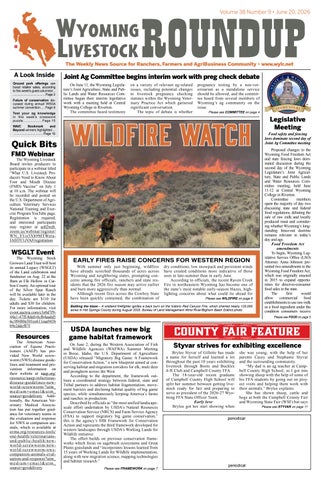
EARLY FIRES RAISE CONCERNS FOR WESTERN REGION
With summer only just beginning, wildfires have already scorched thousands of acres across Wyoming and neighboring states, prompting concerns among fire officials, ranchers and state residents that the 2026 fire season may arrive earlier and burn more aggressively than normal.
Although recent fires across the Cowboy State have been quickly contained, the combination of
dry conditions, low snowpack and persistent winds have created conditions more indicative of those seen in late-summer than in early June.
According to officials, the recent Raven Creek Fire in northeastern Wyoming has become one of the state’s most notable early-season blazes, highlighting concerns about what could lie ahead for
Please see WILDFIRE on page 6
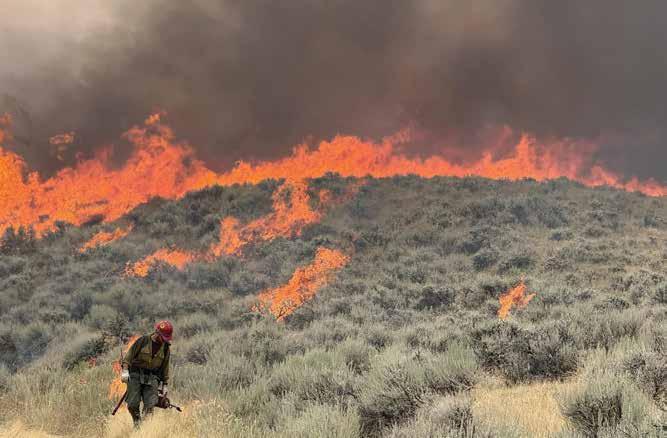
Battling the blaze – A wildland firefighter ignites a back burn on the historic Red Canyon Fire, which charred nearly 125,000 acres in Hot Springs County during August 2025. Bureau of Land Management Wind River/Bighorn Basin District photo
USDA launches new big game habitat framework
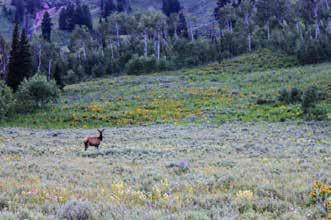
On June 2, during the Western Association of Fish and Wildlife Agencies (WAFWA) Summer Meeting in Boise, Idaho, the U.S. Department of Agriculture (USDA) released “Migratory Big Game: A Framework for Conservation Action,” a new blueprint aimed at conserving habitat and migration corridors for elk, mule deer and pronghorn across the West.
According to the department, the framework outlines a coordinated strategy between federal, state and Tribal partners to address habitat fragmentation, movement barriers and declining habitat quality of big game species, while simultaneously keeping America’s farms and ranches in production.
Described by officials as “the most unified landscapescale effort undertaken by USDA’s Natural Resources Conservation Service (NRCS) and Farm Service Agency (FSA) to support migratory big game conservation,” this is the agency’s fifth Framework for Conservation Action and represents the third framework developed for western landscapes through USDA’s Working Lands for Wildlife initiative.
The effort builds on previous conservation frameworks which focus on sagebrush ecosystems and Great Plains grasslands and “incorporates lessons learned from 15 years of Working Lands for Wildlife implementation, along with new migration science, mapping technologies and habitat research.”
Legislative Meeting
Food safety and fencing laws dominate second day of Joint Ag Committee meeting
Proposed changes to the Wyoming Food Freedom Act and state fencing laws dominated discussion during the second day of the Wyoming Legislature’s Joint Agriculture, State and Public Lands and Water Resources Committee meeting, held June 11-12 at Central Wyoming College in Riverton.
Committee members spent the majority of day two discussing state and federal food regulations, debating the sale of raw milk and locally produced meat and considering whether Wyoming’s longstanding fence-out doctrine remains relevant in today’s day and age.
Food Freedom Act amendments
To begin, Wyoming Legislative Service Office (LSO) Attorney Anna Johnson presented two amendments to the Wyoming Food Freedom Act, which was originally enacted in 2015 to expand opportunities for direct-to-consumer food sales in the state.
The first would allow commercial food establishments to use raw milk as a food ingredient under the condition consumers receive
COUNTY FAIR FEATURE
Styvar strives for exhibiting excellence
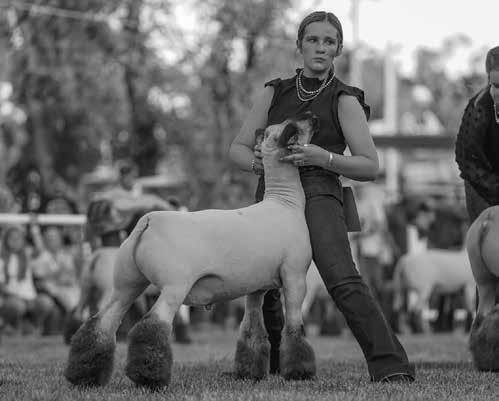
Brylee Styvar of Gillette has made a name for herself and learned a lot throughout the past 10 years exhibiting livestock through Boots and Buckles 4-H Club and Campbell County FFA.
The 18-year-old recent graduate of Campbell County High School will split her summer between getting livestock ready for fair and preparing to serve as president of the 2026-27 Wyoming FFA State Officer Team.
Early love Brylee got her start showing when
she was young, with the help of her parents Casey and Stephanie Styvar and the surrounding community.
“My dad is an ag teacher at Campbell County High School, so I got into showing sheep with the help of some of his FFA students by going out on project visits and helping them work with their animals,” Brylee explains.
She has shown sheep, cattle and hogs at both the Campbell County Fair and Wyoming State Fair (WSF) but says
GUEST OPINIONS
According to Dairy Herd News, “In the 250 years since the founding of this nation, no industry has undergone a more profound transformation than dairy.”
When our nation was founded, most people lived in rural areas and the milk cow was a survival necessity. Now, it is a part of a sophisticated operation.
In my younger days, I remember milking a couple of cows twice a day and separating the cream from the milk to take to town to sell to a creamery.
I remember I didn’t like it, but I didn’t know any better. It was part of the daily chores we did morning and evening.
Later on, when a person was hired to do chores around the ranch, I thought life couldn’t get any better.
My younger years closely reflect the dairy business today in some ways. The dairy business is a very high-tech industry today. Those in the livestock business can learn a lot from the dairy business, I feel.
Today, the dairy business is finding out technology is not replacing labor – it is empowering it. This is what’s happening in the feedlot business, as well with their concentration of cattle.
Only five states – Texas, New York, California, Wisconsin and Idaho – produce more than one-half of the nation’s milk supply. These dairies milk thousands of cows twice a day and use technology to achieve adequate margins. The average dairy across the nation today is 500 cows, but the number of cows is growing.
Most likely the best practice which has affected the dairy business over the last couple of years is the management of dairy calves and using beef on dairy genetics.
Using sexed semen to get higher-quality male calves –which are weaned from their mothers during the first week, then bottle fed – are worth around $1,200 to sell in today’s market. The dairy may also keep the calf and feed it out.
Today, 56 percent of dairies are producing male beef calves, 47 percent are raising them, 37 percent are finishing the calves until they are ready to process into beef products and 17 percent are retaining ownership through the supply chain.
While some dairies are planning to use beef crosses in the future, 33 percent of dairies say they have no plans to use beef genetics. Those who do use a beef cross are calling these times “the honeymoon” as some dairies are now making more money on their calves than they do selling their milk.
Dairies are really taking advantage of higher prices in the beef business, and meatpackers want all of the finished cattle they can get. As long as their calves and yearlings are black, they are making a premium from feeders or processors.
These week-old calves have started another industry for those who buy and raise them. They have learned the secret to raising a small calf and producing a healthy yearling. It is turning out to be a big business in the dairy industry.
Dairies have turned to technology to manage their water use and they are utilizing a number of other management tools. They have also learned to push back on fake milk products.
I salute the dairy industry for all they are doing.
Wyoming Livestock Roundup (USPS # 005-774) is published weekly by Maverick Press, Inc. P.O. Box 850 • Casper, WY 82602 Periodicals postage paid in Casper, WY Fax: 307-472-1781 • E-mail: roundup@wylr.net Wyoming Livestock Roundup Reporting the News by the Code of the West Phone:
DENNIS SUN, Publisher • Cell: 307-262-6132 e-mail: dennis@wylr.net
Barbeque season is in full swing, and most people think of burgers and hot dogs when they think about grilling out, but let’s not forget about the wonderful flavors pork can bring to a backyard cookout.
The U.S. Meat Export Federation continues to share how U.S. pork is finding its way into global markets, which is great for American pig farmers’ bottom lines but U.S. consumers can help fill producers’ profit coffers by throwing some chops or ground pork burgers on the grill or by putting a nice butt on the smoker.
The National Pork Board (NPB), always on the mission to promote wider use of pork in Americans’ diets, launched its “Taste What Pork Can Do” campaign last May,
By Kevin Schulz
and momentum appears to be growing.
According to NPB, offering more ground pork to consumers has the potential to pad retailers’ profitability by $80 million in new sales.
On average, there are 23 ground beef items per store, while ground pork currently averages just two items. Data from a study contracted by NPB showed $80 million in new sales can be generated by merely expanding ground pork offerings by two or four items per store.
NPB added just two more items, like 90-to10 lean-fat ratio ground pork, can bring in $50 million for retailers, and adding forms like patties or meatballs can capture the remaining $30 million.
Ideally, some of these extra retailer dollars will find their way into producers’ pockets.
Although ground beef may, by default, find its way into mainstay dishes such as hotdishes, tacos and spaghetti sauces, ground pork doesn’t have to be seen as a suitable substitute but rather a fulltime replacement.
Don’t be afraid to expand flavor profiles.
Over the years, the pork industry has worked at catering to the variety of ethnic markets which are fans of pork products.
Industry trends have also shown pork consumption is a generational thing. NPB has found Generation Z and millennials are leading the way by purchasing ground pork more often and spending
more compared to other generational groups. Let’s follow the kids’ lead and get on – and stay on – the pork bandwagon. Though “Taste What Pork Can Do” is the current campaign, much of the population remains locked into the “Pork. The Other White Meat” campaign which was introduced in 1985 and retired in 2005. Just as NPB has moved on from “Pork. The Other White Meat” campaign, U.S. consumers need to move on from traditional thinking and not be afraid to expand their culinary horizons by adding pork in some form. Your taste buds will thank you.
Kevin Schulz is the editor of The Farmer This article was originally published in The Farmer on June 8.
Learn more by calling the Casper office at 307.577.4700. 1401 Wilkins Circle Casper, Wyoming
NEWS BRIEFS
Clause retires from WGFD
After an accomplished 35-year career devoted to Wyoming’s wildlife, Pinedale Wildlife Biologist Dean Clause has retired from the Wyoming Game and Fish Department (WGFD).
Clause began his tenure with WGFD in 1988, marking a long-standing commitment to various regions and roles within the state. His diverse experience included seasonal positions as a wildlife damage and fisheries technician in the Green River and Lander regions, as well as a waterfowl technician. He also worked with the U.S. Fish and Wildlife Service and Grand Teton National Park.
From 1993-98, Clause served as a habitat biologist in the Lower Bear River Watershed, based in Kemmerer. In this role, he focused on vegetation surveys and habitat treatments for important big game winter ranges.
In 1998, he relocated to Pinedale, where he worked as a brucellosis, feedgrounds and habitat disease biologist. He was responsible for administering elk vaccinations, collecting data on brucellosis prevalence, developing management plans for feedgrounds, habitat monitoring and implementing habitat improvement projects.
In 2003, he assumed his final position as the Pinedale wildlife district biologist, serving in this role for over two decades.
Throughout his career, Clause traversed the country on foot, skis, horseback, truck and aircraft. He collaborated with the public, served on various committees and mastered the intricacies of wildlife management. He also shared his passion and knowledge by teaching hunter education classes.
In 2015, the Wyoming Game Warden Association recognized his dedication by naming him Wildlife Manager of the Year.
More NWS cases confirmed
As New World screwworm (NWS) cases continue to spread – mostly across several Texas counties – more animals have now been affected, with the first case in sheep reported.
As of June 16, 12 cases have been reported, according to the NWS Confirmed Detections dashboard on the U.S. Department of Agriculture’s (USDA) Animal and Plant Health Inspection Service website.
This includes three active cases in cattle in Zavala County, Texas; two each in La Salle County, Texas and Edwards County, Texas and one in Tom Green County, Texas, as well as one case in goats in both Edwards County, Texas and Gillespie County, Texas; one case in a dog in Lea County, N.M. and one case in sheep in Sutton County, Texas.
USDA urges producers to frequently check animals for draining or enlarging wounds, maggots or egg masses, signs of discomfort and lesions in body openings including the nose, ears, genitalia and umbilical area.
If anyone suspects a screwworm infestation, they should immediately contact their local veterinarian, state animal health official or USDA.
To stay up-to-date on NWS cases, prevention practices and treatment options in the U.S., visit aphis.usda.gov/animals/animal-health/livestock-and-poultry-disease/stopscrewworm
FSA nominations open
Nominations are currently being accepted for farmers and ranchers to serve on local U.S. Department of Agriculture (USDA) Farm Service Agency (FSA) county committees, which make important decisions about how federal farm programs are administered locally.
All nomination forms for the 2026 election must be postmarked or received in the local FSA office by Aug. 3.
Elections for committee members will occur in certain local administrative areas (LAA). Agricultural producers may be nominated for candidacy for the county committee if they participate or cooperate in a USDA program and reside in an LAA up for election this year.
Individuals may nominate themselves or others, and qualifying organizations may also nominate candidates. USDA encourages all eligible producers to nominate, vote and hold office.
Interested producers can locate their LAA at fsa.usda.gov/ coc and determine if their LAA is up for election by contacting their local FSA Office.
For more information or to access to nomination form, visit fsa.usda.gov/about-fsa/county-committee-elections
BLM seeks input
The Bureau of Land Management (BLM) is seeking public input on a preliminary environmental assessment analyzing the proposed gather and removal of approximately 1,800 excess wild horses in the Red Desert Complex, as well as proposed updates to herd management plans for the complex.
The Lander and Rawlins BLM field offices are preparing updates to herd management area (HMA) plans for the Antelope Hills, Crooks Mountain, Green Mountain, Lost Creek and Stewart Creek HMAs, referred to collectively as the Red Desert Complex. Existing herd evaluations for these areas are more than 30 years old and require revision.
Current wild horse populations exceed the appropriate management level of 480 to 724 established for the complex. By the fall of 2026, there are projected to be approximately 2,300 wild horses in the area.
BLM is committed to maintaining healthy wild horses on healthy, productive public rangelands. Public input is valuable early in the process and will enable the BLM to develop a well-informed environmental assessment.
Comments may be submitted online by July at eplanning.blm.gov/Project-Home/?id=6c9a6ab7-c027-f1118341-001dd804183b
For more information, e-mail BLM Wyoming State Office Public Affairs at BLM_WY_Comms@blm.gov.
UW to showcase ag research
On June 30, the University of Wyoming’s (UW) Powell Research and Extension Center (PREC) will host its annual field day at 747 Road 9 in Powell.
The field day will contain two sessions designed for different audiences. Both are free and open to the public.
A morning session from 9:30 a.m. to 12:30 p.m. is geared towards agricultural professionals and others interested in the technical aspects of PREC’s research projects.
The afternoon session, held from 2-5 p.m., is an open house created for community members and families.
A raffle of items donated by local businesses and a free barbecue lunch will take place at noon for those who attend the morning session, then PREC will briefly close following lunch.
The afternoon open house is designed for community members and families, and participants are invited to explore displays about subjects like insects and plant diseases, seed identification, combines and tractors and the PREC hoop house.
Activities offering prizes for children will also be available.
No pre-registration is required for the afternoon session of the field day.
For more information, e-mail agarfink@uwyo.edu or call 307-754-2223.
ShREC celebrates anniversary
On July 1, the University of Wyoming’s (UW) Sheridan Research and Extension Center (ShREC) will host its annual field day at 663 Wyarno Road in Sheridan beginning at 8:30 a.m.
The field day, which is free and open to the public, will celebrate the 110th anniversary of ShREC’s Wyarno location, which is maintained as a dryland research farm, in addition to conducting research at the irrigated Adams Ranch location.
“Much of the work at the station in recent years has come full circle,” says ShREC Interim Assistant Director Tyler Jones. “One hundred and ten years ago, crop introductions and variety selection were a primary function of the station’s existence, answering the simple question of ‘What will grow in our environment?’”
This year, Jones says, the field day will answer this question by showcasing successful varieties of crops like alfalfa, perennial grasses, cowpeas and soybeans. Presentations will also provide information about topics like hay production and weed and insect management.
A ribbon-cutting ceremony for the Upper Mississippi River Basin (UMRB) Climate Station Network will take place at 12 p.m. The UMRB Climate Station Network provides real-time climate data to improve detailed weather forecasting throughout the U.S. Wyarno was the first site in Wyoming to host a UMRB weather station.
Lunch will be served at 12:30 p.m. After lunch, participants can explore a trade show with agricultural equipment vendors.
Attendees are encouraged to RSVP by e-mailing shrec@uwyo.edu or calling 307-673-2856.
JBS closes facilities
On June 12, JBS USA announced the planned closure of two facilities in Pennsylvania and Tennessee. The company emphasized its commitment to supporting those affected as it makes targeted changes to strengthen operations for the future.
The closures include a beef production facility in Souderton, Pa. and a value-added facility in Memphis, Tenn. JBS emphasized these actions are part of a broader strategy focused on growth, modernization and long-term competitiveness in the U.S.
Dean Clause Courtesy photo
Current statute
Currently, the Wyoming Veterinary Practice Act dictates only licensed veterinarians may practice veterinary medicine within Wyoming with a few pertinent exceptions regarding pregnancy testing, according to a Legislative Service Office (LSO) brief compiled by LSO Staff Attorney Anna Johnson.
As the law currently stands, “the owner of an animal, the owner’s employees or any livestock operator and such operator’s employees with whom the owner exchanges work and assistance in connection with animals may care for and treat any animal belonging to such owner, in any manner desired by said owner.”
Proposed changes to the act could instate an exemption allowing permit non-veterinarians to perform pregnancy tests on cattle which are not being sold as bred cattle, the brief explains.
Veterinary perspective
To begin, Wyoming Administration and Information Rules, Policies and Procedures Administrator JoAnn Reid shared some statistics on veterinary
medicine in Wyoming to provide a backdrop for the conversation.
She noted there are currently 763 licensed veterinarians, along with 21 artificial insemination technicians and three embryo transfer technicians. Of these experts, Reid said 380 of the licensed veterinarians and 18 of the artificial insemination technicians list a Wyoming home address.
The committee then heard from Dr. Ben Osborne, a private practice veterinarian based in Uinta County who also serves on the Wyoming Veterinary Medical Association (WVMA) board.
Osborne expressed concerns over potential changes to the act’s pregnancy checking statutes, emphasizing veterinarians undergo extensive training equipping them to offer more complete care and better serve livestock owners in ways a layperson performing services could not offer.
“I have some concerns as a WVMA board member regarding the ability of lay individuals potentially performing pregnancy diagnosis without a license and without any oversight, spe-
cifically in regard to the public interest and clients,” Osborne stated. “Our recommendation as a board is pregnancy testing still be performed by a licensed veterinarian within the state of Wyoming.”
Osborne emphasized, during pregnancy checking, veterinarians perform herd health assessments in addition to determining whether a cow is open or bred, which can help diagnose and prevent outbreaks of fertility-impacting diseases from brucellosis to trichomoniasis.
He admitted the act of pregnancy checking itself is easy enough for non-veterinarians to become proficient at, but expressed concern over potential issues an untrained layperson may miss outside of determining breed-up rates.
“When the animal is determined to be open, this is where the education of veterinary medicine is so vitally important,” Osborne shared. “Veterinarians have education not only in the diseases which affect fertility, but also trace mineral deficiencies or nutritional deficiencies which may arise.”
“We think of things like how to consult our
producers on their vaccine schedule, artificial insemination and synchronization protocols,” he added. “All of these things are running through my mind as I’m doing my procedure of pregnancy diagnosis in cattle.”
Osborne also shared perspective on the financial importance of routine examinations like pregnancy testing to large animal veterinarians.
“As a private practitioner, a lot of my business relies on performing routine procedures, including pregnancy diagnosis,” Osborne explained. “In order for my business to be economically sustainable, pregnancy testing is a vitally important service to my practice so I can remain present within the state and continue to provide my regulatory duties and my emergency duties.”
Additional commentary
Several other veterinarians also testified during the committee meeting, echoing Osborne’s comments and sharing additional perspective.
Wyoming State Veterinarian Dr. Hallie Hasel shared results of a recent global survey conducted by Boehringer Ingelheim which highlighted the top three overlooked aspects of veterinary care including
uncovering hidden health problems and pain, protecting food chain safety and conducting surveillance programs to limit the spread of disease.
Hasel noted surveilling for disease is of particular importance to Wyoming producers, many of whom operate on public lands and share grazing with wildlife.
“As we all know, we have a lot of public grazing land in Wyoming,” Hasel stated. “Whenever we have a disease within any herds grazing in common on public lands, it spreads like wildfire. If there is a trichomoniasis or brucellosis issue, a veterinarian performing herd work can pick up on these things.”
She further emphasized the critical role of veterinary expertise with the recent detection of New World screwworm (NWS) in the U.S.
“Something else coming into play right now from a regulatory disease standpoint is an infestation of NWS, which could cost our industry millions and millions of dollars and is spreading northward right now,” Hasel added. “A veterinarian can instantly pick up on the smell of this situation and potentially know where to look if they suspect a screwworm infestation, whereas a layperson is not necessarily going to pick up on this extremely important issue facing our industry right now.”
Brooke Hirsch, a young veterinarian based in Fremont County, also spoke to the financial importance of pregnancy checking regarding her veterinary business and being eligible to repay student loans.
Hirsch explained pregnancy checking accounts for roughly 75 percent of her annual income and helps her meet eligibility requirements for the Veterinary Medicine Loan Repayment Program, which requires recipients to dedicate 12 hours a week to large animal veterinary medicine.
She also emphasized the shortage of rural veterinarians affecting the country currently and stressed opening up pregnancy testing to laypersons could seriously threaten the future of rural large animal veterinary medicine by making the practice even less financially secure.
Dr. Kevin Dickey, owner of Owl Creek Veterinary Service and Greybull River Veterinary Service, shared comments on the importance of the veterinary client patient relationship (VCPR) and veterinarians’ roles in protecting public health.
As a member of the WVMA board of directors, Dickey emphasized expanding pregnancy testing into the hands of nonlicensed veterinarians has the potential to put animal health at risk and jeopardizes VCPR.
“VCPR is the foundation of safe and effective
veterinary care which we enjoy in the U.S.,” Dickey shared. “It must be in place before a veterinarian can diagnose, treat or prognosticate concerning a particular situation. Obviously, this requires contact with a herd, and in my practice area, sometimes the contact I have with the herd may be limited to pregnancy testing.”
Dickey emphasized an active VCPR is required to prescribe medications and antibiotics, and allowing revisions to go to statute, which could potentially impact VCPRs, would be detrimental.
In addition to providing proven care, Dickey argued veterinarians are uniquely positioned to protect producers in a manner laypersons would not be.
“Veterinarians carry the liability of making a proper diagnosis and caring for animals to the point of having to carry liability insurance,” he explained. “In the instance of this practice being open to laypersons, who then carries this liability?”
“The Wyoming Board of Veterinary Medicine exists to protect the consumer and uphold the standard of veterinary care within our state,” Dickey added. “If this is broadened to non-veterinarians being able to make pregnancy diagnosis, who then is protecting the consumer of both veterinary services and of food products being produced on ranches within the state?”
Industry input Representatives of the Wyoming Stock Growers Association (WSGA) and Wyoming Farm Bureau Federation (WyFB) also provided testimony, arguing primarily for the freedom of the individual producer to determine how to run their livestock.
WSGA Executive Vice President Jim Magagna questioned the need for further updates, arguing WSGA feels current statute respects the rights of livestock owners.
Magagna emphasized WSGA supports the current law’s exemptions regarding livestock owners and who can currently perform services, but admitted encouraging non-veterinarians to start businesses based solely on pregnancy checking would be illadvised.
Wyoming Farm Bureau Federation (WyFB) Executive Vice President Kerin Clark advocated for “individual freedom in the free market” for members to manage the animals they own however they choose.
“Our member policy lies within wanting the opportunity and option to pay who they choose to pregnancy test their livestock,” Clark shared.
Grace Skavdahl is the editor of the Wyoming Livestock Roundup. Send comments on this article to roundup@wylr.net.
notice the milk has not been inspected or pasteurized.
The second would allow producers, designated agents or third-party sellers to sell meat products from animals raised by a producer and slaughtered on the producer’s operation or at a custom slaughter facility.
Johnson explained portions of the second proposal heavily depend on federal law, particularly the Processing Revival and Intrastate Meat Exemption Act which would allow the sale of certain custom-processed meat products currently prohibited under federal regulations if passed.
“The Federal Meat Inspection Act prohibits direct-to-consumer sales of uninspected meat by a producer-designated agent or a third-party seller,” Johnson stated. “While the Wyoming Food Freedom Act could be amended to allow these types of sales, the sales themselves would be in violation of federal law unless and until the requirements of subsection O printed in the draft bill are met.”
Raw milk and local meat sales
A majority of the meeting focused on recent enforcement actions carried out by the Wyoming Department of Agriculture (WDA) involving food freedom in small businesses.
WDA Director Doug Miyamoto responded to criticism surrounding these actions, explaining the department was prompted to conduct inspections in Cody and Cheyenne after complaints were filed alleging meat sales were occurring without proper licensing.
“We were initially informed we had an entity selling breakfast items which contained meat, and they didn’t have a license to sell,” Miyamoto said. “Essentially, if an individual wants to open a coffee shop, a restaurant or they want sell things commercially, they need a license.”
“Subsequently, we learned the entity was also selling non-homemade grocery items and preferred food items like breakfast burritos, and they didn’t have a retail or
commercial license,” he continued. “That’s the reason we were there.”
While acknowledging several lawmakers’ frustrations regarding federal oversight, Miyamoto stressed WDA’s obligation to comply with federal law and explained Wyoming’s meat inspection program operates under an agreement requiring the state program to remain “equal to” federal standards established under the Federal Meat Inspection Act.
He also noted licensing requirements serve three primary purposes.
If retailers are not licensed, the state may have no way to identify where recalled products are being sold, verify labeling requirements such as country-of-origin claims or inspect facilities to ensure products remain safe and unadulterated.
One of the most contentious issues brought up during the meeting was the use of raw milk in commercial settings.
Under current Wyoming law, raw milk may be sold direct-to-consumer but cannot be used as an ingredient in a licensed commercial food establishment because federal food safety regulations treat raw milk differently than pasteurized milk.
WDA Deputy Director Joe Budd described the situation as a “catch-22,” noting if a business obtains a commercial food license, it becomes subject to federal pasteurization requirements, but if it operates outside of the commercial licensing system, it may lose the ability to offer certain prepared food products.
Several lawmakers questioned why products like eggs and produce can be sold with fewer restrictions than milk and meat.
“The reality of it is different products are treated differently because they are defined differently in various laws,” Miyamoto retorted.
Sen. Taft Love further commented, “When we look at the way God has packaged things and handed them to us in life, the egg retains its full packaging all the way to the point of sale, and so does the skin on a fruit or vegetable.”
“It’s therefore considered a person can wash off any external issues which have shown up and consume those products somewhat safely,” he added.
“Meat, however, is removed from the package – the skin is gone – and raw milk is no longer part of the package given to it naturally, so I think the natural distinction, the biological effects of how we harvest things and the way things are grown is the reason behind that,” Love concluded.
A call for reform
When the floor opened for public testimony on the topic, one message rang loud a clear – a growing desire for lawmakers to revisit the Wyoming Food Freedom Act in its entirety.
Former Rep. Tyler Lindholm, author of the original Wyoming Food Freedom Act, noted the law has become increasingly difficult to interpret after years of amendments.
“The Wyoming Food Freedom Act seems like it’s just been bolted together,” he said, suggesting a broader rewrite of the bill rather than making small continual changes.
Representatives of the Wyoming Food Coalition and Rocky Mountain Farmers Union echoed this sentiment and urged lawmakers to work collaboratively with producers, consumers and regulators to improve the legislation.
“I think we’ve got a lot of great ideas here, we just need to work on it, make a good bill and give Wyoming the food freedom they’re looking forward to,” said Rep. Steve Johnson.
Wyoming fencing laws
Later in the day, the committee shifted its focus to Wyoming fencing law.
LSO Attorney Savannah Collins provided an overview of Wyoming’s longstanding fence-out doctrine.
She noted, under traditional common law, livestock owners are required to fence animals in.
However, as livestock production expanded across the Cowboy State’s vast rangelands, Wyoming
became a fence-out state for cattle, meaning landowners are responsible for constructing fences around their properties if they wish to keep livestock out.
“The western U.S. was mostly established on the principle of open range grazing and generally does not follow the common law principle of fencing in,” she stressed. “In Wyoming in particular, the concept was never applied to cattle, so Wyoming is a fence-out state when it comes to cattle.”
She also mentioned a “foundational case for fence law in Wyoming” which occurred in 1902. In the case, two men were found liable for damages their sheep caused while grazing on an adjacent landowner’s property after repeatedly being asked to stop.
“The Wyoming Supreme Court found the men liable for the damages for a number of reasons, including that they had not honestly and prudently endeavored to confine their sheep to public lands,” Collins explained. “Through a combination of the common law principle, the way Wyoming was established and early cases like this one, Wyoming does not have any statutes on the books regarding fencing in of livestock.”
Collins comments prompted questions from lawmakers about whether sheep and cattle are treated differently under Wyoming law.
She responded by noting there is no statute explicitly requiring sheep to be fenced in, but court precedent has created a “practical distinction between sheep and cattle management.”
Rep. J.T. Larson noted producers have operated for a long time under the assumption sheep must be fenced in, while cattle fall under the traditional fence-out doctrine.
Committee members decided the issue needs further examination as livestock production continues to evolve across the West.
Rural development and livestock production
When the discussion opened up to public comment, the committee heard testimony regarding the growing challenges between rural development and livestock production.
Representatives of county planning organizations mentioned the increasing confusion for planners, developers, neighboring landowners and producers around fencing requirements and subdivision approvals.
Wyoming Planners Association Representative Joy Hill further noted legislative changes enacted in recent years moved subdivision fencing requirements into planning statutes, leaving a long list of unanswered questions in its wake.
The complexities of fencing and modern devel-
opment were echoed in multiple testimonies and lawmaker comments.
Sens. Bob Ide and Cheri Steinmetz discussed how maintenance agreements between neighbors are more complicated when large parcels are subdivided into smaller residential lots, while Love noted fencing discussions now have to extend beyond livestock containment and property boundaries to include wildlife migration patterns, subdivision development and changes in landownership.
Moving forward
At the end of the meeting, committee members agreed more work is needed before legislation advances on either issue.
In regards to the Wyoming Food Freedom Act, the committee tossed around the idea of forming a working group made up of legislators, WDA officials and other stakeholders to address lingering questions around raw milk sales, designated agents and licensing requirements.
On the topic of fencing law, they suggested holding future meetings to focus on criminal penalties, federal land issues, subdivision fencing concerns and other questions raised during the meeting.
Hannah Bugas is the managing editor of the Wyoming Livestock Roundup. Send comments on this article to roundup@wylr.net.
producers and rural communities in the West.
Raven Creek Fire
On June 7, the Raven Creek Fire ignited near the junction of Weston, Campbell and Crook counties approximately 13 miles southwest of Moorcroft, just a few days after the nearby Ship Wheel Fire was started by lightning and burned through 426 acres.
According to state and federal fire officials, a downed powerline is believed to have caused the Raven Creek Fire, which ultimately scorched about 4,246 acres before it was 100 percent contained.
Firefighters from multiple counties, the Bureau of Land Management (BLM), the Wyoming State Forestry Division and other agencies responded to the blaze, and at the height of suppression efforts, approximately 125 firefighters and support personnel, 25 engines and a helicopter were assigned to the incident.
Although no homes or livestock losses were reported, fencing and
valuable grazing forage were damaged, according to a June 8 Cowboy State Daily article by Kolby Fedore.
“We’re experiencing late-summer fire weather conditions and fire behavior in the first part of June,” Weston County Fire Warden Daniel Tysdal tells Cowboy State Daily “It’s unprecedented fuel conditions right now.” Fires across Wyoming
While the Raven Creek Fire garnered the most attention, numerous other fires have blazed through Wyoming this year as well.
In Sheridan County, the Meadow Draw Fire burned roughly 100 acres of BLM lands near the Campbell County line at the beginning of the month.
On May 12, the Rochelle 2 Fire burned through 1,317 acres near Wright, while the Spread Creek Fire to the west scorched 257 acres in the Bridger-Teton National Forest, becoming the largest May wildfire ever recorded in the area.
According to a May 22 Jackson Hole News and Guide article by Christina MacIntosh, officials note the fire occurred four to five weeks earlier than the national forest’s typical wildfire season and required extensive resources, including helicopters, Super Scooper aircraft, hotshot crews and multiple engine companies.
“The blaze substantiated fire managers’ concern about an early wildfire season due to low snowpack and early melt and indicates – should conditions stay dry and warm – there will likely be a busy fire season to come,” MacIntosh reports.
Additionally, during the month of April, both the 377-acre Antelope Creek Fire and 356acre Walker Creek Fire burned through Converse County, and in March, the Kane Fire burned about 1,915 acres in the Yellowtail Wildlife Habitat Management Area near Lovell, the Porcupine Creek Fire burned 2,490 acres west of Wright and the Sandpiper Fire burned 6,287 acres
outside of Casper.
Regional fire activity
Widespread wildfire devastation has occurred across many of Wyoming’s neighboring states as well.
Few have had it as bad as Nebraska, though, where a historic wildfire season scorched more than 827,000 acres by mid-March, shattering the state’s previous record set during the 2012 drought year.
The Morrill Fire alone consumed over 643,000 acres, surpassing the previous state record for an entire year. Other notable fires include the South Fork Fire at 39,000 acres, the Ashby Fire at 36,004 acres, the Road 203 Fire at 35,892 acres and the Minor Fire at 14,082 acres.
In Custer County, South Dakota, firefighters continue to battle several active incidents, including the Qury Fire, which has burned more than 9,100 acres and remains only partially contained, and the 79 Fire, which burned 5,408 acres before reaching full containment.
In Montana, the East Side Fire south of Red Lodge burned 1,219 acres
within the Custer Gallatin National Forest in May, and while Colorado has seen fewer large incidents so far, the Paradox Trail Fire and Beehive Fire were both quickly contained after charring a combined 389 acres.
Staying vigilant
As weather conditions worsen and fire activity increases, Wyoming agencies emphasize the importance of preparedness and interagency coordination.
On June 3, representatives of the Wyoming National Guard, Wyoming State Forestry Division, Wyoming Office of Homeland Security and other agencies participated in a statewide wildfire tabletop exercise in Cheyenne.
In an article published on June 8, Wyoming National Guard Major Craig Heilig reports the exercise focused on improving communication, resource sharing and emergency response coordination before major incidents occur.
“Wildfire response starts with relationships and understanding long before an incident occurs,” states Lt.
Col. Casey Henry, Wyoming National Guard joint director of military support, in the article.
Wyoming State Forester Kelly Norris echoes this sentiment.
“Wildfires don’t recognize organizational boundaries,” Norris says. “Exercises like this help us build relationships, understand capabilities and improve coordination before an incident occurs.”
Additionally, multiple sources note fire managers across the state are continuing to monitor weather patterns closely, and they urge Wyoming residents to remain vigilant.
“We could be in for a long fire season with the predicted above average temperatures,” BridgerTeton National Forest North Zone Fire Management Officer Dave Wilkins tells Jackson Hole News and Guide . “It’s predicted to be a real hot summer this year, so people should exercise caution.”
Hannah Bugas is the managing editor of the Wyoming Livestock Roundup. Send comments on this article to roundup@wylr.net.
Wyoming Stock Growers Land Trust welcomes intern
The Wyoming Stock Growers Land Trust (WSGLT) is pleased to welcome Jack Vollbrecht as the 2026 summer conservation and stewardship intern.
In this role, Vollbrecht will be instrumental in supporting WSGLT’s conservation and stewardship team by assisting with annual monitoring visits
on 126 conserved properties encompassing more than 330,000 acres across Wyoming.
Vollbrecht recently earned his Bachelor of Science in Environmental Systems Science from the University of Wyoming, along with minors in rangeland ecology and watershed management
and a certificate in remote sensing.
In addition to his studies, he served in the Wyoming National Guard for six years. He plans to continue his education by pursuing a master’s degree focused on voluntary wildlife conservation.
“We’re excited to welcome Jack to WSGLT this
summer,” said Conservation and Stewardship Director Averi Davies. “His background and passion for working landscape conservation positions him well to contribute to our work, and we’re proud to support him as he builds the relationship and experience which will shape his future.”
A collaborative effort
In pursuit of the highest quality forage available in each passing season, migratory big game animals rely on vast, connected and diverse landscapes to meet their individual needs.
Recently, however, state fish and wildlife agencies have identified declines in habitat quality and connectivity as two of the greatest threats facing big game populations across the West and believe improvements need to be made to native plant communities, forest health, invasive species, physical barriers and landscape fragmentation.
Because big game animals’ range is so wide and frequently crosses private ag lands and working ranches, USDA officials have emphasized conservation efforts require collaboration and must be compatible with livestock production.
“Across the West, the future of iconic big game herds – elk, mule deer and pronghorn – depends on the health of our working lands,” states USDA NRCS Chief Colton Buckley in the department’s June 2 press release. “Privately owned lands provide the vital seasonal habitats and connectivity required to sustain these healthy, resilient herds.”
USDA Undersecretary for Farm Production and Conservation Richard Fordyce further comments, “We know migratory big game rely on large and connected landscapes to meet their daily, seasonal and annual needs. This new framework helps us better target our resources and align our efforts, which benefit wildlife as well as ranching operations.”
Protecting habitat and connectivity
According to the department, the new framework will guide conservation investments through existing farm bill programs like the Environmental Quality Incentives Program Conservation Stewardship Program, Agricultural Conservation Easement Program, Regional Conservation Partnership Program and Conservation Reserve Program (CRP) and will cover 17 states including Arizona, California, Colorado, Idaho, Kansas, Montana, Nebraska, Nevada, New Mexico, North Dakota, Oklahoma, Oregon, South Dakota, Texas, Utah, Washington and Wyoming.
Under these programs, USDA will provide assistance through three primary conservation strategies. First, the department will focus on protecting big game habitat and maintaining landscape connectivity by utilizing voluntary conservation easements and CRP contracts
to help keep working lands intact and reduce habitat fragmentation caused by development.
The framework notes preserving large, connected landscapes is critical to maintaining migration corridors and seasonal habitats used by big game herds, and rather than removing land from production, the agency’s new approach is intended to support ranching operations while ensuring habitat remains available for wildlife.
“We’re supporting migratory big game conservation by offering farmers and ranchers program opportunities to benefit big game and strengthen agricultural operations,” states FSA Administrator William “Bill” Beam. “Like the ranchers who are stewards of our western grasslands, USDA recognizes agriculture and conservation are most effective when they work together to strengthen working lands and protect wildlife such as big game species for future generations.”
Reducing barriers to movement
The department’s second priority is to reduce any barriers that impede wildlife movement, such as fencing.
Because fencing is one of the most widespread obstacles affecting migration corridors throughout the West, USDA says wildlife-friendly fence modifications are central to the new framework, and the agency recommends replacing fence designs with more wildlife-friendly options, modifying existing fences to improve wildlife passage and/or removing fencing where appropriate.
The framework also highlights virtual fencing technology as an efficient management tool.
“As a modern alternative to physical fences, this framework supports the adoption of virtual fencing,” the document reads. “This technology allows producers to manage livestock distribution and grazing patterns with high precision through GPS collars on livestock, reducing the need for internal physical fences while maintaining the open landscapes required for migratory big game.”
The department points to road crossings and other physical barriers as additional challenges affecting habitat connectivity.
Improving habitat quality
The third conservation strategy USDA highlights is to make improvements to habitat quality on both summer and winter ranges used by big game species.
The agency notes invasive annual grasses, conifer encroachment, degradation of wetlands and declining forest health are significant threats to forage production and wildlife habitat.
To address these concerns, the framework promotes practices such as invasive species control, conifer removal, restoration of mesic habitats and forest health treatments.
Agency officials note these practices can also improve rangeland resilience, reduce wildfire risk and maintain reliable forage and water resources for both livestock and wildlife.
“This framework represents a historic alignment, ensuring the management authority of
states is backed by the full strength and resources of the USDA to collaboratively conserve the West’s iconic migrations,” says WAFWA Executive Director Zach Lowe. “By investing in sustainable ranching practices, we are improving habitat quality, boosting rangeland resilience and ensuring these iconic herds can continue to move safely across vast and open grazing lands.”
Hannah Bugas is the managing editor of the Wyoming Livestock Roundup. Send comments on this article to roundup@ wylr.net.
For more information or to view the U.S. Department of Agriculture’s Migratory Big Game: A Framework for Conservation Action, visit wlfw.org
WYLR photo
Yablonski discusses future of conservation during WSGA summer convention
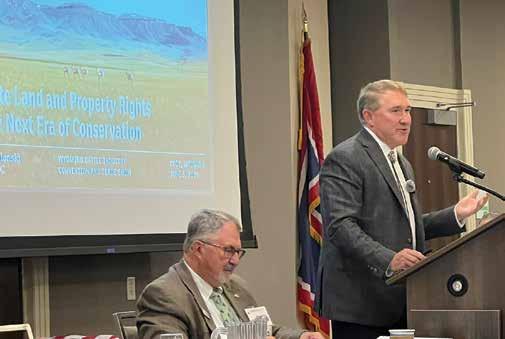
During the Wyoming Stock Growers Association (WSGA) Summer Cattle Industry Convention and Trade Show, held June 3-5 in Cody, Property and Environment Research Center (PERC) Chief Executive Officer Brian Yablonski discussed private land and property rights in the next era of conservation.
Yablonski’s talk centered on the intersection between ranching and conservation, imploring producers to understand the critical role private property management plays in the future of conservation and encouraging cooperation between private property owners and conservation groups.
Legacy of conservation
A self-described “tree hugging capitalist,” Yablonski’s work with PERC focuses on bringing market- and incentive-based solutions to conservation.
“I believe in the power of markets, reaping the fruits of hard work and production, the sanctity of property rights and the spirit of innovation and entrepreneurship that built this country,” Yablonski shared.
“This makes me a tree-hugging capitalist which, in a nutshell, is PERC.”
He then gave an overview of America’s conservation legacy, emphasizing the country’s “patriotism of place” evidenced by care for federal, state and private lands.
Yablonski detailed a broad timeline of conservation events, including the establishment of Yellowstone National Park, national wildlife refuges and Bureau of Land Management rangelands.
“Whether it’s a national park or a ranch, the patriotism of place is uniquely American,” Yablonski stated. “The history of conservation in America has moved in waves or eras, generally lasting about 50 years. Understanding these eras matter because we’re living through the beginning of a new one right now.”
A new era
According to Yablonski, America is entering a critical third era in the history of conservation which will focus on private land, preceded by the first era at the end of the 19th century which involved the establishment of national parks and federal land and the second era which began in the 1960s and focused on combatting pollution.
“Right now, we’re at a genuine hinge point in conservation,” Yablonski said. “The moment’s not about designating federal lands or pesticides and pollution, it’s about what I call the spaces in between –our nation’s rich mosaic of private land.”
Yablonski shared private lands are home to 75 percent of all remaining wetlands in the lower 48 states, 90 percent of remaining grasslands
and 80 percent of biodiversity hotspots.
“These systems are some of the most productive habitats, so what happens there really matters,” he added.
“Private ranches, farms and forests comprise 1.3 billion acres in America,” Yablonski emphasized. “Federal land is only half this number and yet, 150 years of conservation history has been primarily focused on government land.”
With this, Yablonski stressed the critical importance of ranchers and private land owners taking an active role in conservation.
“We’re entering a third era of conservation in America, and unlike the two eras which came before it, this one will not be written in Washington, D.C,” Yablonski emphasized. “It will be written on ranches, because private lands and private land stewardship is the next frontier of conservation and what will happen there will be the defining feature of the era.”
Aligning interests
Yablonski admitted, throughout history, the interests of ranchers and conservation or environmentalist groups have not always seemed to align.
However, he also expressed a belief in changing this narrative, advocating for more involvement with landowners throughout the next
era of conservation.
“In the next era of conservation, conservation must be done with – not to – landowners,” he emphasized.
He explained historically, the conservation community has treated private property rights as a threat to be managed rather than the very engine driving conservation.
This is an outdated and ineffective view, Yablonski argued, emphasizing landowners and their generational knowledge should be respected and invited to participate in conservation as valuable resources.
Yablonski spoke out about the ineffectiveness of some federal environmental policies such as the outdated Endangered Species Act, advocating instead for wildlife policy which rewards landowners with less regulation as conditions improve.
“Actual knowledge is localized and specific to time, place and landscapes. The person who runs cattle on a piece of ground for 30 years knows things no federal agency, centralized bureaucracy or conservation organization will ever fully understand,”
Yablonski said. “In the conservation community, we need to stick with ranchers rather than stick it to them.”
Yablonski emphasized the interests of conservation and ranching have always been in alignment, and more people are beginning to realize this.
“Ranchers are incentivized to make the land as productive as possible, which means healthy grass, clean water, intact habitat and open space,” he shared. “As it turns out, this is also exactly what wildlife needs. These interests aren’t in conflict – they’re aligned and always have been.”
Yablonski also highlighted a growing change throughout the conservation community.
“Where grazing and ranching were once condemned by mainstream environmentalists and ranchers were cast as adversaries, they are now being recognized for what they have always been –the last best defense of our last best places,” Yablonski stated.
Stronger together
Yablonski expressed recognition for ranchers is long overdue and PERC remains
committed to partnering likeminded groups to accelerate this understanding.
In closing, he implored ranchers to keep an open mind and seek opportunities to collaborate with conservation groups.
“You will be the architects of the next era of conservation, not its subjects,” Yablonski said. “But help the rest of us get there. Be willing to trust again, despite sometimes long and checkered histories with conservation groups.”
“We understand trust has to be earned,” he added. “Be willing to teach people about why what you do is so important for wildlife, land and water. Use bridge-building organizations like ours and others who are property rights advocates and conservationists.”
“Many of us in the conservation community want to stand with you – not in front of you and not above you, but with you,” he concluded.
Grace Skavdahl is the editor of the Wyoming Livestock Roundup. Send comments on this article to roundup@wylr.net.
Ranching and conservation – Property and Environment Research Center (PERC) Chief Executive Officer Brian Yablonski, pictured left, spoke at the Wyoming Stock Growers Association (WSGA) Summer Cattle Industry Convention and Trade Show on June 5 in Cody. WSGA President Reg Phillips, picutred right, introduced Yablonksi who spoke on a new era of conservation. WYLR photo
China to buy ag products
Coming out of a two-day summit in China, U.S. Trade Representative Jamieson Greer said China agreed to buy more than “double-digit billions” in agricultural products over the next three years, though there were no specific details on what would be included.
In an interview with Bloomberg Television, Greer talked about success “trying to rebalance trade with China,” noting the trade deficit was down and there are multiple industries in which the U.S. wants to sell more to China, including Boeing jets, soybeans or other ag or energy or medical devices.
In his interview, Greer noted China also renewed permits for meatpackers to again export beef to China. The export permits had been suspended for more than a year.
The U.S. Meat Export Federation offered some clarity on the situation, issuing a statement explaining China’s General Administration of Customs has granted a five-year registration extension to 425 overdue U.S. beef establishments in the China Import Food Enterprise Registration (CIFER) system.
Additionally, 77 new U.S. beef establishment registrations have been added to the CIFER system with an effective date of May 15, and registrations are valid for five years. There are 38 beef establishments which remain suspended. Of the suspended facilities, 25 were also expired and are now renewed but remain ineligible for export.
PHILIP W. HABECK, MOORCROFT WY 1 BLK-COW 1245 184.50 WT 2,297.02
BRAY CATTLE CO., KAYCEE WY 4 BK/RD-COW 1261 184.50 WT 2,327.00 AG RESERVES INC., WOODRUFF UT 1 RED-COW 1450 184.00 WT 2,668.00 THE LAWRENCE J. & LIGOCKI TRUS, SHERIDAN W
STOLTZ CATTLE CO, ARVADA WY 1 BLK-COW 1515 184.00 WT 2,787.60 RONALD A. & JEANIE M. SCHLAUT, GILLETTE W 1 BLK-COW
CALENDAR
EVENTS SALES
June 20-21 World Famous 65th Annual Woodchopper’s Jamboree and Rodeo, Encampment-Riverside Lions Club Arena, Encampment. For more information, visit woodchoppersjamboree.org
June 22 Wyoming State Engineer’s Office Voluntary Water Conservation Act Public Meeting, 1-4 p.m., Valley Community Center, Baggs. For more information, visit seo.wyo.gov/home/colorado-river-voluntary-water-conservation-program or e-mail Jack Morey at jack.morey2@wyo.gov.
June 22-25 Wyoming Funding Summit, the CAM-PLEX, Gillette. For more information, visit sbd.wyo.gov/grants/wyoming-funding-summit
June 24 Growing Food in Wyoming Masterclass: Water and Irrigation, 7-8 p.m., Zoom. For more information or to register, visit dirtworkswyo.com
June 25-July1 Great American State Fair, National Mall, Washington, D.C. For more information, visit freedom250.org/celebration/the-great-american-state-fair
June 25 University of Wyoming Extension Managing Landscapes in Drought Webinar, 6-7 p.m., Zoom. For more information, visit bit.ly/drought-webinar-26
June 25 Wyoming Stock Growers Association 2026 Environmental Stewardship Tour, Stoltz Cattle Company LLC, Arvada. For more information or to RSVP, e-mail anna@wysga.org or call 307-638-3942.
June 26 2026 Sportsperson’s Conservation Forum, the CAM-PLEX, Gillette. For more information or to purchase tickets, visit wgfd.wyo.gov
June 26-27 National Bison Association Western Regional Bison Conference, Syracuse, Utah. For more information, visit nationalbison.org/wp-content/ uploads/2026/03/2026-Western-Bison-Conference.pdf
June 30 2027 State Wildlife Action Plan Virtual Public Meeting, 1-2 p.m., online. For more information, visit wgfd.wyo.gov/wyoming-wildlife/wyoming-state-wildlife-action-plan
June 30 Producers and Agricultural Professionals Field Day, Powell Research and Extension Center, Powell. For more information, visit facebook.com/p/PowellResearch-and-Extension-Center
July 1 Wyoming Livestock Board “What U.S. Livestock Producers Need to Know About Foot and Mouth Disease Vaccine” Webinar, 10 a.m., Zoom. For more information or to register, visit us02web.zoom.us/webinar/ register/WN_YUo5Xh9MTWetuJAEOY1zVA?utm_medium=email&utm_ source=govdelivery#/registration
July 1 University of Wyoming Sheridan Research and Extension Center Field Day, Sheridan Research and Extension Center, Sheridan. For more information, contact shrec@uwyo.edu.
July 3-4 81st Annual Ten Sleep Rodeo, Ten Sleep. For more information or to purchase tickets, visit tensleeprodeoassociation.com or call 307-251-7693.
July 3-11 Central Wyoming Fair and Rodeo, Casper. For more information, visit centralwyomingfair.com
July 6-11 98th Annual Rooftop Rodeo, Estes Park, Colo. For more information or to purchase tickets, visit rooftoprodeo.com/
July 9 2026 Range War Rodeo Series, 7 p.m., Buffalo. For more information, visit rangewarrodeo.com.
July 10-12 Up in Arms LLC Flea Market and Gun Show, Cody Recreation Gymnasium, Cody. For more information, call 308-420-2295.
July 10-18 Converse County Fair, Douglas. For more information, visit conversecountyfair.com
July 12-14 2026 Cattle Industry Summer Business Meeting, Gaylord Rockies Resort and Convention Center, Aurora, Colo. For more information or to register, visit ncba.org/events/summer-business-meeting
July 13 25th Annual Angus Foundation Golf Tournament, Quail Chase Golf Course, Louisville, Ky. For more information or to register, visit angus.org/foundation
July 17-26 Cheyenne Frontier Days, Cheyenne. For more information or to purchase tickets, visit cfdrodeo.com
July 18-25 Washakie County Fair , Worland. For more information, visit washakiecountyfair.com
July 18-26 Teton County Fair, Jackson. For more information, visit tetoncountyfair.com
July 19-21 Ag Media Summit 2026, Hyatt Regency St. Louis at the Arch, St. Louis, Mo. For more information or to register, visit agmediasummit.com/
July 21-25 Park County Fair, Powell. For more information, visit parkcountyeventsandfair.com/home
July 22-25 Sublette County Fair , Big Piney. For more information, visit sublettecountyfair.com
July 22-Aug. 1 Albany County Fair, Laramie. For more information, visit albanycountywy. gov/435/Albany-County-Fair
July 23 Bureau of Land Management Day of the American West Wild Horse Adoption Event, Cheyenne Frontier Days, Frontier Park, Cheyenne. For more information, visit blm.gov/whb
July 23-Aug. 1 Uinta County Fair, Evanston. For more information, visit uintacountywy. gov/1080/Uinta-County-Fair
July 24 Wyoming Game and Fish Department Aquatic Invasive Species Inspector Training, 9 a.m.-4 p.m., Sheridan Regional Office, Sheridan. For more information or to register, visit wgfd.wyo.gov
July 24-Aug. 1 Platte County Fair, Wheatland. For more information, visit plattecountyfair.org
July 24-Aug. 1 Niobrara County Fair, Lusk. For more information, visit wyoextension.org/ niobraracounty/niobrara-county-fair
July 24-Aug. 2 Johnson County Fair, Buffalo. For more information, visit johnsoncountyfairgrounds.com
July 24-Aug. 2 Goshen County Fair, Torrington. For more information, visit goshencounty. org/226/Goshen-County-Fair
July 24 -Aug. 2 Campbell County Fair, Gillette. For more information, visit campbellcountywy. gov/959/County-Fair
July 25 Growing Food in Wyoming Masterclass: Fertilization and Soils, 7-8 p.m., Zoom. For more information or to register, visit dirtworkswyo.com
July 25-31 Hot Springs County Fair, Thermopolis. For more information, contact Sadie Eckley at hscfairgrounds@gmail.com.
July 25-Aug. 1 Crook County Fair, Sundance. For more information, visit crookcofair.com
July 25-Aug. 1 Fremont County Fair, Riverton. For more information, visit fremontcountyfair.org
July 25-Aug. 2 Weston County Fair , Newcastle. For more information, visit westoncountyfair.org
July 25-Aug. 3 Sheridan County Fair, Sheridan. For more information, visit sheridancountyfairgrounds.com
July 27-30 American Lamb Board Targeted Grazing Workshop, Plymouth, Indiana. For more information or to register, visit lambboard.com/grazing-workshops
July 27-Aug. 2 Big Horn County Fair, Basin. For more information, visit bighornfair.com
July 28-Aug. 1 Sweetwater County Fair , Rock Springs. For more information, visit sweetwaterevents.com
July 29-Aug. 8 Laramie County Fair , Cheyenne. For more information, visit laramiecountyevents.com/fair
June 25
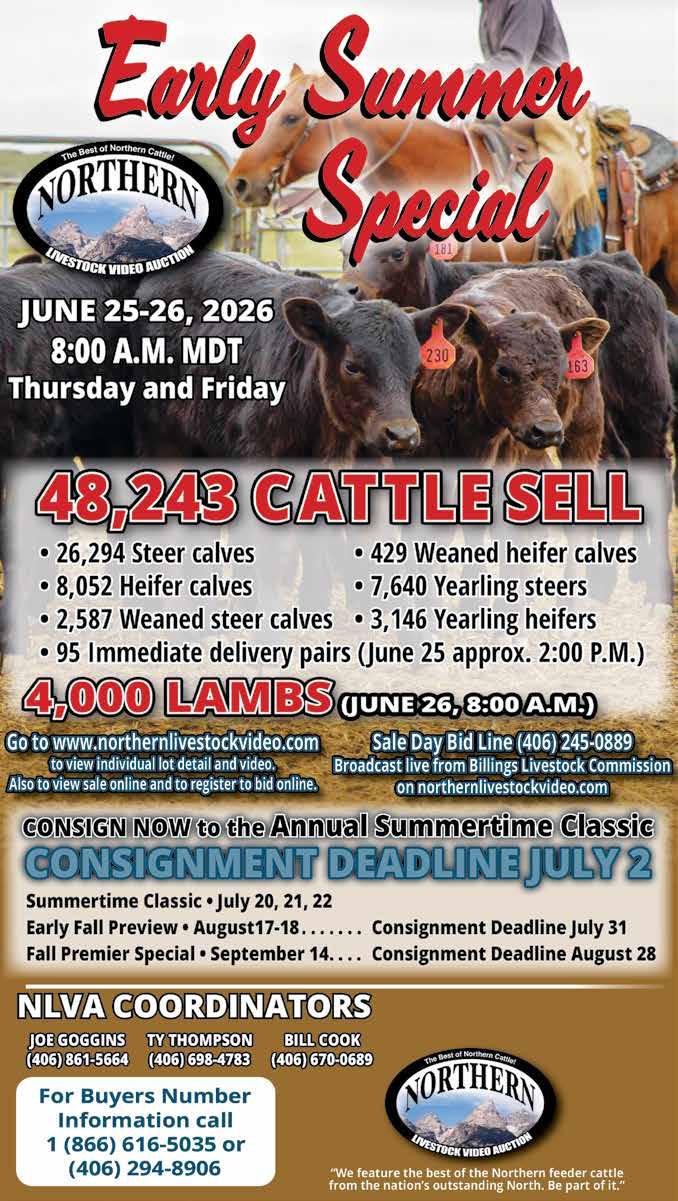
Northern Livestock Video Early Summer Special, 866-616-5035, northernlivestockvideo.com
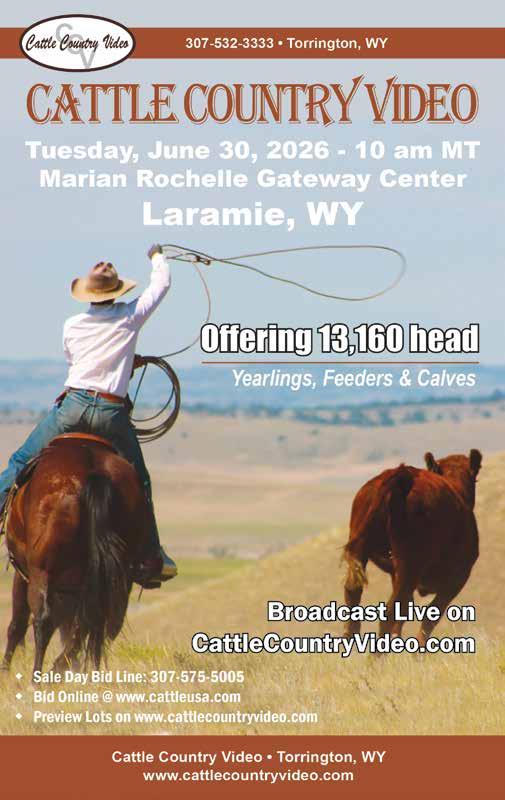
June 30 Cattle Country Video High Plains Showcase, University of Wyoming Marian H. Rochelle Gateway Center, Laramie, 888-322-8853, cattlecountryvideo.com
July 6-10
July 13-15
July 20
July 21
July 24
July 27-31
Aug. 4-5
Aug. 10-11
Aug. 17
Aug. 17-21
Aug. 22
Aug 22-25
Sept. 5
Sept. 5
Sept. 10
Sept. 12
Sept. 12
Sept. 14
Sept. 15
Superior Livestock Auction Week in the Rockies, The Steamboat Grand, Steamboat Springs, Colo., 800-422-2117, superiorlivestock.com
Western Video Market, Silver Legacy Casino Resort, Reno, Nev., 530-3473793, wvmcattle.com
Northern Livestock Video Auction Summertime Classic, 866-616-5035, northernlivestockvideo.com
Tri Brothers Equipment Summer Consignment Auction, Torrington, 307575-2427 307-338-8216, tribrothersauctions.com
Stellpflug Cattle Company “New Frontier” Female Sale, at the ranch, Guernsey, 307-351-1712, stellpflugcattle.com
Superior Livestock Auction Video Royale, Winnemucca, Nev., 800-4222117, superiorlivestock.com
Cattle Country Video Oregon Trail Classic, Gering Civic Center, Gering, Neb., 888-322-8853, cattlecountryvideo.com
Western Video Market, Little America, Cheyenne, 530-347-3793, wvmcattle.com
Northern Livestock Video Auction Early Fall Preview, 866-616-5035, northernlivestockvideo.com
Superior Livestock Auction Big Horn Classic, Sheridan, 800-422-2117, superiorlivestock.com
Memory Ranches 4th Annual Foal Sale, at the ranch, Wells, Nev., 208-4126156, 208-695-0399, memoryranches.com
Lauing Mill Iron L Ranch 21st Annual QH Production Sale, online auction only, prohorseservices.com, 605-347-6193, 605-280-0698, 605-280-0398, lauingmillironlranch.com
Proffit Ranch 25th Annual Labor Day Horse Sale, Diamond X Barn, Evanston, 307-723-5857, proffitranch.blogspot.com
Cattle Country Video Frontier Fall Roundup, Cheyenne Frontier Days Event Center, Cheyenne, 888-322-8853, cattlecountryvideo.com
Open Box Rafter Ranch Quarter Horses 33rd Annual Production Sale, Rapid City, S.D., 605-538-4450, rafterranch.com
SanBar Ranch Quarter Horses 15th Annual Production Sale, Producers Livestock, Salina, Utah, 435-469-1232, sanbarranch.net
Northern Livestock Video Auction Fall Premier, 866-616-5035, northernlivestockvideo.com
Western Video Market, Haythorn Ranch, Ogallala, Neb., 530-347-3793, wvmcattle.com
POSTCARD the Past
King
the Rodeo World
With the rodeo season well underway and the publication of the marvelous Rocky Mountain Horse Edition in a recent Wyoming Livestock Roundup, memories of a past Postcard – plus some laziness – prompted this week’s contribution to this column. Enjoy.
An article in the 1943 annual edition of the Record Stockman declares:
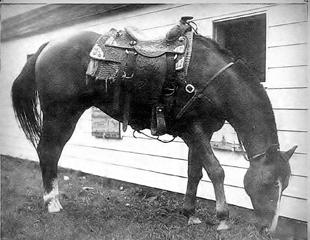
Meet Bullet, the daddy of all rodeo horses. Such ropers as Ike Rude, Bill Wilkinson, John Bowman and Everett Shaw have practically had reserve seats on him from year to year.
The Rodeo Association of America’s steer roping event was won in 1941 by Rude on Bullet, and the 1942 title was won by King Merritt, his owner, mounted on Bullet.
One peculiar characteristic of this horse is when the tie is completed, he nearly always looks back over his shoulder and nickers as if to signal the judge of a job well done.
Bullet was born in 1929. His sire was Jack McCue by Peter McCue. Hoyt Lewis of House, N.M. raised him and broke him when he was a twoyear-old.
His rodeo career began when he was three with
the two famous calf ropers – Roy and Pat Lewis – roping calves on him. Firsts and seconds were won at many shows that season.
The McCues took him to Cheyenne in 1934 and sold him to Bob Crosby, who immediately started training him for steer roping but never used him in a contest.
He brought him back to Cheyenne in 1935 and sold Merritt half interest in him for $250. Three weeks later, Rude bought the other half interest for $350.
The first rodeo to which Rude and Merritt took Bullet was Pendleton in September 1935. They won a first and second average on him
there, about $1,700 in cash and a $450 Hamley roping saddle.
Crosby won the steer roping on him at Cheyenne the next year, and Rude won it at Pendleton.
Rude sold his interest in Bullet to Merritt for $600 in the spring of 1937. Bullet has been a consistent winner ever since in all steer roping contests. His big year was 1941 when a total of $7,500 was won on him. Of that, $3,070 was taken at Cheyenne in placing first, third and fourth in the average. Three weeks later, at Ada, Okla., he won first and third in the average. The following week he finished second and third at Carlsbad, N.M. This year, $1,900 was won on him at Cheyenne.
Bullet is a chestnut and weighs 970 pounds.
On July 18, 1948, the first annual Platte Valley Steer Roping was held in Encampment, with Merritt of Federal and Marvin Reid of Encampment as the sponsors, but then that’s another Postcard from the Past.
Back in the 1930-40s, Bullet was considered the daddy of all rodeo horses. Photo from the 1943 Record Stockman in the Dick Perue/Bob Martin collection. Historical Reproductions by Perue
sheep are undoubtedly her favorite. In fact, her earliest showing memories are of exhibiting sheep in Pee Wee Showmanship classes at the county fair.
“I did Pee Wee Showmanship at the county fair when I was super young and just kind of fell in love with sheep person -
alities,” Brylee says. “Sheep are really fun to show and to hang out with, and they all have a ton of personality.”
Over the years, Brylee has worked hard to build up her showing skills and her sheep herd. Three years into showing as a 4-H member, she started a
club lamb operation called Styvar Livestock, and today, she has seven ewes in addition to her market lambs.
Family affair
Showing livestock has long been a family event for the Styvars. Brylee’s younger brother Korbin also shows animals, and this year, the siblings have all four species in the barn between the two of them.
Brylee plans to exhibit five market lambs and two hogs this year and notes traveling to county fair, WSF and different jackpots serves as quality family time.
“Instead of going on vacation, spending time in the barn and working animals is our family time,” Brylee says. “It’s really enjoyable and a lot of fun.”
Brylee enjoys looking back at memories and photos from past fairs, observing changes in both livestock quality as the program grows and industry standards throughout the years.
She describes last show season as “an awesome year,” having earned
honors in several categories at the 2025 WSF, including exhibiting the Reserve Champion Lamb in the Champion of Champions Showcase and being named Grand Champion FFA Showman.
Although she enjoys seeing her hard work pay off, Brylee says supporting others is most important to her. Her favorite part about county fair is helping younger members learn about showing and seeing them find their own success and enjoyment in the show ring.
“My favorite thing is watching others succeed and achieve their goals,” Brylee says. “It’s so much more fun to celebrate others’ successes rather than just my own.”
Blazing a trail
Brylee’s dedication to agriculture has led her to many opportunities, including being elected president of the 2026-27 Wyoming FFA State Officer Team.
“FFA has created a ton of friendships and has essentially been a family to me,” Brylee comments.
“With my dad being an ag teacher, it’s something I’ve always been a part of. I’ve enjoyed see -
ing students who join FFA achieve their goals, figure out what they want to achieve in the future and find a way to prosper.”
Brylee plans on keeping agriculture in her life throughout her own future, with plans to attend Casper College and study ag business and animal science while competing on the livestock judging team in the fall. She hopes to someday become an ag teacher, a ruminant nutritionist or a livestock geneticist and says she would do all three if she could.
She also expresses gratitude for the many opportunities being involved with showing and agriculture have given her.
“The thing I love most about being a part of the show industry in Wyoming is being able to make different connections with people from across the state while learning, growing and creating a path for my future,” she says. Grace Skavdahl is the editor of the Wyoming Livestock Roundup. Send comments on this article to roundup@wylr.net.
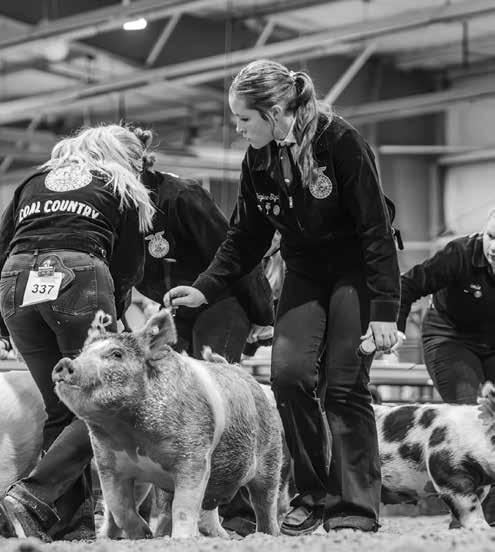
Showing success – Brylee Styvar of Gillette has shown livestock at the Campbell County Fair and
Multiple talents – Throughout her showing career, Brylee Styvar has exhibited sheep, cattle and hogs in countless 4-H and FFA classes.
NOTICE: Publication in this newspaper does not guarantee the legitimacy of any offer or solicitation. Take reasonable steps to evaluate an offer before you send money or provide personal/fnancial information to an advertiser. If you have questions or believe you have been the victim of fraud, contact the Wyoming Attorney General’s Offce, Consumer Protection Unit, 109 Capitol Building, Cheyenne, WY 82002, 307-777-6397 TFN
update our post to Sugar Company for a full-time, Agriculturist. View description and apply WyomingSugar.com. 307this run for 4
Events
UP IN ARMS, LLC FLEA MARKET AND GUN SHOW July 10-12, Cody, WY at the Cody Recreation Gymnasium. Open to the public. Fri., July 10, 3-7 p.m. Sat., July 11, 9 a.m.-5 p.m. Sun., July 12, 9 a.m.-3 p.m. Giving away a .22 pistol Sunday at 2 p.m., must be present to win, 21 years of age and able to pass background check. Buy, sell, trade. Adults $6, children 12 and under free (when accompanied by an adult). For more information, contact Lisa, 208-420-2295 7/4
Feeders is looking for Cowboys/Pen Riders for their feedyard in Red Cloud, NE. The main focus of the Cowboy/Pen Riders are spotting, pulling, diagnosing and taking cattle to the hospital and shipping fat cattle. This person will need to be a team player who is seeking a long-term position. You will have the opportunity to work with and learn from some of the best in the industry. We offer a benefts package that includes health insurance, dental, vision, 401(k), health savings, life insurance and paid vacation. Retention bonus offered to full-time employees. Incentives paid out at 6 months and 1 year of employment. If you are interested stop by and fll out an application or visit our website at
Call Mike Faimon at 406-469-1585 or Davin Arnold 970-301-3098 for more information.
FULL-TIME RANCH MANAGER: BISON RANCH, SHERIDAN, WY. We are seeking a dedicated, experienced ranch manager to join our growing bison ranch operation. This is a hands-on role for someone who takes pride in hard work, reliability and caring for land and livestock. Responsibilities: Daily care and management of bison herd. Maintaining fencing, equipment and ranch property. Assisting with feeding, health checks and handling livestock. General ranch maintenance and upkeep. Supporting ongoing growth and operations of the ranch. Requirements: Prior ranching or livestock experience (bison experience preferred but not required). Strong work ethic and reliability. Ability to lift heavy items and perform physical labor daily. Self-motivated and able to work independently. Available to start immediately. Salary starts at $145,000 and up. This is a fulltime position with opportunity to grow alongside a rapidly expanding ranch. Apply today if you’re ready to work hard and be part of something being built from the ground up. Call Landon, 205531-9819 or e-mail sheryl@bisonunion.com 7/11
Wyoming Sugar Company is now hiring for a welder: Looking for a capable, prompt and disciplined welder for our facility. This person would be responsible for all welding and mechanic projects such as fabrication and maintenance throughout our facility. Preferred qualifcations: Any welding certifcations. Mechanic experience, pipe ftting experience. Starting wage $24.27/hour or DOE. Send resume to mrideout@wyosugar.com
WIGGINS FEEDYARD, LLC
HIRING FULL-TIME EMPLOY-
EE: Current driver’s license required. Call Sue Wiggins, 308279-0924, e-mail sswiggins@ wigginsfeedyard.com, 10077 U.S. 385, Bridgeport, NE 69336, provide references with phone numbers 7/4
MEATCUTTER WANTED: Valley Foods in Saratoga, WY has an immediate opening for a meatcutter. Experience is preferred but not necessary. Ideal candidate is selfmotivated, effcient and customer service minded. Pay DOE. Send resume to valleyfoods9024@ hotmail.com 7/4
RANCH HAND FOR FARM AND RANCH IN NORTHEAST
COLORADO: Seeking an experienced quality ranch hand with a good work ethic and responsible enough to work on their own. The position requires livestock care, helping with calving and branding, moving cows to pasture and cornstalks. There is some farming to prepare felds for planting corn, putting up hay and working on pivot sprinklers. Also putting up electric fences and maintaining all pasture fences. Work pickup and housing with utilities provided. Wages based on knowledge and experience. Send resume, references and work history to bkkramer.kk@gmail.com. Call Kim at 970-520-2513 6/27
RANCH HAND/GROUNDS
KEEPER: Full-time position at a family-owned ranch near Cody, WY and located in the Shoshone National Forest. Position entails lawn care, irrigation, heavy equipment operation, carpentry, equipment maintenance, building maintenance and overall residential and agricultural property maintenance. Experience is welcome but will train the right candidate. The ideal candidate will be reliable; have a strong work ethic; be able to perform individually and with a team; be a self-starter and enjoy working outdoors. Benefts include health, with optional dental and vision; paid-time off and 401(k) with employer matching contribution. For the right candidate housing on property is also available. Salary based upon previous experience. Send resumes to emilyb@collier rou offce co 7/25
Dogs
LIVESTOCK GUARDIAN DOGS: PUPS FOR SALE: Great Pyrenees/Akbash/Anatolian/Maremma mix pups. Both parents are on site and guarding livestock. Born Feb. 25. Located east of Chugwater, WY. Priced with the rancher in mind. For further information call Donna, 307-262-5699 or Clay, 307-331-5762 6/27
ALL TYPES OF EQUIPMENT AND VEHICLE FINANCING. Great service!! Great rates!! Call Chuck Brown at C.H. Brown Co. LLC, 307-322-3232 offce 307-331-0010 cell or e-mail chuckbrown@wyoming.com 6/20
AGRI-ONE FINANCIAL: Farm/ ranch and all commercial loans. RATES AS LOW AS 5%. We have been helping with all aspects of agricultural, commercial fnancing and management for years. LET US HELP YOU on a consulting level with management to increase proftability, deal with and fx credit problems and for all your fnancing needs. WE CARE AND HAVE WORKING PROGRAMS designed for the farmer/rancher and not the banker. Please call Steve, 303-773-3545 or check out our website, a rionefnancial.com. I will come to you and get the job done!! 7/11
CUSTOM HARVESTING SERVICES: Wheat, corn, millet, milo and sunflowers. Running Case IH combines with full support equipment. Timely, reliable and competitive rates. For more information, call 2D Harvesting, 970-6308639, Wray, CO 7/4
A PIECE OF WYOMING HISTORY,
calving ease, gain and disposition. Reasonably priced. Call Shippen Angus 307-709-0484 or 307-709-0488
BULLS FOR SALE: Registered yearling and 2-year-old Black Angus range bulls for sale private treaty. Good selection for heifers and cows. From popular sires and industry leaders. Semen tested and ready to go. CLAY CREEK ANGUS, 307-762-3541, www.claycreek.net 6/27
REGISTERED ANGUS YEARLING BULLS: Breeding soundness, fertility tested and PAP tested. Ready to go to work. Call Paul at TAG Double H Cattle Co., Ten Sleep, WY, 307-690-4225 6/27
REGISTERED ANGUS YEARLING AND 2-YEAR-OLD BULLS FOR SALE, visit www.crookedcreekangus. com or call 785-332-6206, St. Francis, KS 8/29
REGISTERED BLACK ANGUS YEARLING AND 2-YEAR-OLD BULLS: For sale private treaty. Performance and fertility tested. Delivery available. REPLACEMENT HEIFERS available. TRANGMOE ANGUS RANCH, Glendive, MT. Call 907-2326093, 406-687-3315 or 406-9893315 6/20
SALE * CHRISTENSEN RED ANGUS * SALE: Registered, vaccinated and fertility tested bulls. We have a deep carcass, high ADG packaged with moderate to low birthweights available. Call 406-208-4315 or e-mail criters64@gmail.com 7/4
BEST LAST CHANCE SALE!! LYTLE RED ANGUS is offering private treaty bulls from our herd founded on 30+ years of selection for fertility, consistency and effciency. Highly adaptable, our bulls have proven themselves from Arizona to New York state. Age-advantaged and yearling bulls available. Passed breeding service exams and ready to go!! Visit www.lytleredangus. com or call Zeb, 605-441-7658. To view photos, go to www.wylr. net in the classifeds 6/20
3/H SIMMENTAL RANCH, PLAINS, MT OFFERS POWERFUL SIMANGUS BULLS: Yearlings and 18-month-olds sired by top AI genetics. Bred for performance, soundness and longevity, with a strong emphasis on calm disposition. These bulls are built to work and last in real world conditions. Call Alan at 503-931-6815, to fnd t e ri t ft for our rogram. To view photos, go to www. wylr.net in the classifeds TFN
MINI DACHSHUND PUPPIES:
Born April 23. First shots and dewormed. Dad AKC black/ tan, mom ACA red, 9 lbs. each, $1,000. Call 406-598-5444. To view photos, go to www.wylr. net in the classifeds 6/27
TWO AUSSIE/BORDER PUPS: One red bi male, excellent workers and companion animals. Will have an off switch for seasonal work, both parents work well, dad heads, mom heads and heels. Both parents are house dogs. House broken to a dog door, $100. Call 801721-8620. Southwest Wyoming location. To view photos, go to www.wylr.net in the classifeds 6/27
FEEDLOT NEAR WATERTOWN, S.D., 3,500 HEAD: Specializing in replacement dairy cattle and custom beef operations. AI service available. Shots/vaccines to your protocols. Room available. Call/text to talk rates, Nathan, 605-8687383 7/11
CUSTOM FEEDING AND FINISHING FOR CATTLE AND SHEEP. Cactus Hill Ranch Company, Fort Collins, CO. Contact AJ Nelson, 970-3728273 8/22
SUMMER PASTURE WANTED FOR YEARLINGS: Seeking summer grass for 2026. For 500-1,500 head. Wyoming, Colorado, Nebraska, South Dakota. Prefer long-term potential, competitive rates offered. Call Jon, 831-240-5795 TFN
LOOKING TO LEASE A RANCH FOR APPROXIMATELY
HEAD OF COWS. Prefer area in Johnson and Sheridan counties. Call 307290-1643 6/20
COUNTY, WY RANCH NEAR CODY, WY IS AVAILABLE FOR A LONG-TERM
The ranch has over 50,000 acres and supports an irrigated hay base with BOR water rights. Carrying capacity is 700 animal units year-round with hay production. Willing to split the hay ground and grazing. Please e-mail Melanie Giliati at mgiliati@acpg.com for details 6/27
SILVER STATE INTERNATIONAL RODEO JUNE 29JULY 6: Winnemucca Events Complex, Winnemucca, NV.
$20,000 ADDED money. ALL STAR TEAM: Each state will pick 5 contestants to represent their state. The team with the most points will win $1,500 cash. Prizes include: Cash prizes, saddles for event winners and buckles for 2nd-4th and go round prizes, 1st-3rd. For more information or to register online, visit www. ssir.us, call Kathy, 775217-2810 or e-mail silverstate10@yahoo.com. Check us out on Facebook 6/20
LS CUSTOM LEATHER: New tack, belts and cell phone cases. ALSO, SADDLE AND TACK REPAIR. Custom orders welcomed. Contact Lester, 307-631-1053, leave a message. Riverton, WY 6/20
WEANER PIGS FOR SALE. ALSO, butcher hogs. Located in Powell, WY. For more information, call 307-271-1014 1/16
BARLEY STRAW: ertifed weed-free small squares, $4/bale. ALSO, 5x6 round bales, $125/ton. GRAIN OATS, wheat and barley, $20/cwt. Greybull, WY area. Call 307-762-3878 or 307-899-4714, leave message 7/11
ATTENTION FEEDLOTS AND BACKGROUNDERS!!
Chopped alfalfa (3 inches) feed mixer ready. We are a large scale hay farm with our own trucks and can work with your delivery schedule. Stored inside sheds immediately after baling. No rain. No wastage due to weathering!! Call/text Rob’s cell 204-209-1066 or e-mail rob@redriverforage.com. To view photos, go to www.wylr. net in the classifeds 7/11
FEED/GRAIN FOR SALE: Alfalfa, grass and rye/triticale mix hay. Large squares and rounds. Semi loads and delivery only. Call 308-882-1498 7/4
CERTIFIED TRITICALE
STRAW: Long stem round bales. Farson, WY. Call 307350-0350 6/27
400 TONS DURUM STRAW: Round bales, 1,000 lbs., $60/ bale, 780 bales available. Excellent bedding or feed. Call 406-765-7172 6/27
MONIDA OATS: $16/cwt.
Combine run, great for seed or feed. Will auger into truck, trailer or large totes/ag bags. Located between Powell and Cody, WY. Certified scales on site. Call or text Knopp Farms for details, 307-2540554 7/18
HAY FOR SALE: 2025 grass/ alfalfa, first and second cutting alfalfa, millet, haybet barley and CRP hay. ALSO, 2025 GRINDING HAY available. All in net-wrapped round bales. Semi load delivery available. Call for pricing, ask for Klint, 701-290-4418, if no answer, send a text or keep trying 6/20
2018 DODGE RAM 3500: 4x4, crew cab, 6.4 Hemi. Gooseneck hitch, 94,000 miles. Covercraft seat covers, eather ech oor mats. New transmission. Call Dan, 307-250-2178 7/11
ROTO GRIND TUB GRINDER: Good condition. Pulls well behind a pickup for transport, $9,000 OBO. Leave message, I will call you back, 406-5847582 6/27
FOR SALE: Alfalfa and alfalfa/grass mix, large rounds with net wrap, several hundred bales, nice hay. 2022 KW T680 day cab semi with PACCAR MX-13 engine, automatic transmission, air ride, air slide 5th wheel, aluminum wheels, 486,100 miles, asking $29,500. New Holland 9’ sickle mower. New Holland 7150 hydroswing, low acres. Rowse 9’ pull type sickle mower. CIH 1100 3 pt. 9’ pull type sickle mower. Hesston/AGCO 5556 large round baler with net wrap and twin tie, 7,400 bales. H&S hay windrow uffer. H wheel fnger rake. Ford 7N tractor with wide front and 3 pt. Schulte hydraulic rock picker with 3 bat reel. New Holland 195 manure spreader, 410 bushel with slop gate, double oor chains, tandem axle. Behlen Country livestock working chute with automatic headgate. Apache portable creep feeder. Burns portable loading chute. 2019 John Deere 714A chuckwagon with John Deere tandem running gear. H&S 7+4 24’ chuckwagon with bunk feeding extensions and tandem 14 ton running gear. J&M 350 gravity wagon with 385/65 R22.5 tires and ag topper. 12’ and 14’ HD box scrapers with tilt. All in very nice condition!! Call 605-999-5482 7/4
1985 GMC 7000 TRUCK: 5+2 transmission, 20 ton Harsh hoist, 18’ box, silage end gate, new carburetor and fuel pump, $8.000; 1,000 GALLON WATER TANK ON FLATBED, fts on a pickup, , FORMOST HYDRAULIC SQUEEZE CHUTE WITH PALPATION CAGE, breast bar, neck extensions and more, good working condition, $8,000. Call 307-8573102, early morning, noon or evening 7/4
LODGEPOLE OUTDOOR FURNACES, 307-223-2046. Your authorized Central Boiler Dealer. Get your outdoor wood furnace today!! ffcient wood heat. Heat multiple buildings. Invest in your heating, don’t just pay for it!! See us at www.cb.lodgepoleproducts. com!! 6/27
NEW HOLLAND 855 BALER: Has been reconditioned. Always been shedded. TWO INTERNATIONAL MODEL 7100 DRILLS: Purchased new in 1986. Always been shedded. HAVE LIQUID FERTILIZER TANKS WITH SQUEEZE PUMPS, both 14’, has hitch to pull both planters at the same time. Call 303-947-2338 or email slhieb@msn.com 6/27
CASE IH STEIGER 335 TRACTOR: Four wheel drive, serial #Z8F109603, 3,389 hours, CHEAP horsepower, pre DEF, bareback, always shedded, tires 50%, 12 speed transmission, guidance ready, deluxe cab, CLEAN!! $87,500, Chugwater, WY. Call 307-331-0446. To view photos, go to www.wylr.net in the classifeds 6/20
ORIGINAL ROUND BALER BELTING FOR ALL MAKES: Save $100s. Free shipping, www.balerbelts.com. Call Hammond Equipment, 334627-3348 10/24
WE DO ALL TYPES OF FENCING!! Agricultural, commercial, residential, with 3 generations of experience. Call Glen, 605-3805311 or e-mail fenceguru@ live.com 7/11
LODGEPOLE PRODUCTS, 307-742-6992, SERVING AGRI-BUSINESSES SINCE 1975!! Treated posts, corral poles, buck-and-rail, western rail, fence stays, rough-sawn lumber, bedding. SEE US at www.lodgepoleproducts. com and click our “Picking A Fence Post” tab to see why folks choose our posts!! TFN
OBITUARIES
The Wyoming Livestock Roundup prints obituaries free of charge. To submit, please e-mail to roundup@wylr.net or call the office at 307-234-2700.
Everet Lee Bainter
Sept. 23, 1948 – June 13, 2026
Everet Lee Bainter, a dedicated soil conservationist whose career was marked by steadfast commitment to the preservation and stewardship of natural landscapes, passed away on June 13 in Casper.
tion to his nation during a pivotal era.
Following his military service, he pursued higher education, earning a master’s degree which laid the foundation for his long and impactful professional career.
to protecting rangelands and promoting sustainable agricultural practices.
Born on Sept. 23, 1948 in Oberlin, Kan., Everet’s life journey was one characterized by service – both to his country and to the land he cherished.
Everet married the love of his life Sheila Tomanek in 1969. He proudly served in the Army National Guard from 1970-76, exemplifying his dedica-
Edward "Ed" S. Weppner
Feb. 20, 1941 – June 9, 2026
Surrounded by family, Edward “Ed” S. Weppner died peacefully at Davis Hospice Center on June 9. As a lifelong Cheyenne resident, Ed was heavily involved in Laramie County and the state of Wyoming.
Ed was born on Feb. 20, 1941 to Albert and Virginia Weppner in Cheyenne. He graduated from St Mary’s High School and later attended the University of Wyoming (UW) where he majored in engi -
neering. While at UW, he met and married Mary Caldwell. After a couple summer jobs working for the U.S. Army Corps of Engineers, he changed his major to agriculture.
Ed and his wife Mary, along with her sister and brother-in-law, spent a lifetime running the family ranch. Like most ranch families this included the typical cycle of a Wyoming cattle ranch – winter feeding, calving, fixing fence, moving cattle, irrigating, haying, weaning, etc.
Ed started out as a member of the “crew,” working into the day-today management alongside his mother-in-law Elizabeth Caldwell, his wife and sister-in-law Beth McNiff at the D.R. Whitaker Ranch which was established by Mary and Beth’s grandfather, Dugald R. Whitaker, in 1895.
James "Jim" Francis Doyle
Aug. 17, 1942 – June 9, 2026
James “Jim” Francis Doyle, age 83, died suddenly of natural causes on June 9. He was born on Aug. 17, 1942 in Billings, Mont. to Ruth and Francis Doyle. He met his future wife Nancy in 1964, and they were married on July 1, 1967 by Paul Hallock, after Jim returned from Vietnam. Jim served honorably in the U.S. Army from March 1965 through December 1966. As a military policeman, he served in Vietnam, where he achieved the rank of Specialist E-4 and was awarded the National Defense Service Medal, the Vietnam Service Medal and the Viet-
With a profound passion for environmental conservation, Everet held a vital role as a soil conservationist with the Soil Conservation Service, an agency which later became part of the U.S. Department of Agriculture.
He retired as a range conservationist, having devoted many years
Ed was a longtime member of Laramie County Stock Growers and the Wyoming Stock Growers Association (WSGA).
At WSGA, he went from being a member to being an officer, later becoming president. In later years, he participated in lobbying efforts for the association. He enjoyed attending state meetings for as long as he was able. Involvement with state and local organizations also included the Wyoming Livestock Board, Laramie County Weed and Pest, Laramie County Fire District #2 as a volunteer firefighter and a board member, Laramie County Fair, Laramie County Civil Defense, Cheyenne Chamber of Commerce, Military Affairs Committee and USS Cheyenne Committee, as well as Cheyenne Frontier Days (CFD).
Ed was a lifelong CFD volunteer. He started out working with the CFD
nam Campaign Medal.
Jim retired from the U.S. Postal Service after serving as a postmaster in Wyoming.
He was an avid ham radio operator at KB7YP, as well as a member of the Casper Amateur Radio Club and Wyoming Cowboy Net.
A lifelong hunting and fishing enthusiast, he also enjoyed gold prospecting as a member of the Gold
Everet’s professional achievements were complemented by his personal interests, among which camping held a special place in his heart. His love of the outdoors reflected his deep connection to nature, and he found joy and solace in the quiet beauty of the wilderness.
Everet is preceded in death by his parents and his daughter Michelle Roenz.
He is survived by his beloved wife Sheila Bainter; his sister Jan
Parade Committee as a teenager, and as time went by, he was made a parade marshal. Then he joined the racing committee – later known as Contract Acts – assisting with chuckwagon racing and the Quarter Horse racing, where he became the track steward for the Quarter Horse race meet.
Ed was selected to serve as the Contract Acts chairman on the General Committee from 198486. In 1985, in an attempt to broaden the customer base, he hired the first rock band to open CFD.
Later, he became the night arena director starting the chuck wagon races, then a Professional Rodeo Cowboys Association approved timer for rough stock events.
He was also involved in the CFD Governors Invitational Art Show from its inception, a member and officer in the CFD Heels organization, a member of the wagon
Prospectors Association of America.
Jim spent his winters in Quartzsite, Ariz., four-wheeling, prospecting, flying RC aircraft and, above all, enjoying the companionship of his close friends there.
Jim knew the desert like the back of his hand, and he loved American history.
He adored his daughters Kim and Amy and his
Pope; his brother Lyman Bainter; his children Lori Bainter Ratzlaf and Todd Bainter and numerous grandchildren who carry forward his legacy, including Briana Lejarza, Tyler Roenz, Alana Ratzlaff, Kenna Ratzlaff, Janessa Ratzlaff, Luke Bainter, Layton Bainter, Abigail Bainter, Adelyn Bainter and Thane Bainter.
Everet’s life was a testament to dedication, compassion and respect for the environment. His contributions to soil and range conservation have left an enduring impact, and his memory will be lovingly
doctors and various other activities.
Ed and Mary were true partners in their family, business and community life, which resulted in many lifelong friendships, particularly from WSGA and CFD.
Season tickets for both UW football and basketball kept Ed and Mary entertained during the fall and winter for many years.
They particularly enjoyed being part of a local motorcycle group, touring most of the lower 48 states and parts of Canada.
Ed also enjoyed fishing and hunting with his father and brother in his youth. In later years, he traveled to South Dakota to fish and hunt with a group from Cheyenne and would reciprocate by hosting the South Dakota folks who came down to hunt on the ranch.
Ed is preceded in death by his wife Mary Weppner and brother Jim Weppner. He will be missed by
grandson Fisher.
Jim and his family loved the time they spent at the family cabin, “Alpine,” especially his afternoon naps in the mountains of Casper.
Jim is preceded in death by his wife Alice “Nancy” Doyle.
He is survived by his daughters Kim Doyle of Casper and Amy (Jim) Carlson of Colorado Springs, Colo.; his grandson Fisher Carlson of Colorado
his children Rob Weppner, Ginny Weppner and Tricia Tarantola; son-in-law Chris Tarantola; sister Ann Blades and sister-inlaw Linda Weppner.
His two grandchildren Izzy and Gabbi Tarantola lovingly called him Boppa. “Uncle Ed” was a big influence on his nieces and nephews Niffy “McNiff” (Chris) Bube and their son Jack, John McNiff, Wann McNiff, Jodi (Eric) Weppner Davis and their children Lance and Taryn, Tracy (Cody) Weppner Wilson and their children Dakota and Chyann and Matt Jagow.
Donations in Ed’s memory may be made to the CFD Memorial Foundation at cfdmemorialfoundat.wixsite. com/mysite/donate or St. Joseph’s Children’s Home in Torrington at stjosephwy.org
The funeral service will be held at St. Mary’s Cathedral in Cheyenne on June 22 at 10:30 a.m.
Springs, Colo.; his sister-inlaw Jackie Tighe of Casper; his niece Veronica “Nikki” Fenner of Colorado Springs, Colo.; his nephew William Tighe Jr. of Casper and his cousin Sharon Jackson of New Smyrna Beach, Fla. Memorials may be given in his memory to the James and Nancy Doyle Scholarship Fund at Casper College. Funeral arrangements will be announced at a later date.
CROSSWORD
by Lee Pitts
The Computer Cowboy
In our area, we’ve been invaded by Silicone Valley tycoons with too much money who are buying up ranches at astronomical prices even though they don’t know the first thing about the cattle business.
These geeks look at real cattlemen like we are neanderthals because of the way we dress and talk and our failure to incorporate AI into our operations.
I tried it once years ago, before these pimplyfaced computer cowboys had made their first million, and it was a wreck of epic proportions. Some ranches are just not compatible with artificial insemination.
Oh, wait a minute, computer cowboys are not talking about our reluctance to use artificial insemination. They are referring, of course, to artificial intelligence.
I have tell you, if all of these robo-calls I get are an example of the use of artificial intelligence, then I don’t want to live in a world that is artificially intelligent.
Another example often given about the wonders of AI is something called ChatGPT, which allows its users to plagiarize from writers like me without giving any credit or any royalties.
Since AI is going to put a lot of people out of work, I just don’t under-
stand all of the excitement about it.
Here’s just one example of how AI and algorithms are costing these computer cowboys lots of money.
I enjoy shipping cattle, and I did it occasionally for a couple order buyers and one very astute auction yard owner. Usually, these folks called me when they were overbooked for shipping cattle that had sold on the video. Invariably, they only sent me to the one- or two-load deals close to my home.
My instructions were very simple – sort off the bad eyes, the gimps and any cattle that were outliers and just didn’t fit. My instructions also depended a lot on the market. If the cattle were bought too high on the video, I was instructed to be a lot more picky, and if the cattle were bought real cheap, I was told to put every animal that could limp up the chute on the truck, even if it was already overloaded.
The last time I shipped cattle, it was to a new computer cowboy who refused to send his cattle to the auction market where they would be subjected to true price discovery. So, the owner of the auction yard just bought the cattle real cheap and resold them at his weekly auction sale.
When I arrived at the ranch to ship the calves,
I noticed they had been deprived of feed and water overnight, as per the deal, and they looked like they must have been worked real hard the day before by wifey, the drones and dogs used to round them up.
The reason people are so excited about AI is it will reduce human involvement in many tasks – in this case cowboys.
The computer cowboy excitedly told me, in the future, he was also going to be incorporat -
ing facial recognition on his cows, electronic ear tags, virtual fencing with each cow having to wear a collar around its neck and cameras everywhere so he could check on his cattle at all times using his smartphone.
With only one load to ship, I thought I’d be in and out of the shipping in an hour, but I was still at it five hours later.
This is because the computer cowboy insisted on individually weighing
and recording other data on every single calf so he could “build data sets to use in his algorithms.”
Whatever that means.
I swear, each calf was weighed on a scale which looked more like a clipping chute than it did a scale, but these weren’t show calves.
It was a hot day, and as the owner was busy building his data sets, the calves waiting to be weighed were shriveling up like raisins.
After the auction owner sold the cattle at his weekly sale, he sent me a nice check as a thank you because the calves had the biggest shrink he’d ever heard of. He also asked, “I don't know what you did when you shipped those calves, but do you want a full-time job?”
From this and other experiences, I’ve come to the conclusion the more artificial intelligence is employed, the less intelligent people become.
U.S. Department of Agriculture announces New World Screwworm investments
The U.S. Department of Agriculture (USDA) is announcing funding for 40 breakthrough projects to bolster the nation’s defenses against New World screwworm (NWS).
These innovative proposals, which will receive a combined total of about $105
million, promise to sharpen detection, accelerate control and eradication tools and strengthen rapid-response capabilities.
USDA launched the NWS Grand Challenge on Jan. 21, marking the next milestone for U.S. Secretary of Agriculture Brooke Roll-
ins’ five-pronged plan to support producers’ success, protect the nation’s food supply and build long-term resilience against NWS.
The Grand Challenge called on innovators from federal and non-federal entities to help in efforts to prevent the spread of NWS by devel-
RIVERTON LIVESTOCK AUCTION
oping high-impact projects to enhance detection, control and eradication readiness.
USDA reviewed 226 applications, requesting about $664 million in total funding. Projects were selected based on their innovative approaches, scientific gold standards and their potential to make a significant impact on the prevention and
response to NWS. In addition to these 40 projects, work has already started on two additional USDA-funded projects which are part of the Grand Challenge.
Texas A&M AgriLife Research is assessing the feasibility, efficacy and operational readiness of electron beam technology as a non-
radioactive alternative to cobalt-60 gamma irradiation for sterilizing NWS pupae in sterile insect technique programs, and the University of Florida is evaluating two U.S.-made X-ray irradiators for sterilizing NWS pupae using secondary screwworm as a surrogate. For more information, visit screwworm.gov
USDA issues grazing directive
On June 12, U.S. Secretary of Agriculture Brooke Rollins announced the distribution of a comprehensive directive to all U.S. Forest Service employees from the Office of the Under Secretary for Natural Resources and Environment.
These actions advance implementation of the Advancing Grazing on Forest Service and Bureau of Land Management (BLM) Lands Memorandum of Understanding and the U.S. Department of Agriculture (USDA) and Department of the Interior’s Grazing Action Plan, delivering on the Trump administration’s commitment to strengthen American ranching, restore multiple-use management on federal lands and combat regulatory lawfare against producers.
Hellyer Ranch- 25 Blk Ang 3-8 yr old pairs. Cows Rec Virashield 6VL5 and Vision 7 in March. One Brand, Ranch Raised, Age Branded. Reputation Genetics with multiple generations of Popo Agie Angus Genetics. Calves are not branded. High Elevation and Fancy!
Applequist Ranch – 20 Blk Ang 7-10yr old pairs. Rec Enforce 3 @ birth. Rec Nasalgen 3IP & 7way @ branding. Tagged to match. Choice. One brand. High desert! WEIGHS
ALL CATTLE CLASSES • START TIME 9:30 AM W/ WEIGH UPS
TUESDAY, JULY 14 - No Sale
TUESDAY, JULY 21
ALL CATTLE CLASSES W/ SHEEP & HORSES START TIME 9:30 AM W/ SHEEP & WEIGH UPS PAIRS
TUESDAY, JULY 28 - No Sale
TUESDAY, AUGUST 4
ALL CATTLE CLASSES • 4-H RESALE (NOON) START TIME 9:30 AM W/ WEIGH UPS
TUESDAY, AUGUST 11 - No Sale
TUESDAY, AUGUST 18
ALL CATTLE CLASSES W/ SHEEP & HORSES • 4-H RESALE (NOON) START TIME 9:30 AM W/ SHEEP & WEIGH UPS
TUESDAY, AUGUST 25 - No Sale
TUESDAY, SEPTEMBER 1
LABOR DAY YEARLING SPECIAL START TIME 9:30 AM W/ SHEEP & WEIGH UPS
~~~~~~~~~~~~~Consignors~~~~~~~~~~~
Preg Checking/Bleeding Cattle: Cattle need to be in the yard by 2:00 PM prior to the day of sale if they need preg checked or bled. Thank you for your cooperation!
Contact:
(307) 728-8519
Key elements of the directives include expanding access to prioritize permitting vacant and closed allotments, maximizing grazing flexibilities to keep working lands working, eliminating delays by streamlining permitting and allotment authorizations, elevating rural Americans by giving ranchers a better voice and improving service by setting expectations for positive engagement with ranchers.
By elevating grazing as an administration priority, USDA is protecting the roughly 23,000 permittees and lessees who rely on public rangelands while delivering more affordable, American-raised protein to consumers, noted Rollins.
Bookmark and Beyond
Each year, to showcase their understanding and appreciation of Wyoming’s essential resources, second- through fifth-grade students from across the state create bookmarks illustrating a Wyoming resource message through Wyoming Agriculture in the Classroom’s Bookmark and Beyond Program.
This year, 13 winning designs were printed and distributed throughout the state. For coming weeks, the Roundup will share photos of the 2026 Bookmark and Beyond finalists.
Fifth-grade finalist – Created by Paxton Fowles, fifth grade, Verda James Elementary, Casper, taught by Sarah Deschenes, sponsored by Elevate Wealth Management
Fifth-grade finalist – Created by Sula Sasse, fifth grade, Moorcroft Elementary, Moorcroft, taught by Sarah Merchen, sponsored by Superior Livestock Auction