A PR I L 17 - A PR I L 23 , 2020 | TH R E E D O LL A R S
FLOR IDA’S NE WSPAPER FOR T HE C - SUI T E
Pandemic | Marketing CEO’s message to fellow leaders: Don’t slow down. PG.10 PASCO • H ILL SBOROUG H • PIN ELL AS • P OLK • M A N ATEE • SA R ASOTA • C H A R LOT TE • LEE • COLLIER
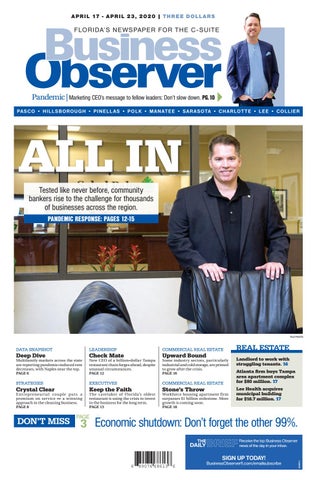
Kettle ALL IN Mettle Tested like never before, community bankers rise to the challenge for thousands of businesses across the region. PANDEMIC RESPONSE: PAGES 12-15
FILE PHOTO
DATA SNAPSHOT
LEADERSHIP
COMMERCIAL REAL ESTATE
Deep Dive
Check Mate
Upward Bound
Multifamily markets across the state are reporting pandemic-induced rent decreases, with Naples near the top. PAGE 6
New CEO of a billion-dollar Tampa restaurant chain forges ahead, despite unusual circumstances. PAGE 12
Some industry sectors, particularly industrial and cold storage, are primed to grow after the crisis. PAGE 16
STRATEGIES
EXECUTIVES
COMMERCIAL REAL ESTATE
Crystal Clear
Keep the Faith
Stone’s Throw
E nt repreneu r ia l c ouple put s a premium on service — a winning approach in the cleaning business. PAGE 8
Workforce housing apartment firm surpasses $1 billion milestone. More growth is coming soon. PAGE 18
Landlord to work with struggling tenants. 16 Atlanta firm buys Tampa area apartment complex for $80 million. 17 Lee Health acquires municipal building for $16.7 million. 17
PAGE
3 Economic shutdown: Don’t forget the other 99%. Receive the top Business Observer news of the day in your inbox.
SIGN UP TODAY!
BusinessObserverfl.com/emailsubscribe
333693-1
DON’T MISS
The careta ker of Florida’s oldest restaurant is using the crisis to invest in the business for the long term. PAGE 13
REAL ESTATE
2
BUSINESS OBSERVER | APRIL 17, 2020 – APRIL 23, 2020
BusinessObserverFL.com
Vol. XXIV, No. 14
Port Manatee Commerce Center
31,000-60,000 SF FOR LEASE 2340 S Dock St, Palmetto, FL
A Division of The Observer Media Group
BusinessObserverFL.com
60,000 SF Space For Lease
Founded in 1997, the Business Observer is Southwest and Central Florida’s newspaper for business leaders. With offices in Hillsborough, Pinellas, Polk, Pasco, Manatee, Sarasota, Charlotte, Lee and Collier counties, the Business Observer is the only weekly business newspaper that provides business leaders with a regional perspective. The Business Observer’s mission is to deliver relevant news and information on Southwest and Central Florida’s leading and growing companies, up-and-coming entrepreneurs and economic, industry and government trends affecting business. The Business Observer is also the leading publisher of public notices on the Gulf Coast of Florida.
31,000 SF Space For Lease
Editor and Publisher / Matt Walsh, mwalsh@BusinessObserverFL.com
· Clear span (no poles) · 30’ eave height · 5 loading docks · 5 grade level doors · Two 26’ bi-fold hangar doors · Drive through access · 20’ x 60’ project cargo door
Executive Editor / Kat Hughes khughes@BusinessObserverFL.com Managing Editor / Mark Gordon mgordon@BusinessObserverFL.com Commercial Real Estate Editor / Kevin McQuaid kmcquaid@BusinessObserverFL.com Tampa Bay Editor / Brian Hartz bhartz@BusinessObserverFL.com Sarasota-Manatee Editor/ Grier Ferguson gferguson@BusinessObserverFL.com
· Rail served by CSX · 200A - 277/480V electric service · Fire sprinklered (NFPA 13 High Hazard) · Convenient to I-75/I-4 (No congestion) · Located outside the security gates of Port Manatee · 24/7 access (No TWIC card required)
Editorial Design /Jess Eng Contributors / Steven Benna, Beth Luberecki, John Haughey
Associate Publisher / Kathleen O’Hara kohara@YourObserver.com Associate Publisher / Diane Schaefer dschaefer@BusinessObserverFL.com Director of Legal Advertising / Kristen Boothroyd kboothroyd@BusinessObserverFL.com Director of Creative Services / Caleb Stanton, cstanton@YourObserver.com Director of Information Technology / Adam Quinlin, aquinlin@YourObserver.com Chief Financial Officer / Laura Keisacker lkeisacker@YourObserver.com Director of Circulation / Anne Shumate subscriptions@ BusinessObserverFL.com
HOW TO REACH US Hillsborough County
200 S. Hoover Blvd., Suite #135 Tampa, FL 33609 Phone: 941-906-9386 (Legal Notices) Fax: 941-954-8530
Lee County
Orange County 330214-1
Kevin@PortManateeCommerceCenter.com · (941) 729-1010 www.PortManateeCommerceCenter.com
661 Garden Commerce Pkwy, Suite 180 Winter Garden, FL 34787 Phone: 941-906-9386 (Legal Notices) Fax: 941-954-8530
Charlotte County
Address: 949 Tamiami Trail, Suite 202 Port Charlotte, FL 33953 Phone: 941-906-9386 (Legal Notices) Fax: 941-954-8530
Pinellas County
14004 Roosevelt Blvd. Clearwater, FL 33762 Phone: 941-906-9386 (Legal Notices) Fax: 727-447-3944
LIKE US WEEKLY? YOU’LL LOVE US DAILY
5570 Gulf of Mexico Dr., Longboat Key, FL 34228 Phone: 941-362-4848 Phone: 941-906-9386 (Legal Notices) Fax: 941-954-8530
Sarasota County
18070 S. Tamiami Trail, Suite 11 Fort Myers, FL 33908 Phone: 239-703-7802; Fax: 941-954-8530
Contact Kevin Button for lease terms and conditions.
Manatee County
Sarasota, FL 34230 1970 Main St., Suite 400, Sarasota, FL 34236 Phone: 941-362-4848 Phone: 941-906-9386 (Legal Notices) Fax: 941-954-8530
Collier County
The French Quarter, 501 Goodlette Road N., #D-100 Naples, FL 34102 Phone: 941-906-9386 (Legal Notices) Fax: 941-954-8530
Pasco County
3030 Starkey Blvd. New Port Richey, FL 34655 Phone: 941-906-9386 (Legal Notices) Fax: 941-954-8530
Polk County
1102 S. Florida Ave. Lakeland, FL 33803 Phone: 941-906-9386 (Legal Notices) Fax: 941-954-8530 To send Legal Notices, email to: legal@BusinessObserverFL.com. Name the county of interest in the subject line and attach notice. Deadline for legal notices is noon Wednesday. For Display Advertising, call (941) 362-4848. Deadline for display advertising space is noon Friday.
HOW TO SUBSCRIBE Subscription Price
One-Year Periodical Rate........................................................................................ $75 One-Year First-Class Mail......................................................................................$107 Two-Year Periodical Rate.......................................................................................$127 Two-Year First-Class Mail.......................................................................................$180 Three-Year Periodical Rate....................................................................................$185 Three-Year First-Class Mail...................................................................................$239 Single copy price: $3 Group rates for five or more corporate subscriptions are available. To subscribe online: www.businessobserverfl.com If you have a question about your subscription or wish to suspend your subscription temporarily, call Anne Shumate, (877) 231-8834 or contact her by email: subscriptions@BusinessObserverFL.com
Receive the top business news of the day in your inbox.
POSTAL INFORMATION The Business Observer (ISSN#2325-8195) is published weekly on Fridays by the Gulf Coast Review Inc., 5570 Gulf of Mexico Dr., Longboat Key, FL 34228; Periodicals Postage Paid at Sarasota, FL, and at additional mailing offices. The Business Observer is circulated in Charlotte, Collier, Hillsborough, Lee, Manatee, Pasco, Pinellas, Polk and Sarasota counties. POSTMASTER: Please send changes of address to the Business Observer, P.O. Box 15456 North Hollywood, CA 91615-9166. For information on reprints, visit BusinessObserverFL.com
“The road is cleared,” said Galt. “We are going back to the world.” He raised his hand and over the desolate earth he traced in space the sign of the dollar. Ayn Rand, Atlas Shrugged
www.BusinessObserverFL.com/EmailSubscribe 272780
333902-1
SIGN UP TODAY!
APRIL 17, 2020 – APRIL 23, 2020 | BUSINESS OBSERVER
BusinessObserverFL.com
3
review and comment
FOR SALE | 2.6 ACRES FORT MYERS BEACH BOAT YARD
What about the 99%?
SOLD!
BY MATT WALSH | EDITOR AND PUBLISHER
Two 90-year-olds — one in Sarasota, the other in Colorado — were lamenting last Saturday the state of affairs in the U.S. The Coloradoan said: “Our generation, the one before us and the one after us worked to build up this great, modern economy over the past 100 years, and they’ve managed to kill it in one month.” “They” are the political class and the technocrats in Washington, D.C.; the nation’s sheeplike governors, mayors and bureaucrat city managers — all of whom parade in front of the TV cameras and try to outdo their peers with their authoritarian orders for the “health and safety” of their citizens. Emotions and computer models over facts. High up there with all of them: the national media. Give them a crisis, no matter how small, and they feast like hyenas on the smell of blood, especially President Donald Trump’s blood. They froth too much. To that end, a lot of you aren’t going to like what follows, but here goes: The political classes and media have blown COVID-19 way out of proportion. The medicine they have dispensed across the country is worse than the virus itself. They need to take a breath, to step back from the panic and to start in earnest to sharpen plans and begin reopening the economy — especially in those areas where the coronavirus is not a crisis or a threat. Governors and mayors and city and county commissioners need to face the fact the U.S. is now in a recession. To be sure, Florida is. And how much social and economic destruction that will bring depends on the actions of the political class starting now. The man from Colorado above is totally right. The politicians and media created a panic that has inflicted pain on 99.88% of the U.S. population. Their lives in exchange for: As of Tuesday, 386,800 Americans with confirmed cases of COVID-19 and 10,989 deaths. Together those two groups make up 0.11% of the U.S. population. COVID-19 IN PERSPECTIVE Mind you, we know: All lives matter. But consider some perspective. The following are monthly deaths in the U.S.: Heart disease: 54,000 Cancer: 50,000 Bronchitis, emphysema: 14,000 Stroke: 12,000 Alzheimer’s: 10,000 Diabetes: 7,000 Drug overdoses: 5,600 Flu/pneumonia: 4,700 That’s 157,000 a month. COVID-19 deaths: 12,000 since February. As commentators Bill Bennett and Seth Liebsohn wrote in RealClear Politics: “Where is the daily mortality count
[on those other causes of death]? The blaring headlines? The upending of the country? “Did we ever suggest shelter-in-place orders to clean the streets of illegal drug activity or shut down industries? … Of course not, though its high body count and cost affects a great many more families and businesses.” You’ve seen the economic toll — the skyrocketing unemployment claims. These are all able-bodied families whose mental states now are consumed by the fear, anxieties and, especially, the uncertainties of: “How am I going to pay my bills?” “Will we have money to feed the family?” “Will we have money to keep buying my medicines?” “Will my job come back?” Small-business owners are measuring daily how much longer their cash will keep them in business. What about the federal bailout-relief money for employers and employees? One banker told us: If you’re counting on that money to save your business, don’t. Picking up takeout Saturday night, we saw the restaurant owner bringing bags of food to her customers on the street. “I’m exhausted,” she said. You could tell it. “If I stop, I’ll cry.” She’s hanging on day by day. Multiply that by 836,000 — the number of restaurants in Florida. Look inside the households of working parents with school-age children. We’ve heard from two mothers describing the high-level frustrations of trying to manage their jobs and have their children finish their lessons from the confines of their homes. Think of the toll this is taking on families. Recessions always bring strife that goes beyond money — depression, suicides, drug abuse, domestic violence. This is nationwide. We received a text Sunday from a weekly churchgoer: “My church had a new program for watching Palm Sunday services. If this is what passes for a church today, I can live without it.” It’s difficult to accept that the politicians and religious leaders have shut the doors to houses of worship. You can’t even go in to kneel and say a prayer. Surely, God is distressed as well. This has a bad effect on society. All of this is now. CASCADING EFFECTS Here is what is still to come: The jobless are not paying or are asking for breaks on their mortgages, rent, car payments and credit card payments. Small-business owners are telling their landlords they won’t be paying rent for the next few months, or several months. That means the landlords won’t be paying their mortgages, either. And the investors who are holding the mortgage-backed securities won’t be getting their
See COMMENT page 19
PRICE: $5,250,000 • SALE INCLUDES LAND, BUSINESS & BUILDINGS • HOME OF THE TON TRAVEL LIFT • POTENTIAL FOR150RESTAURANT/TIKI BAR •
OVER 40+ YEARS • INEASYBUSINESS DEEP WATER • 5 MIN BOAT IDLE TOACCESS • 2.6+- ACRES ZONED: GULF IL, CM, IM •
HURRY, PROPERTIES LIKE THIS RARELY COME AVAILABLE IN OUR LIFETIME!! ROBERT W. BEASLEY BROKER/OWNER
239.994.5049
RWBREALESTATE@AOL.COM JASON PADILLA BROKER-ASSOCIATE
239.233.0379
333216-1
One-size-fits-all shutdowns don’t make sense. Public officials should shift their focus to reopening the economy.
able rties avail e p o r p s s Acce lated Gulf e R e in r a other M
1711 MAIN ST., FORT MYERS BEACH, FL 33931 | www.RWBREALESTATE.COM
500
Our business is knowing your business.
TRANSACTION ITEMS PER STATEMENT CYCLE*
GREAT BUSINESS STARTS HERE. Take our Free Business Checking* account, for example: • NO minimum balance • NO monthly service charge • INCLUDES up to 500 transaction items per statement cycle* • INCLUDES up to $10,000 currency deposited/exchanged per statement cycle* • TWO FREE personal checking accounts (monthly charge waived for the business owner)*
Call or visit us today to learn more. www.iberiabank.com
*All products and services are subject to approval, including credit approval. Free Business Checking and free personal checking provides no-cost maintenance and account activity; incidentals on the accounts, such as check purchases, stop payments, etc., are not free. 326262-1
4 topstories from BusinessObserverFL.com
BUSINESS OBSERVER | APRIL 17, 2020 – APRIL 23, 2020
BusinessObserverFL.com
TAMPA BAY
Restaurant CEO takes pay cut Bloomin’ Brands CEO David Deno will forego his base salary until further notice, becoming the latest of multiple public company executives to take a pay cut amid the coronavirus pandemic. Deno’s bonus will not be affected, the company states in a public filing. Members of the company’s board of directors, the filing adds, will forego their cash retainers. Tampa-based Bloomin’ — parent firm of Outback Steakhouse, Carrabba’s Italian Grill, Bonefish Grill and Fleming’s Prime Steakhouse and Wine Bar — reported revenue of $4.14 billion in 2019. SARASOTA-MANATEE
Hospital responds to revenue shortfall Sarasota Memorial Hospital will temporarily furlough workers and reduce hours for other employees, citing financial challenges associated with COVID-19. Hospital officials did not disclose specific cost-reduction plans, saying in a news release that department heads will work to finalize cuts in the near future. Officials say the nonprofit community hospital saw a $16 million reduction in revenue in March, partially from eliminating
quote of theweek I’m reminded, again, that you need a crisis plan before you have a crisis, and that the best defense during difficult times is a strong team.” Richard Gonzmart | Columbia Restaurant Group SEE PAGE 13
nonessential procedures. Officials expect increased losses in April and May. In addition to furloughs, the hospital says it’s implementing pay cuts for senior leaders and suspending noncritical patient services and projects.
Nonprofit names executive director Sarasota Manatee Association for Riding Therapy Inc., a nonprofit that provides therapeutic horseback riding and equine-assisted activities for individuals with disabilities, named Rebecca Blitz executive director. Blitz brings extensive experience in nonprofit management to SMART, according to a news release. She previously served as regional director for Make-A-Wish Southern Florida. At SMART, established in 1987 and based in east Manatee County, Blitz will be responsible for resource development and executive leadership of the mostly volunteer organization, which served 459 individuals with disabilities in 2019. CHARLOTTE-LEE-COLLIER
Media firm announces cuts Beasley Media Group, which owns and operates 64 radio stations in 15 large and midsize U.S. markets, recently announced layoffs, furloughs
GET OFF THE STOCK MARKET ROLLERCOASTER.
and salary cutbacks due to the coronavirus pandemic. Among the reductions: A total of 67 positions across the company have been eliminated; furloughs for 18 full-time employees and several parttime employees; reducing hours for all full-time hourly employees from 40 to 36 for the second quarter; and CEO Caroline Beasley, who earned $1.82 million in base pay in 2018, according to public filings, will take a 20% pay cut in the second quarter.
Retailer adopts rights plan Chico’s FAS, one of the largest employers in Lee County, has adopted a short-term shareholder rights plan, commonly know as a poison pill. A poison pill is a defensive strategy designed to avoid a hostile takeover when a company’s shares are down. In Chico’s case, company shares have dropped more than 73% year-to-date, against the S&P 500 index drop of 21.8%, according to MarketWatch. The company is issuing one right per each common share as of the close of business April 13. The shareholder rights plan, the company says in a statement, isn’t a response to any specific takeover bid or other proposal to acquire control of the company.
BY THE NUMBERS 3.61%
Drop in multifamily lease rates from March 11 through April 5 in Naples, according to a CoStar report PAGE 6
35
Locations of Tampa-based Checkers & Rally’s Drive-In Restaurants temporarily shuttered due to the coronavirus pandemic PAGE 12
4,500
SBA loans handled by First Home Bank’s SBA division, CreditBench, in the past five years PAGE 14
392
Units at the Altis Wiregrass Ranch apartment complex in Wesley Chapel, recently acquired for $80 million PAGE 17
12,000
Total multifamily units controlled by Stoneweg US LLC, a St. Petersburg-based affiliate of a Swiss firm PAGE 18
WORKING
ALL ABOARD THE SELF-DIRECTED IRA TRAIN!
FROM HOME?
DIVERSIFY with a Self-Directed IRA
Change your delivery address to the Business Observer.
YOU'RE THE CONDUCTOR. YOU CHOOSE YOUR INVESTMENTS. All gains inside a self-directed retirement account grow tax-free! Learn how Midland Trust can help you diversify your retirement portfolio. · Real Estate · Private Equity · And More!
ons ly at locati te o m re g to keep w workin you need ou are no y w f o o n k y n o a m nsettling es. We als We know ring this u work plac u r d u s o y w e n n a other th business e current th f o t s a abre can help. ddress time. We bscription a u s r u o y e k li L.com. sObserverF ly and would s te e o in m s u re B g @ in s ork ubscription If you are w ress. il Anne at s a m e e delivery add s / a g le in p il , a d m e g r n u cha nge yo ediately cha nic She will imm the electro e iv e c re w l il r inbox, no ay, you w u d o ri y F to ry t e c v e :E erver dir BONUS iness Obs s u B e th f edition o 020. une 30, 2 through J Observer. Business e th to g bin for subscri Thank you
Dear Valu
· Futures & Forex · Hard Money Lending
Contact us today! Mention this ad and receive 50% off your new account setup fee!
To subscribe: 877.231.8834 | To advertise: 941.366.3468 333556-1
www.midlandtrust.com/diversify I (239) 333-1032
ber:
ed Subscri
Invest in alternative assets such as:
PASCO HILLSBOROUGH POLK PINELLAS MANATEE SARASOTA CHARLOTTE LEE COLLIER 333417-1
APRIL 17, 2020 – APRIL 23, 2020 | BUSINESS OBSERVER
BusinessObserverFL.com
CoffeeTalk
5
Sun sets One of the Sarasota-Manatee region’s most established and top-performing publicly traded companies, Helios Technologies, recently had a rare public misstep. Known to many locally by the name of what’s now one of its top subsidiaries, Sun Hydraulics, Helios’ board ousted its CEO, Wolfgang Dangel, April 9. The company, in a statement, says Dangel “violated company policy, demonstrated behavior that was inconsistent with the company’s core values and code of business conduct and ethics, and also exhibited poor judgment involving a consensual relationship with an employee.” The violation of company policy did not involve financial misconduct or the integrity of the company’s financial systems or controls, officials add. Longtime company CFO Tricia Fulton was named interim president and CEO, effective immediately, and the board initiated a search process to identify a permanent successor. The process will include internal and external candidates. Helios, then Sun, was a Wall Street darling for most of the 2000s and early part of last decade, winning top-managed company accolades from national business publications, including Fortune and the Harvard Business Review — and earning shareholders solid returns. Shares of the company, known in multiple global markets for its highend, screw-in hydraulic valves, for example, increased 1,315% from 2000 to 2016, from $2.41 a share to $34.11. The company has also been lauded for its innovative culture, which is based on a
FILE
WOLFGANG DANGEL was named CEO of Helios Technologies in 2016. horizontal management approach that eschews corporate hierarchies. The stock grew to nearly $50 a share over the last year before sliding in the recent stock market plunge. And Dangel, who took over for retiring CEO Al Carlson in 2016, had ratcheted up the ambitions. Under his leadership, the company made several acquisitions, rebranded under the Helios umbrella and launched a program dubbed Vision 2025, a strategy statement with a goal that included hitting $1 billion in sales by 2025. The company is more than halfway there, posting $554.6 million in revenue in 2019.
Virus spreads, news doesn’t
Life has changed. We know getting your job done looks a little different these days. COURTESY PHOTO
The Gabber, a weekly paper serving Gulfport since 1968, has shuttered because of the COVID-19 economic crisis. paper, or to support our colleagues in bringing you news. And while we remain hopeful for a future where The Gabber can continue, we don’t know when that will be.” In a voicemail greeting that plays when one calls the office, the Reicharts remain hopeful the paper will live to gab again — some day. “Due to the coronavirus pandemic, we have suspended operations temporarily,” the greeting says. “We don’t know how long this is going to last, but we will be back.”
See COFFEE TALK page 6
Through change, uncertainty and separation – we’re here to help. Visit StearnsBank.com to find out more or call us: Sarasota (941) 929-9000
St. Petersburg (727) 521-1000
Venice (941) 497-6660
www.StearnsBank.com
331395-1
Restaurants, hotels and other hospitality enterprises aren’t the only businesses laying off staff and shutting down because of the COVID-19 crisis. Newspapers, facing precipitous drops in advertising, are also suffering. The Tampa Bay Times and Creative Loafing in Tampa have laid off staff and, in the case of the Times, severely cut back on printing, delivering the paper to subscribers on just Wednesdays and Sundays. Gannett-owned daily newspapers in Lakeland, Sarasota, Fort Myers and Naples have also announced cutbacks and furloughs. In Gulfport, Pinellas County, the situation is even more dire. The Gabber, a weekly that dates back to 1968, has shuttered indefinitely. Ken and Deb Reichart have owned and operated The Gabber for the past 28 years. In a March 24 statement to readers, the Reicharts say they’ve decided to close up shop — for now. “As a newspaper supported solely through advertising, … we depend on local business,” they write. “But so many businesses are now in crisis mode. In these uncertain times, businesses everywhere are having to make difficult, sometimes unthinkable decisions. Our paper is no different.” In an addendum to the March 24 statement, the paper says it cannot afford to continue as an online-only publication because of an inability to pay reporters and other staff members who would make that happen. “This has been a truly unexpected turn of events,” the statement reads. “But the reality of a suddenly dwindling revenue stream means that we can no longer continue to print the
6
BUSINESS OBSERVER | APRIL 17, 2020 – APRIL 23, 2020
BusinessObserverFL.com
CoffeeTalk
datasnapshot
FROM PAGE 5
The Wright stuff The coronavirus pandemic halted most of the progress Lauren Wright had made with the promising Tampa startup she co-founded in 2018, the Natural Nipple. Behind a line of bottles to help nursing mothers overcome latching problems, the firm was near the prototype phase. Among its accolades and grants: It was awarded $53,000 for customer discovery research by the National Science Foundation, was selected as the Most Promising Health Care Innovation of 2018 by Florida Blue Healthcare, won the first Clinical Quickfire Challenge and investment by Johnson & Johnson for $50,000, and was one of eight area companies selected to pitch for Steve Case’s Rise of the Rest Tour. But anything in health care or a medical-related field has been totally focused on fighting coronavirus in some form — which Wright, a nurse practitioner, embraces. She wants to help too. “I want to find something relevant to do while on hiatus,” Wright says. “This isn’t a super-conducive climate to raise money for pre-revenue companies,” she adds. Wright has instead shifted her focus to connecting her manufacturing network, which also creates medical masks and supplies, directly with hospitals. One of her first big accomplishments was to match St. Petersburgbased PathOg3n Solutions, which has a footwear sanitizer station, among
RENT DECREASE MARK WEMPLE
Downtown St. Pete on March 27.
Drop down
COURTESY
LAUREN WRIGHT cofounded the Natural Nipple. other cleaning technology products, with The Medical Reserve Corps in New York City. A clinical and research advisor for PathOg3n, Wright worked with the firm’s COO, Scott Beal, to secure six PathOg3n sanitizing units for the Corps. The units, donated overnight and worth $174,000, are able kill COVID-19 on personal protective equipment in eight seconds, according to a statement. Wright is also helping the Society of Nurse Scientists, Inventors, Entrepreneurs and Leaders in that group’s effort to help desperate hospitals get face masks. “The real challenge,” Wright tells Coffee Talk, “is to figure out where the biggest need is.”
The long reach of the coronavirus pandemic has punctured what was a long period of rising multifamily rents in the state, according to a new report from real estate data firm CoStar. Naples, with a 3.61% drop in multifamily lease rates from March 11 through April 5, posted the secondlargest fall in the state, behind only Fort Walton Beach, at 3.97%. Overall, 16 markets statewide have losses that exceed 1%, the report shows. Ocala, with a 0.25% gain, is the lone region in Florida with a gain. Florida multifamily landlords and owners, according to CoStar, have been among the hardest hit of any state nationally. “This is likely due to the state’s dependence on many of the industries that have been most acutely affected by the coronavirus outbreak,” the report states, “especially in the leisure and hospitality and retail sectors.”
MARKET RENT DECREASE Naples 3.61% Tampa 1.78% Lakeland 1.27% Fort Myers 1.18% Sarasota 1.08% Punta Gorda 0.95% The report focuses on four- and five-star properties — units that tend to update their rents the most frequently. During the same time frame of Florida’s fall, the average asking rent in upscale and luxury apartments in the U.S., the report shows, has dropped about 0.9%. The decrease in rents is about to collide with another issue for multifamily developers: increased supply. That’s because 60% of the markets experiencing falling rents — and all the ones of Florida’s west coast — are adding new multifamily units at relative rates well above the national average. Of the 10 Florida markets with the highest negative rent growth, only Panama City is building less than the nation’s average 3.6% of existing inventory.
YOUR LOCAL CREDIT UNION FOR YOU, YOUR FAMILY AND YOUR BUSINESS Achieva Credit Union has been in your community for over 80 years. We have lead and supported our members through many emergency situations through the years, and financially we are well-poised to continue to do so. • Our Net Worth Ratio is nearly twice the government’s requirement
• We have a 5 Star rating from BauerFinancial
• Your funds are insured by the NCUA up to $250,000
• Ranked top 10 credit union in Florida for 2019 by Forbes
We are here and ready to guide and support you through these challenging times. Visit us online or contact us by phone. 800.593.2274 • www.achievacu.com 333820-1
Insured by the NCUA. Equal Housing Lender
APRIL 17, 2020 – APRIL 23, 2020 | BUSINESS OBSERVER
BusinessObserverFL.com
infocus | pandemic response |
7
BY GRIER FERGUSON | SARASOTA-MANATEE EDITOR
Staffing, search firms see varied impacts on employers, employees from pandemic Confusion spawned by the coronavirus pandemic has made the going particularly rough for staffing executive search firms.
T
h e c or on a v i r u s h a s caused a range of impacts on businesses, especially when it comes to their workforces. Some companies, making essential items including everything from face shields to hand sanitizer, have added more employees to their teams to get the work done. Other companies, seeing shrinking revenue, have slashed their employee base. Others fa ll somewhere in the middle, trying to hold steady as they shift existing employees to different tasks, work on long-term projects or push the pause button as effects of the pandemic play out. A rea staff ing and search firms are seeing all of the above and more as they navigate the evolving needs of employers throughout the region. Sarasota-based HH Staffing has helped some clients staff up quickly during the crisis. For instance, Owner Darrin Rohr says his firm has been working with a local nutritional supplement provider that’s seen more business from customers trying to stay healthy. Rohr has also witnessed increased demand for hiring employees for companies that sell such items as hand sanitizer and cleaning products. Anything to do with commercial cleaning is seeing a bump too, he says. There’s a lso dema nd for warehouse and distribution employees. Those employees are needed now to help companies get their products out
of warehouses and into retail stores, as well as to work on fulfillment for online businesses. Another labor implication of the current environment Rohr’s seeing is a domino effect caused by retail giants, such as Publix, hiring thousands of employees for its stores and distribution centers. Employees who have worked at a smaller warehouse or distribution center might jump at the chance to work for Publix, Rohr says. “Companies are saying, ‘We’ve lost some people — they’ve gotten hired by larger employers,’” he says. “It’s a confused marketplace. It will sort out, but the dynamics that are in play in this marketplace haven’t been experienced previously.” Rohr is watching demand increase for workers who handle tasks related to finance, from medical billing to accounts receivable. “The health care system is being taxed right now,” he says. “A lot of additional activity is needed to keep the whole volume of work in order.” Accounts receivable specialists are increasingly working with customers who are not able to pay their bills on time. Also impacting the market are what Rohr calls unintended — or perhaps intended, depending on perspective — consequences of current levels of unemployment benefits that might incentivize some workers to stay home and not work. For clients trying to fill warehouse and distribution jobs that pay less than those benefits, this can present a hiring
challenge, he says. Rohr’s adv ice for smaller employers facing unsettled times and potential employee attrition includes companies communicating their value proposition to employees and firms ensuring wages are competitive. If they don’t, companies might lose more people and end up training one of their employees for their next employer. Fra nk Ferreri, ma naging partner and founder of Tampabased Ferreri Search, says the impacts of COVID-19 he’s seeing with area employers vary widely. “It’s been all over the map — just a totally unpredictable, unprecedented time,” he says. In 2019, the search firm, specializing in accounting and finance, information technology and executive search, had its best year ever, Ferreri says. Things were going well in January, February and into March before the coronavirus started to impact the area more, and some of its business dropped off. “This week we’ve seen an uptick in clients looking to utilize consultants and contract resources, so that’s a positive for sure,” he says. “We have seen needs with our immediate clients for consultants in the area of accounting and finance.” Ferreri Search is working with a number of clients that remain in active hiring mode now. The firm is also talking with a couple of its clients about quick ways to retrain long-term employees, so they can find a way to keep them on staff. Some executives the company recently completed searches for, meanwhile, don’t have confirmed start dates yet. Others have experienced their first days virtually. Some individuals the firm has been working
Sarasota-based HH Staffing has helped some clients staff up quickly during the crisis. For instance, owner DARRIN ROHR says his firm has worked with a nutritional supplement provider that’s seen more business lately.
COURTESY PHOTOS
FRANK FERRERI, managing partner and founder of Tampa-based Ferreri Search, says the impacts of COVID-19 he’s seeing with area employers vary widely. with have decided to put their job searches on hold. Others have beg un aggressive job searches because they think their positions are at risk. “It’s just a wide array of different circumstances,” Ferreri says. “Every company is different. The dynamics are different and the situations are different. We’re seeing things all over the grid.”
It’s a confused marketplace. It will sort out, but the dynamics that are in play in this marketplace haven’t been experienced previously.” Darrin Rohr | HH Staffing KLEIBER BUTTON INC. Lic Real Estate Broker
Industrial & Office Properties For Sale or Lease
KLEIBER BUTTON MANAGEMENT INC. Lic Real Estate Broker
Jeff Button | 941-313-1193
SE LEA R O F
SE LEA R O F
SE LEA R O F
8072 Fruitville Rd
2169 10th Street
1724 Barber Rd
7614 15th Street East
6503 19th St East, Bldg 1
5.23 Acres at Signalized Intersection of Fruitville Rd & Sarasota Center Blvd In the Path of Progress!
10,000 SF, Two-Unit building with 3 Phase & Fenced Storage, 1 Unit Leased, 1 Unit For Lease, DTE Zoning
7,618 SF Free-Standing Office/Whse with Loading Dock, 3 Phase Power, Nicely Finished Offices, Near I-75 & Fruitville Rd
5,011 SF Office/Whse with Open Showroom Multiple Private Offices, A/C Warehouse and two overhead doors
27,850 SF Office/Whse & Fenced Yard Plenty of Nicely Finished Office 3 Phase, 6 Drive-In Bays
FOR LEASE $11.25/SF
FOR LEASE CALL FOR PRICING
FOR LEASE CALL FOR PRICING
FOR SALE $1,140,000
10,000 SF FOR SALE 5,350 SF FOR LEASE CALL FOR PRICING
Richardson Kleiber Walter, a family-owned business celebrating 30+ Years of Excellence in Commercial and Industrial Real Estate
332210-1
ND E AE EARSSAL L FOR FO
E SAL FOR
Jeff@SarasotaWarehouses.com | www.SarasotaWarehouses.com
8
BusinessObserverFL.com
infocus | growth |
BUSINESS OBSERVER | APRIL 17, 2020 – APRIL 23, 2020
BY GRIER FERGUSON | SARASOTA-MANATEE EDITOR
CLEAN Machine An area cleaning company is growing by staying true to its niche — even if that sometimes means turning down clients.
F
or most people, a gift card to Walmart doesn’t lead to entrepreneurial success. It did for Steven and Kristina Pajevic. The couple sta r ted t heir Sa r a sot a-ba sed c ompa ny, Crystal Clean Green Cleaning, by using a gift card to buy a batch of cleaning supplies. That was in 2012. Since then, they’ve grown their company by differentiating themselves in severa l ways, including cleaning with green cleaning products, focusing on customer service and staying true to a core underlying principle of the industry — trust. As Steven Pajevic puts it, “We’re in the trust business, and it just so happens that we’re into cleaning.” When they started the company eight years ago, Pajevic was a business analyst. He and his wife decided they needed some extra income, so they discussed different options before settling on cleaning. “Both Kristina and I are OCD,” he says. “Once you have little ones, we took it a step further. Everything was clean, disinfected and tidy. We took something we do at home and do very well and said, ‘Maybe we can turn a profit with this.’” Early on, the firm, which serves clients in Sarasota and Manatee counties, decided
to clean homes using green cleaning products. The company also emphasized hiring qua lit y employees. One of the ways the Pajevics guard aga inst people who mig ht not be a good fit is by putting a clear notice on job applications: “If you change jobs more than you change underwear, it’s not a good fit.” Employees also have to buy in to the company’s values. Steven Pajevic says even though some companies have their mission statement printed on their walls, sometimes employees can’t recite a single word of it. For his business, he decided to simplify it. Instead
We’re in the trust business, and it just so happens that we’re into cleaning.” Steven Pajevic | Crystal Clean Green Cleaning
of a lengthy mission statement, Crystal Clean has four core, easy-to-remember values — be real, help out, create value and have fun. By stick ing to its va lues, Crystal Clean has seen steady growth with some spikes in growth since its founding. The firm’s growth has come organically, with referrals being a top source of new business. The first year, Crystal Clean had five or seven clients. Now it cleans about 100 homes. It’s also grown to eight employees. In another marker of success, the company, which at one point was run out of the Pajevics’ garage, now has a 1,700-square-foot office. They use the office for practical purposes, including doing laundry and storing supplies, but having a home base also helps build camaraderie. “Having a dedicated place to incubate the culture means the world,” Pajevic says. Crystal Clean’s employees generally work in teams of two, and the same team is sent to houses, so clients don’t see new faces all the time. That’s part of the trust factor, Pajevic says. “I wouldn’t want a stranger in my home,” he says. “It would be hard for me to ask somebody to do that.” To continue grow ing, the
LORI SAX
KRISTINA and STEVEN PAJEVIC started Sarasota-based Crystal Clean Green Cleaning in 2012.
COVID-19 UPDATE
Amid the coronavirus pandemic, Steven Pajevic of Crystal Clean Green Cleaning says the company has been persevering while also making a few shifts to new opportunities. One example? It recently launched a disinfectant fog and misting service that consists of two disinfection application types. First, countertops, table edges, light switches, knobs and handles are disinfected with a spray-and-wipe process. Then a disinfectant solution is distributed by fogging, misting or a combination of both. The company has maintained all of its positions and plans to hire three additional employees. It has also used available time during the crisis to cross train and provide education sessions for its cleaning teams about marketing, advertising, sales, inventory and client care. Crystal Clean has also completed specialized cleaning services and requests, including cleaning a tack room in a barn.
f i r m wa nts to ex pa nd t he area it serves, possibly into Charlotte and Hillsborough counties. It also started a new ser v ice — home watching. Because some clients are seasonal, the Pajevics want to retain business during the summer when seasonal residents
head north. In the wake of the coronavirus, Crystal Clean is starting a specific disinfecting service as well. The company’s growth plan includes doing more work for existing customers, too. It’s encouraging clients to add on services, such as a refrigerator cleaning or pressure washing. “We’ll try to cross-promote and grow from within that relationship,” he says. To stay true to its core business, Crystal Clean departs from one industry norm by turning some clients down. Potent ia l clients who f ind the company through online search results are vetted. They have to align with the company’s core values because the firm wants long-term relationships. “We have to be as picky as the customers are — that’s how we find that mutual fit,” Pajevic says. “One hundred percent of business is recurring customers only. We don’t take one-offs for deep cleans. We’re looking to be in someone’s home for the long run.” Sometimes, he admits, those one-time clients look good. “It’s tempting to grow revenue from sources that don’t align with us,” he says. But then he reminds himself to stick to the company’s niche. “The value of the business is because of the long-term relationships,” Pajev ic says. “Ou r biggest challenge was to hone it in, target who we are and do it really well, not just to take everything and everybody. Then we’re nothing.”
APRIL 17, 2020 – APRIL 23, 2020 | BUSINESS OBSERVER
BusinessObserverFL.com
No matter the circumstances, CenterState Bank provides the strength and stability of a quick and focused response to helping our clients and community. We’re here for you.
. Rated 5 stars by Bauer Financial . Ellenton
Manatee Ave.
Palmetto
7204 U.S. Hwy. 301 N.
2811 Manatee Ave. W.
410 8th Ave. W.
941.729.0569
941.761.7080
941.722.2992
Osprey
South Trail
University Pkwy.
1307 S. Tamiami Trail
1100 S. Tamiami Trail
6204 N. Lockwood Ridge Rd.
941.918.2265
941.306.0100
941.355.5749
Venice
Parrish
53rd Ave.
901 Venetia Bay Blvd.
12215 U.S. 301 N.
900 53rd Ave. E.
941.441.4210
941.776.1188
941.776.5376
333558-1
For updates please visit CenterStateBank.com
9
10
BUSINESS OBSERVER | APRIL 17, 2020 – APRIL 23, 2020
BusinessObserverFL.com
infocus | strategies |
BY BETH LUBERECKI | CONTRIBUTOR
Actionable Intel A digital marketing firm is primed for a growth surge, behind a unique use of artificial intelligence. It won’t let a pandemic slow it down.
Vectra CEO MATT BERNHARDT expects the firm to grow revenues grow about 80% in 2020 and more than 100% in 2021.
W
hen Vectra Digita l landed some national pizza chains as clients, it was good news for the Fort Myers-based digital marketing company founded in 2017. But it also meant the small firm would have to be able to keep up with its big clients. “We very quickly realized when dealing with large companies with hundreds of locations that we needed an army in order to scale the business,” CEO Matt Bernhardt says. But instead of hiring foot soldiers, Vectra thought virtually. It developed an artificial intelligence tool called Ada to help it build better and more effective digital marketing campaigns for clients. Ada’s constantly in the trenches testing and analyzing ads, producing a higher volume of results much faster than any human could ever do. Bernhardt says at some other digital agencies, once they
land a client and create a marketing plan for them, there’s not a lot of analysis that takes place. “If they look at things a few times a month, that would be pretty exceptional in the industry,” he says. “With Ada, she’s going in there several times every day, tweaking and making adjustments, creating new ads and really leveraging technology to do jobs that a regular agency can’t do. For the amount of manpower you would need to duplicate what Ada is doing on a daily basis, you wouldn’t be profitable.” It took thousands of hours to build the system, but Vectra had the benefit of being able to enlist the software team at sister company Stickboy Creative. “We developed it very quickly,” Bernhardt says, “as opposed to larger companies that move slowly and smaller companies that don’t have the budgets to pour into something like this.
You’ve got to constantly prove your worth and value to the client. … You’ve got to keep reinventing and getting better.” Matt Bernhardt | Vectra Digital
It was a big advantage for us.” That has now put them ahead of their competition, Bernhardt says, and is setting them up for some major growth. To this point the 14-employee company has grown pretty much organically, but it’s putting plans into place to expand dramatically in 2020 and 2021. Bernhardt won’t elaborate on most of those plans — “We want to keep it our secret sauce,” he says — but he expects to see revenues grow about 80% in 2020 and more than 100% in 2021. (He also declined to share revenue figures.) He will say that acquisitions a re one way t he compa ny will grow, and it’s already announced one in 2020, acquiring Bonita Springs digital marketing and public relations firm iPartnerMedia. That move will help Vectra gain a foothold in the home services industry, a space where the company sees major potentia l and where iPartnerMedia already had a lot of experience. Bernhardt, a Business Observer 40 Under 40 winner in 2017, expects to make one or two more acquisitions this year. Vectra Digital currently has about 400 clients, split 50-50 between local and national companies. The kind of results that Vectra is able to get with everything from reputation
KEEP GOING During the coronavirus pandemic, Vectra Digital CEO Matt Bernhardt has been delivering one core message to all the firm’s clients, through video, social media, phone calls and any other way he can: Don’t slow down. His firm recently hired two people to work remotely and plans to hire at least two more over the next month. Although some current clients have cut back work now, the larger point to Bernhardt’s message is to be ready to roll when the economy reopens. “Now is not the time to sit,” he says. “The ones that stop doing marketing are the ones that won’t make it. You can’t be scared. If you believe in your business, if you believe in your product, now is not the time to slow down.”
management to response rates go a long way toward persuading clients to come aboard. For a small, family-owned business in Southwest Florida, for example, Ada was able to optimize its digital ads to consistently bring in more than 90 leads a month. “This is a massive increase in business compared to the previous year
STEFANIA PIFFERI
before we worked with them,” Bernhardt says. Vectra is also partnering with IBM Watson to increase the information its AI data already provides. “What Watson gives us back as far as insight is unbelievable,” Bernhardt says. “It analyzes the writing in [online] reviews and can give a degree of certainty on the type of people buying a product and giving a review.” That knowledge can help a company know if its target audience is on social media or if it would be better reached through, say, political radio or a particular news website, and then spend its ad dollars appropriately. “It’s really fine-tuning your marketing to a level that humans can’t do,” he says. Even with the power of Ada, Vectra still faces some of the same challenges any marketing agency out there does. “Whether you’re a digital or traditional agency, the challenge is always proving yourself,” Bernhardt says. “You’ve got to constantly prove your worth and value to the client. … You’ve got to keep reinventing and getting better.”
APRIL 17, 2020 – APRIL 23, 2020 | BUSINESS OBSERVER
BusinessObserverFL.com
11
Looking to Grow, Expand or Relocate your Business?
CONSIDER THE CAPE LARGEST WORKFORCE BETWEEN TAMPA AND MIAMI
No State Income Tax Hiring Incentives Available 800K Workers in 45min Radius Top 50 U.S. Cities to Start a Business
For Business Expansion & Development Opportunities Contact Madelon Miuccio at 941-769-3718 or MMiuccio@capecoral.net
316205-1
Within 30mins of Multiple Universities & Colleges
12
BUSINESS OBSERVER | APRIL 17, 2020 – APRIL 23, 2020
BusinessObserverFL.com
Frances Allen
PANDEMIC RESPONSE
BY BRIAN HARTZ | TAMPA BAY EDITOR
Checkers & Rally’s Drive-In Restaurants
Books, articles, TV shows, podcasts and/or audiobooks you’ve focused on during this time: One of the most critical things a leader must do is stay mentally healthy. That means switching off from the crisis at some point in the evening. My husband and I are working our way through the entire Marvel movie series (in order). We have two out of 23 left to go. “Star Wars” is next. How far out into the future are you looking? In the past week, the daily crisis mode is receding now that we have all our procedures in place and our cash flow managed, and we’re starting to look to the other side of the crisis: What will the industry look like? What consumer trends will continue? And how will/ can we position ourselves for maximum advantage for the balance of 2020? How do you maintain your spirit/morale? I am very optimistic about Checkers & Rally’s future, and I am very proud of the organization’s response in this time of crisis. I believe we are better positioned than most to emerge in a position of strength on the other side of the pandemic. I take energy from the amazing people I am in this fight with from our crew who show up everyday to our stores, to our franchisees who are staying calm in the face of adversity, to our executive team who are displaying great teamwork, leadership and focus throughout this crisis. On a personal note, I have spent most of my marriage traveling during the week. It has been wonderful to spend quality time with my husband every evening. Exercise or stress relief during the crisis: Every now and then, I need sunshine. Living in Colorado, there are some stunningly beautiful walks/hikes we can do from the house that make me feel good to be alive and very fortunate. For exercise most days, I use the rowing machine in our basement. Last trip out of the house: Apart from walking, the last time I exited the house was to meet up on a friend’s deck for a socially distant “happy hour.” We took our own cocktail and sat about 10 feet apart, but the opportunity for nonvirtual human interaction was very pleasant.
COURTESY PHOTO
With its emphasis on walk-up and drive-thru service and closed kitchens, Checkers & Rally’s could be well positioned to survive the COVID-19 pandemic relatively unscathed.
RALLY THE
TROOPS The coronavirus pandemic delivered one of the region’s newest big-company CEOs, Frances Allen, a supersized jolt. She’s already shifted to Plan B.
I
magine becoming CEO of a 900-unit, nearly $1 billion quick-ser v ice restaurant chain in mid-February — mere weeks before the coronavirus pandemic and its social-distancing requirements devastated the U.S. economy. For Frances Allen, the new leader of Tampa-based Checkers & Rally’s Drive-In Restaurants, the scenario is all too real. Allen, 57, is stuck at home in Colorado, unable to finalize her move to Tampa while the pandemic rages. But she’s making the best of a difficult situation. “Any CEO goes into a new role with a very clear idea of what they’re going to get done in the first hundred days,” she says, “and so I had a very specific plan laid out.” The plan would have seen Allen, who officially started her role Feb. 17, spend four to six weeks visiting Checkers and Rally’s restaurants across the country to get a sense of how the organization operates from top to bottom. In two weeks, “I talked to as many franchisees as I could,” says Allen, previously the CEO of Boston Market. “I managed to get that in before the world imploded.” Now, Allen’s task is clear: survival. How will she keep the company going in a crisis that has decimated the nation’s restaurant industry? She has some elements in her favor, including not having dining rooms inside the restaurants.
“In QSR, it’s all about daily routine, and people’s daily routines are really curtailed right now,” she says. “But we do benefit enormously from being drive-thru-only and having closed kitchens.” Allen says some restaurants have had to close altogether as a result of the pandemic. Most of those, 35, were in mall food courts, while only a handful of standalone restaurants have shuttered. Some employees at the company’s support center have been furloughed, but no workers at the 250 companyowned restaurants have been laid off. That’s not to say layoffs won’t happen at some point. The chain has seen a slump in sales, overall, particularly on weekends because people aren’t out and about running errands. Late-night sales, predictably, have also declined because people aren’t working late or staying out socializing after work. “We are probably faring better than most,” says Allen, who replaces former CEO Rick Silva, a charismatic leader at Checkers & Rally’s for more than a decade. “We’ve been able to keep sales relatively high versus our competitors.” EXPERIENCE COUNTS If anyone knows how to survive in the fast-paced, brand-heavy world of franchise restaurants, it’s Allen, who was born and raised in England and started her career in advertising in London. Prior to her last post, a
two-year stint as CEO of Boston Market, she enjoyed a peripatetic career in advertising and marketing, starting with FritoLay — which brought her to the U.S. — in the mid-1990s. She then made the leap to the burgeoning cell phone industry, taking a job with Sony Ericsson, before moving back to food in 2007 as chief marketing officer of Dunkin’ Donuts. She followed that up with stints at Denny’s and Jack-in-the-Box. Allen believes that an important lesson she learned from her long and varied career is one that will serve Checkers & Rally’s — which is owned by private equity firm Oak Hill Capital — well in a time of troubles and turmoil: “Every brand has got to understand what its DNA is and what it means to people,” she says. “There’s the rational connection, and then there’s the emotional connection. Your brand DNA needs to be packaged in a way that’s appropriate for the macro environment in which you find yourself.” To explain that point, Allen uses the example of how Denny’s, in trying to compete with IHOP, tried to position itself as more of a family restaurant and less of a diner in the years leading up to the last recession. “As we emerged from the great recession, the comfort of a diner as a place that was affordable, and where everybody dropped their titles at the door, was really powerful,” she says. “A diner is a feeling, not a place. It’s about finding your north star and
Executives are tackling the COVID-19 crisis with a variety of strategies. Go to www.BusinessObserverFL. com/spotlight/coronavirus for more coverage. what you mean to people. Everything stems from that.” Allen, so far, has been unable to complete a comprehensive strategic review of Checkers & Rally’s — a first step she would normally take. On the flip side, the pandemic has allowed her “an incredibly unique opportunity to really see what this organization is made of.” And she likes what she sees. “There’s nothing like a crisis to bring a team together,” Allen says. “I’ve probably come to understand what my team is capable of, what our franchisees are capable of, what the people at head office are capable of in a very condensed period of time.” Checkers & Rally’s has been quick to support restaurant employees, many of whom live paycheck to paycheck. Allen says the company immediately extended 80 hours of paid sick time and made relief funds available to employees unable to come in to work because of child care or other domestic responsibilities, such as caring for a sick family member. Allen and her team have also gotten creative when it comes to keeping paychecks in people’s hands. “We’ve been working with partners like Albertsons, Walgreens and Kroger to set up an employment exchange because the grocery industry is looking for a lot more temporary workers — they’ve got extra needs,” she says. Franchisees are also being extended a helping hand, with royalty and marketing fees waived for some who are struggling. “We’re just trying to do everything we can to help them get through this,” Allen says. The coronavirus pandemic, she adds, “isn’t like anything we’ve seen before. Even the Great Recession did not see the extended sales losses like we’re experiencing right now. It’s unprecedented.”
APRIL 17, 2020 – APRIL 23, 2020 | BUSINESS OBSERVER
BusinessObserverFL.com
Ted Bill
Richard Gonzmart, Columbia Restaurant Group
Pelican Wire Naples
EMPLOYEES: 1,400 TITLE: President
Work situation: Working out of the company’s Naples facility, which is still operating at regular capacity.
Work situation: I’m still going in the office, properly masked and quarantined in my office. Obviously, all of our streetside restaurants are closed for now. I am visiting all of our projects now undergoing improvements and construction, like the new insulated roof being installed at Ulele and the termite tenting at our St. Augustine location. I’m also very excited about the new dish and glass washers we’re installing at the Columbia in Ybor City. To be Florida’s oldest restaurant with the most modern dish room is a big deal to me, even if it’s something our guests will never see.
Biggest challenge with the current work setup: Sending the 35 or so office employees home over midMarch was initially complicated. “We had some fun surprises,” Bill says, “like who has a laptop and who doesn’t, and who has home internet and who doesn’t.”
Biggest challenge with the current work setup: Well, obviously, I miss seeing everyone. We have team members who have worked for the restaurants for 10, 20, 30 and even 58 years. Also, communication is more difficult because I learned a long time ago that looking someone in the eye
REVENUE: $37 million EMPLOYEES: 80 TITLE: CEO
Crisis management: One employee at the company’s Loveland, Colo., facility recently tested positive for COVID-19. “We did a superdeep clean there,” Bill says. And the Naples facility, although it hasn’t had any personnel testing positive, is also getting deepcleaned often. How far out into the future are you looking? The company, with clients in the aviation, defense, medical device and automotive sectors, has so far been on its normal long-term plan. There haven’t been any canceled orders, Bill says, though some clients in California have postponed orders. Demand is back in China, he adds. On the flip side, Bill is cautious: The company has applied for relief under the federal CARES Act and has canceled capital projects for the rest of the year. “Right now, our main focus has been cash preservation and preparing for any downturn,” Bill says. “We know at some point the other shoe will drop, … but you can’t run a business scared. You have to figure out a way.” Last trip out of the house: Not including the office, his mom’s house. Bill and his wife have been getting groceries delivered to their house then delivering them to family across town. At the last visit to his mom’s house, Bill dropped off food and fixed a tire on her tricycle, so the 78-year-old can get out and about the neighborhood. “The most important part,” Bill says, “is we got to see each other — and we kept our social distance.” — Mark Gordon
and shaking hands is better than any contract or email. Obviously, that’s a challenge right now. Most important lesson you’ve learned so far during this time: I’m reminded, again, that you need a crisis plan before you have a crisis and that the best defense during difficult times is a strong team. I have been planning for a crisis like this over the last 25 years. We are ready. Books, articles, TV shows, podcasts and/or audiobooks you’ve focused on: I’m spending every waking moment (and some nonwaking moments) figuring how to best get through this. I am reviewing communications from other businesses that I admire to see how they might apply to us. How far out into the future are you looking? In Spain, they take the long view. I’ve always said that short term to me is 10 years. That said, we’re looking at short-term managing through this crisis
and reopening and then surveying the new landscape once restaurants are allowed to reopen. But we are making large long-term investments in our company while we have the opportunity. We know there will be a pent-up demand to dine out again. In what numbers and how fast they return are questions we have to resolve. How do you maintain your spirit? I look at the examples from our 115-year-old history, at the way my grandfather got through the Spanish Flu outbreak, Prohibition, the Great Depression and the way my father and mother got through Ybor City urban renewal in the 1950s and even the financial issues that I inherited in 1995. Every generation of our family business has faced moments of crisis when survival was not guaranteed. But we got through them all with hard work, good ideas, effective teamwork and some “impossible” dreams. Also, I’m a man of great faith. So during the Lenten season, I attend or stream
Alex Miller, Mercedes Scientific REVENUE, 2019: $45 million EMPLOYEES: 67 TITLE: CEO Working situation: Working in the office three to four days a week. We are running half the staff working in the office and half the staff working from home, and each group rotates week to week to reduce exposure. Every employee has been given masks [and] gloves, and we have a temperature checking [and] hand sanitizing station at our entrance. (The company recently moved into a new office/facility in Lakewood Ranch.) My WFH is really just my laptop and phone and sitting at my kitchen island, where I wait in anticipation for an occasional grunt from one of my teenagers foraging for provisions in between online classes. Most important lesson you’ve learned in the shutdown: Just how fragile and vulnerable
businesses of all sizes are. A business may have been considering expansion and growth opportunities one minute, and the next they’re thinking about paring operations down to the basics and just surviving through the pandemic storm. I’ve learned to be grateful for the good times because the bad times can come at you fast and furious. Books, articles, TV shows, podcasts and/or audiobooks have you’ve focused on: I’m a big Audible fan and listen to a novel a week. It keeps my formerly long commute more palatable. But with reduced traffic now, I can get to work in 32 minutes flat, so that’s an upside to all this. How far out into the future are you looking? With so much uncertainty we can’t look further out than a week or two at a time. As a lab distributor that imports a lot of product from
China in normal times, we are doing our best to supply our customers around the country with the products they need. What they need now above all others are COVID-19 products, and as you’ve read, it’s a very tough situation securing them. Just this week, we are receiving product that we ordered about six weeks ago. COVID-19 rapid antibody test kits, hand sanitizer, gloves and masks, and it’s all pre-sold and will go out the door the same day they come in. Those will be good days, but with the overall temporary decline in laboratory testing (due to canceled surgeries, and physician office closings, etc.) we will need them to offset the slow days.
Jeff Jackson, PGT Innovations REVENUE, 2019: $745 million EMPLOYEES: 3,000 TITLE: CEO and president Work situation: Jackson is working at the office, mainly from the Venice location of the window and door manufacturer. Some of the firm’s employees who are able to do their jobs remotely are working from home. He says it’s important for leadership to be present during this time, especially to workers on the floor. “I think being more visible to team members goes a long way,” he says. “You need to be visible. You need to communicate with people more.” Biggest challenge with the current work setup: “The biggest challenge is you’re not with the people you’re usually with day in and day out,”
Jackson says. “I think that’s been a hurdle.” Most important lesson learned during this time: “During dark times of uncertainty, I think your eyes will focus more, and you see more clearly around you,” he says. He’s also learned the importance of being flexible in the face of an evolving situation. “You really have to be nimble so you can respond to new developments,” Jackson says. PGT, for instance, is adjusting its manufacturing lines across the company to take into account social distancing. How far out into the future are you looking? With COVID-19 news changing frequently, Jackson has been thinking more than usual about the short-term. “Every day is some-
thing,” he says. “I’m planning daily now because we have to react. But I’m more looking long-term — what’s the impact on our second quarter?” TV shows watching during this time: “I’ve probably watched more TV than I ever have,” he says. With two daughters home from college, the current top shows they’re watching are the much-talkedabout “Tiger King” along with “The Outsider” and “Ozark.”
13
daily Mass, and during this Holy Week, I’m reading even more scripture than normal for comfort and perspective. Exercise or stress relief: “Allowing” my two German Shepherds to take me for a walk. I probably should take this time to exercise more, but I’ve been spending all my time on the business. Have you taken a pay cut or made any personal sacrifices? I’m not taking a salary, and I turned back my ownership profit share for all of 2019, one of our most successful years. I will do whatever it takes to preserve this family business and to take care of our team members. — Brian Hartz How do you keep the team motivated? This is an unsettling time for employees, and we try to quell their fears by telling them we will do everything possible to keep every one of their jobs. The PPP funds are paramount to small and mid-sized companies for this reason. We also cater lunch a few times a month using a local catering firm because it’s so important for local businesses to help one another. And of course we’re always dog friendly, so that helps. Exercise or stress relief have you’ve turned to during the crisis: My husband and I have a small bedroom we converted to a gym. We have a Peloton, a treadmill and the workout Mirror. It’s all you need. We also walk the dogs. A lot. Last trip to out of the house: We waited in line to enter Home Depot for planting soil. It was quite an adventure. — Mark Gordon
How do you maintain your spirit? “I am an avid exercise guy,” he says. With gyms closed, he made his garage his home gym. Now he works out there daily at 6 p.m. “My wife and two girls from college join,” Jackson says. “It’s been more of a family event.” They’re also taking more walks in their neighborhood and have taken kayaks out for a spin on the water to explore the mangroves. The family has played card games as well and the U.S. and Europe versions of the board game “Ticket to Ride.” “We’re kind of getting back to the oldfashioned way of family time, which has been good,” he says. Last trip out of the house: Jackson went to Lowe’s and bought some plants. “That’s the other thing we’re doing — we’re planting,” he says. They’ve redone their front yard with new flowers and bushes. — Grier Ferguson
14
BUSINESS OBSERVER | APRIL 17, 2020 – APRIL 23, 2020
BusinessObserverFL.com
PANDEMIC RESPONSE
BY MARK GORDON | MANAGING EDITOR
FILE PHOTO
JASON WOODY, president of the Lions Eye Institute for Transplant and Research, sought $1.4 million from the Paycheck Protection Program.
MAX EFFORT
Go behind the scenes of a massive mobilization of manpower inside some of the region’s community banks.
F
orget bankers’ hours. Bankers across the region have been working more like bartenders’ hours, or, in some cases something akin to the lifestyle of a partying college student. Some are staying at the office until 2 a.m., and many are coming in on weekends. Some are wearing shorts and flip-slops to work, while others are eating pizza straight out of the box — practicing social distancing — and humming along to rock music while they crunch numbers. One more similarity to the college kid-bartender image: Bankers, normally a close-cropped and well-coiffed group, aren’t getting haircuts. (They don’t have time, and no places are open anyway.) The reason for all work? The CARES Act. The federal legis-
lation, passed March 29, has $349 billion in totally forgivable loans for businesses that put 75% of the money toward payroll. Known as the Paycheck Protection Program, the goal is to allow businesses to stay open — and pay employees — in what would otherwise be a likely closure, courtesy of the coronavirus pandemic. Funds are from the federally backed Small Business Administration. In an average year, the SBA does some 60,000 loans worth about $30 billion. Under PPP, the agency is being asked to handle $120 billion in loans — a month. The hours of frantic work bankers have been logging since April 3 stems, obviously, from the vast interest in the funds given the widespread impact of the economic shutdown. For business owners and executives seeking the money, it has played out like trying to
get tickets to the Super Bowl: lines are long, the process is time-consuming and, for some opaque, and many worry the program will run out of money before it’s their turn. (As of April 10, Congress was debating putting an additional $250 billion into the program; other funds for PPP could be coming from the Federal Reserve.) But for the most part, area bankers have been pragmatic about the program’s launch. “The SBA has never had the infrastructure to handle this sort of volume,” says Neil McCurry, president of Sarasota-
based Sabal Palm Bank. “Obviously, there’s going to be problems.” Bank of Tampa President and CEO Bill West agrees, saying: “This was a mammoth prog ra m, u n l i ke a ny t h i ng the government has ever done or anyone has ever seen. So there’s no way the rollout was going to be smooth.” Tom Zernick, president of the SBA lending division at Seminole-based First Home Bank, branded CreditBench, uses a car analogy to illustrate the blitzkrieg of banking work that appeared almost overnight. “We’ve had a solid four-door Ford pickup,” says Zernick of CreditBench, one of the largest SBA lenders in Florida and the country. It’s handled about 4,500
We are in a difficult situation. We have almost no revenue coming in and 150 employees.”
Jason Woody | Lions Eye Institute for Transplant & Research
EXECUTIVE SUMMARY Industry. Banking Key. Banks shift resources to meet Paycheck Protection Program demand. Trend. Banks aim to fine-tune process to do more SBA loans.
APRIL 17, 2020 – APRIL 23, 2020 | BUSINESS OBSERVER
BusinessObserverFL.com
15
MARCO’S MOMENT
Bank of Tampa President and CEO BILL WEST says bank staff has been working nights and weekends to keep up with PPP demand. SBA loans in the past five years, worth more than $1 billion. “Now we are building a racecar.” McCurry, a longtime Sarasota-area banker, saw, or at least heard, the crunch the PPP put on the SBA up close. McCurry was on the phone with someone in the Miami SBA office the second day of the program when the employee said: “Wait, hold on. Our system just completely shut down.” GET THROUGH IT Despite t he never-beforeseen volume of work, and long hours, five community bank executives in the region agree: The PPP is put-up-or-shut-up time for a community bank to do the things for customers — personalized service, fast response, no haggle-decisions — it says it was designed for. “I know people are scared, and tensions are high,” says McCurry, whose bank, Sabal Palm, had $253.8 million in assets through Dec. 31, 2019. “I get that. We want to help businesses.” Craig Albert, president and CEO of Sanibel Captiva Community Bank, with $450.86 million in assets, says he’s been going to work, like many others, with a heavy heart. On his drive in on Periwinkle Way, normally bustling in March and April, he sees the devastation in closed bed and breakfasts and momand-pop restaurants. “A lot of these businesses are staying positive, and they want to be able to fight through this,” says Albert, who has been in banking for nearly 40 years and adds this crisis easily trumps the chaos of Hurricane Charley in 2004 and the recession
COURTESY PHOTOS
HEATHER KARAMITSOS with American Momentum Bank in Tampa says all departments have chipped in to handle PPP work. in 2008. “My goal is to get them through to Thanksgiving.” Just like bankers are entering new territory with the CARES Act and PPP, so too are some clients — business blindsided by the pandemic-led collapse in customers. Dr. Toni Richards-Rowley, a pediatrician and owner of Kids First Pediatric Care in the Fishhawk Ranch a rea of east Hi l lsboroug h County, says patient visits, both well and sick, have fallen up to 75%. “It’s been horrible,” Richards-Rowley says. She heard about PPP from physician and pediatrician groups and went over the application with her banker, Bank of Tampa Senior Vice President Tim Mann, the first day it was available. She sought $80,000, enough, she reasons, to get her three-employee practice through the next eight weeks. “It’s going to be tight,” she says. “I really appreciate all the work Bank of Tampa has put into this,” Richards-Rowley adds. “Without it, I won’t be able to survive.” Fellow Bank of Tampa client Jason Woody, president and CEO of the Lions Eye Institute for Transplant & Research, a Tampa nonprofit, faces a similar predicament. Lions Eye, which provides ocular transplant services and operates on an annual budget of about $20 million, is losing $600,000 a month in lost medical services during the pandemic. “We are in a difficult situation,” says Woody, a well-known Tampa civic leader and outspoken supporter of keeping the Tampa Bay Rays in Tampa Bay. “We have almost no revenue coming in and 150 employees.”
corporatereport | SARASOTA-MANATEE
Brokerage creates general manager post, names leader Coldwell Banker Residential Real Estate in Florida named Duff Rubin to the newly created position of general manager. In this position, Rubin will oversee daily operations of the company’s approximately 80 offices and more than 6,500 affiliated sales associates across the state, according to a news release. Rubin will succeed current company President Clark Toole, who will retire at the end of 2020. Prior to his new role, Rubin served as president of Coldwell Banker Residential Brokerage in the Mid-Atlantic. There he oversaw 28 offices and more than 2,400 indepen-
TOM ZERNICK, president of the SBA lending division at Seminolebased First Home Bank, says the bank is ready to handle a large volume of PPP/SBA loans. Lions Eye sought $1.4 million from PPP, which, Woody says, will allow the organization to keep all its employees on the payroll, at salary cuts of up to 25%. He prefers that to furloughs, which would create new problems in patient care and retraining people when they come back to work. “We don’t want to be greedy,” he says. “We just wanted to be able to maintain payroll through June 30.” ASSEMBLY LINE Community banks in the region, for the most part, have taken a similar strateg y to handle the increased workload. Most have shifted employees from a variety of departments to PPP/SBA roles. At A mer ica n Momentum Bank in Tampa, it’s “all hands on deck” to handle the wave of work, says Heather Karamitsos, a senior vice president and director of the bank’s association banking program. “We’re not a huge bank, and we have limited resources,” Karamitsos says. “Our commercial lenders, my team, our treasury team and even our office managers are all working on these SBA loans to accommodate our current clients.” First Home, with $531.1 million in assets, and Sabal Palm are among the banks that reconfigured cubicles and desks to accommodate social distancing. And the sheer volumes have shattered anything most of these banks have ever done in such a short period of time. Within the first week, for example, Bank of Tampa, with $1.87 billion in assets, was doing 100 PPP loans a day and had cleared $70 million by the pro-
FILE PHOTO
NEIL MCCURRY says the Paycheck Protection Program is a time for banks to come through for desperate clients. gram’s second day. “We’re like an assembly line,” says West, taking a break from the surge. “We moved some people over to one side and moved some others, so we can have all the right pieces in place.” Sabal Palm, meanwhile, had done 300 PPP loans worth some $30 million in the program’s initial days. Several were over $1 million, McCurry says, while one was $1,500. “We call ourselves a community bank, and this is our time to shine,” McCurry says. “I’m really proud of the team.” Ditto for Albert at Sanibel Captiva. His bank moved nine branch and assistant branch managers to the main office, then divided up the bank’s 360 PPP loan applications to 40 per person. That leader then created other teams to process the loans. “I thought I’d be retired when the next crisis hit,” Albert quips. ‘MOVE QUICKLY’ Banks focused first on current customers, but several executives say they would consider doing PPP loans for nonclients next. Under the rules of the CARES Act, banks can’t charge fees for the work, and there’s no interest to collect. But banks are still getting compensated: The SBA says it will pay 5% for loans under $350,000, 3% for loans from $350,000 to less than $2 million and 1% for loans over $2 million. Zernick, with First Home Ba n k ’s Cred it Bench, say s since SBA loans are one of the bank’s strengths, it intends to do as many PPP loans as it can over three months of the program. The bank aims to close
Four area bankers praised U.S. Sen. Marco Rubio’s role in moving the bureaucracy inherent in any supersize government program like the CARES Act and the Paycheck Protection Program. The chairman of the Senate Committee on Small Business and Entrepreneurship, Rubio was on several calls with the Florida Bankers Association and other groups in the early days of implementation, working out kinks. Rubio received some national press for the work, too, including a feature story in Politico, “Marco Rubio finds his next act.” “As chairman of the usually sleepy Small Business Committee, Rubio has a key position in the country’s response and recovery from the pandemic,” the April 6 story reads. “His panel’s ($349) billion lifeline for small businesses is a linchpin of Congress’ $2 trillion economic rescue package, and Rubio’s efforts are winning praise from Republicans and Democrats alike even as implementation of the program remains deeply uncertain. “Now, Rubio’s emergence as a leading responder to the outbreak of the novel coronavirus is fueling talk among his colleagues that he, like a handful of prominent Senate Republicans, is keeping an eye on where his party goes in 2024, when Trump is no longer the GOP’s standard-bearer.” PPP loans in five days or less — normally it takes 60 to 90 days to do an SBA loan. “We think we can move very quickly on these,” Zernick says. Bank of Tampa will also be hyper-focused on PPP loans for the duration of the program, and McCurry was considering opening a call center to handle PPP overflow. “This started as a health crisis and has become a financial crisis,” McCurry says. “Everyone has to do their part.”
BY BUSINESS OBSERVER STAFF
dent agents in Greater Baltimore, Greater Washington, D.C., northern Virginia and the Maryland and Delaware beaches, the release states. Rubin, in his new role, also returns to the Florida company where he had served as a regional senior vice president of Coldwell Banker Residential Real Estate, before his time at the Mid-Atlantic company. In that role, he oversaw operations for the southeast Florida region, including Miami, Fort Lauderdale and Boca Raton. Coldwell Banker Residential Real Estate is part of NRT LLC. COLLIER-LEE-CHARLOTTE
Firm recruits onetime city official Civil engineering and land planning firm Morris-Depew Associates named Heather Urwiller, a former city planner
DUFF RUBIN in Pinellas County, a principal planner for its Southwest Florida market. Urwiller was previously director of planning and zoning for the city of Tarpon Springs in Pinellas, where she played a pivotal role in leading projects through the planning process, according to a statement. In her 16 years in the public sector planning field, Urwiller
has worked for a number of municipalities in Florida, New York and Massachusetts, the release adds, including Citrus and Manatee counties. At Morris-Depew Associates, she will be working under the direction of Partner and Planning Director Tina Ekblad. Morris-Depew Associates is a multiservice consulting firm with specialties in civil engineering, land planning, expert witness, landscape architecture, and surveying and mapping services. It has offices in Fort Myers, Destin and Tallahassee. TAMPA-ST.PETERSBURG-CLEARWATER
Board welcomes five new members
The Florida Senate recently confirmed the appointments of five board members of the Southwest Florida Water Man-
agement District Governing Board. The list includes: n Roger Germann, who represents Hillsborough County with a term that ends March 1, 2022; n Seth Weightman, who represents Pasco County with a term that ends March 1, 2023; n Jack Bispham, who represents Manatee County with a term that ends March 1, 2021; n Joel Schleicher, who represents Charlotte and Sarasota counties with a term that ends March 1, 2023; and n Kelly Rice, who represents Citrus, Lake, Levy and Sumter counties, with a term that ends March 1, 2023. Board members for the organization, known as Swiftmud, are unpaid, citizen volunteers appointed by the governor and confirmed by the Senate.
commercial real estate
16
BUSINESS OBSERVER | APRIL 17, 2020 – APRIL 23, 2020
BusinessObserverFL.com
Benderson Development working with tenants
Trendline Acceleration
K.L. MCQUAID One of the nation’s largest retail landlords is working with its tenants on a “case by case” basis in response to the COVID-19 pandemic. Benderson Development Co., which owns and operates hundreds of retail properties nationwide, is seeking “the best solution” for occupants beset by diminished sales and government stayat-home orders that have curtailed merchant sales. “We are working directly with each tenant on a caseby-case basis to find the best solution we can give these unprecedented circumstances,” Benderson Development spokeswoman Julie Fanning says in an email. “We have many different types of businesses within our shopping centers, and not everyone is impacted the same,” Fanning adds. “We are especially focused on doing what we can to help our local and family-owned tenants, including providing information about the resources that can help mitigate some of the financial impacts of COVID-19.” Although University Park-based Benderson is hardly alone in working with tenants, its sheer size makes it a bellwether for other shopping center landlords. In all, it owns more than 750 properties in 38 states, though some of its holdings are in the office and industrial sector. The company formed by the late Nathan Benderson also owns hotel operator Buffalo Lodging. Hospitality companies also have been particularly hard hit by the pandemic. The nation’s largest mall operator, Simon Property Group, shuttered some 200 malls nationwide last month in response to the global health crisis. Conversely, Michigan-based Taubman Centers Inc. — owner of the International Plaza mall in Tampa and, with Benderson, the Mall at University Town Center, outside Sarasota — said in March that tenants would be responsible for April rent payments despite the health crisis. Numerous retail tenants, most notably The Cheesecake Factory and Mattress Firm, have indicated that they won’t be able to meet rent obligations and have asked for forbearance or to renegotiate leases. Some tenants have even sought to apply “force majeure” — “act of God” — clauses in their See COLUMN page 17
COURTESY PHOTO
Although some commercial real estate sectors will suffer long term because of COVID-19, others, like industrial properties, could be boosted by the crisis, some industry experts say.
Industry groups say COVID-19 pandemic will heighten existing and emerging trends in the CRE industry.
T
he COVID-19 pandemic is expected to “accelerate” trends that were already taking hold in the commercial real estate industry prior to the health crisis, according to a prominent national trade group. Along the Gulf Coast and into Central Florida, leaders with several of the industry’s foremost groups concur that although the pandemic has generated upheaval and tragedy throughout the state, for much of the commercial real estate industry regionally, the disruption could be relatively short term — if new cases of COVID-19 diminish over the coming weeks. In a webinar late last month, as the COVID-19 crisis was just beginning to grip the U.S., an economist with the National Association of Industrial and Office Properties indicated that the health crisis could even lead to an industry expansion once the coronavirus abates. The virus will “accelerate trends that had been forming in commercial real estate and cause dramatic changes in the industry faster than anticipated,” says Timothy Savage, a NAIOP economist and New York University professor, in the webinar. Savage also believes the virus and shutdown of the U.S. economy also could ultimately produce positive results for commercial real estate sectors such as industrial properties. As consumers turn increasingly to e-commerce as a way to purchase goods during the crisis and online
shopping becomes more accepted, Savage predicts industrial fulfillment centers in key locations will flourish nationwide, following a temporary slowdown. He expects development of distribution centers will experience a dip through the middle of next year, when demand will more closely mirror early 2019 — a particularly robust time. That would be good news for Central Florida Development and other, similar builders active in the industrial sector in the Interstate-4 Corridor, between Tampa and Orlando. “Certainly the long-term implications for the industrial real estate sector are good, especially if more people were to turn to e-commerce as is expected coming out of the crisis,” says Jeff Lucas, a Central Florida executive and the 2018 president of NAIOP’s Tampa Bay chapter. “And for Central Florida, it bodes very well, better than in many areas around the country.” Lucas and others speculate that in the wake of the pandemic, medicaloriented manufacturers and even some retailers will begin utilizing warehouse space to build up inventories of essential consumer items and rely less on foreign supply chains. At the same time, if online shopping receives a further boost, purveyors
such as Amazon, retailers and thirdparty logistics firms will need to increase infill development of so-called “last-mile delivery” locations around urban centers to meet consumer demand for speedy deliveries. Pat Kelly, a regional managing director with Tampa-based brokerage and investment firm Franklin Street and another NAIOP Tampa Bay leaders, agrees that new industrial development — especially of cold storage and freezer space — will likely increase if online grocery shopping becomes part of the crisis’ legacy. But although the industrial sector might fare well, office and bricks-andmortar retail will likely continue the struggles each faced prior to the outbreak of the virus earlier this year. For office space, the health crisis could perpetuate the trend of decentralized work places and cause at least some company owners to reconsider their space requirements, experts say. “I do think that one outcome to this will be how people view office space,” says Chase Mayhugh, a senior adviser who specializes in investment sales with Fort Myers-based Mayhugh Commercial and a board member for See TRENDS page 17
Certainly, the long-term implications for the industrial real estate sector are good, especially if more people were to turn to e-commerce as is expected coming out of the crisis.” Jeff Lucas | NAIOP, Tampa Bay chapter
APRIL 17, 2020 – APRIL 23, 2020 | BUSINESS OBSERVER
TRENDS from page 16 the Society of Industrial and Office Realtors’ Florida chapter. “As in, are they really necessary? For a lot of companies, their office space had been a showroom, but now, many businesses realize that they can make the lack of an office work, and that could have longterm implications.” Kelly, too, says this crisis is different than any other he has seen over the past three decades and how it’s affected commercial real estate. “People have just stopped going to work, en masse,” he says. “That’s what makes this different. I’ve seen an awful lot of economic cycles, but this one is unique in how it’s playing out and in how rapidly it’s playing out.” Retail space, too, that lack credit tenants or superior grocery anchors and were perhaps already suffering from deteriorating sales, will have an arduous time recovering from the pandemic, the experts warn. “While I believe the shortterm impact will in general outweigh the long-term, I do fear the retail sector, along with the restaurant and en-
tertainment industries, could really be hurt. Social distancing may, out of necessity, be a part of our collective psyches for some time to come.” A lt houg h Kel ly believes well-capitalized owners with solid locations will be able to weather the COVID-19 storm, he worries that small-business tenants in many Class B and Class C properties — and their landlords — could suffer. He also expects some loans to slide into non-performing status if the crisis is prolonged. “There’s a lot of forgiveness going on right now, between tenants and their landlords and landlords and their lenders,” he says. “Ever yone is trying to make things bearable. But as time goes on, I fear there will be a moment in time when folks are not as forgiving. Will we see distressed properties come out of this? Yes, I’m afraid we will.” Kelly and others, however, maintain the crisis could be either shorter lived than many anticipate or that it could spur businesses to resiliency. Lyle Fogarty, founder of Clover Investment Properties and a senior leader of the Urban Land Institute in Tampa, says the crisis could ultimately be
COURTESY PHOTO
Benderson Development Co., which owns 750 properties in 38 states, is working with tenants to find solutions amid the coronavirus crisis. COLUMN from page 16 leases amid the pandemic to abate rent payments. Fanning did not indicate specific tactics Benderson is taking with tenants. But she did praise those merchants in Benderson Development centers that have stayed open to meet consumer demands. “We are grateful for the businesses in our portfolio — the grocers, pharmacies, pet supply stores, banks and restaurants — that have quickly adapted operations and remain open to keep our communities supplied with essentials,” she wrote.
Atlanta REIT buys Wesley Chapel apartments An Atlanta-based real estate investment trust has acquired a Wesley Chapel apartment project completed in 2018 for an estimated $80 million. Preferred Apartment Communities Inc. says the 392unit Altis Wiregrass Ranch apartment project fits its overall business strategy. “The acquisition demonstrates our commitment to our strategy of selectively adding newly constructed, Class A multifamily commu-
nities to our portfolio, which we believe will translate into sustainable and growing cash flows,” says Jeff Sherman, president of Preferred Apartment’s multifamily division. Preferred Apartments became involved with the Pasco County community when it loaned the project’s Boca Raton-based developer capital to construct the four-story complex at 28878 Golden Vista Blvd. The company did not acquire the gated complex traditionally in late March but bought partnership interests in a related company, Altis Wiregrass Capital LLC. John Isakson, the company’s CFO, did not respond to a request for comment. “Altis Wiregrass Capital conveys 100% of its membership interests … to PAC Carveout LLC, which will convey the property to PAC Wiregrass Ranch LLC,” Preferred Apartment explains in county records associated with the sale. In structuring the purchase that way, which is permitted by Florida law, Preferred Apartment was able to avoid payment of hundreds of thousands of dollars in documentary stamp taxes to the county. Instead, its bill came to 70 cents.
analogous to the economic impact in the wake of the Sept. 11, 2001, terror attacks. “After 9/11, travel of all kinds was extensively stymied,” Fogarty says. “Changes were made. But in time, people got used to them, and prior to the pandemic, people were traveling more than ever before. “We have, as a species, thousands of years of social interaction; I think it unlikely that we won’t go back to being together, even if modifications have to be made,” he adds. Fogarty also expects that a collective pent-up demand will need to be satiated the longer the crisis drags on. “I think we’ll be back quicker than not,” says Tina Marie Eloian, the owner and broker of Florida Commercial Group, in Tampa, and the past president of the CCIM Institute’s Florida chapter. “The show must go on. I’m telling people they need to be proactive, not reactive.” McHugh also says he’s trying to focus on the positive and separate the short-term pain from the longer-term economics. “We’re all trying to be cautiously optimistic,” he says. “There’s a lot of positive that could come out of this, too.”
Sherman notes, as well, that Preferred Apartments will obtain a 10-year, 2,9% fixed-rate loan from Nationwide. The first mortgage debt, which will amortize on a 30-year schedule and carry “no loan guarantees,” is expected to close by the end of June. “We were able to secure outstanding project-level debt for this property,” Sherman says, in a statement. Although the exact purchase price is unknown, newly built suburban multifamily rental properties in the Tampa Bay area have sold for roughly $200,000 per door. At that amount, Altis Wiregrass would have cost more than $78 million. Altis Wiregrass’ units rent for $1,273 per month to $2,130 monthly, according to Apartments.com. The community features such amenities as a “resort-style pool” with cabanas, a fitness center and an indoor pet spa. The complex is in the 5,000acre, master-planned Wiregrass Ranch. Sherman notes a 98,000-square-foot, indoor sports facility and Marriottflagged hotel are both under construction nearby. In buying the complex, Preferred Apartment also seems to be shrugging off concerns about the COVID-19 pandemic, which has greatly impacted Class A multifamily rental landlords nationwide. “Despite the current near-term environment, our financial involvement in the development of this property since inception gives us a deep understanding of the positive long-term attributes of this best-in-class community and the growing market area around it,” Sherman says. At the close of 2019, Preferred Apartment owned, or had invested in, 123 apartment and student housing projects, retail centers and office buildings in 15 states, primarily in the Southeast.
BusinessObserverFL.com
transactions | DEEDS/MORTGAGES The following real estate transactions more than $1 million were filed in Charlotte, Collier, Hillsborough, Lee, Manatee, Pasco, Pinellas, Polk and Sarasota county courthouses. The information lists the seller, buyer, amount of sale, previous price and date, mortgage and lender, if available, address and book and page of the document. CHARLOTTE Buyer: 1000 West Marion PG FL LLC Seller: 1000 West Marion LLC Address: 1000 W. Marion Ave., Punta Gorda Property Type: Multifamily units Price: $2,800,000 Buyer: Par Storage Port Charlotte LLC Seller: Charlotte Commons Venture LLC Address: 23950 Veterans Blvd., Port Charlotte Property Type: Vacant commercial land Price: $1,000,000 COLLIER Buyer: Montgomery Street Realty LLC Seller: 2060 Gordon LLC Address: Gordon Drive, Naples Property Type: Vacant land Price: $3,437,500 Previous Price: $4,800,000, January 2006 HILLSBOROUGH Buyer: Linx Apartments LLC Seller: FO Apartments LLC Address: 4512 Blue Tee Court, Tampa Property Type: Apartment units Price: $26,500,000 Buyer: Saad Investment Inc. Seller: Terrace Oaks Plaza Realty LP Address: 11301 N. 56th St., Temple Terrace Property Type: Retail stores Price: $7,000,000 Previous Price: $5,400,000, May 2013 Buyer: Geoface LLC Seller: 522 Hobbs Road LLC Address: 522 Hobbs St., Tampa Property Type: Warehouse Price: $1,300,000 Previous Price: $657,500, July 2012 LEE Buyer: DASAG Retreat Vista Lake LLC Seller: Sienna Vista Fee Owner LLC Address: 3621-3699 Winkler Ave., Fort Myers Property Type: Multifamily units Price: $96,000,000 Previous Price: $66,000,000, July 2017 Buyer: Lee Memorial Health System Seller: Lee Memorial Hospital Inc. Address: 16271 Bass Road, Fort Myers Property Type: Municipal building Price: $16,701,284 Previous Price: $2,379,000, September 2003 Buyer: CP WSB 20 LLC Seller: Walgreen Co. Address: 4 N.E. Pine Island Road, Cape Coral Property Type: Retail store Price: $6,299,480 Previous Price: $3,265,400, November 2000
17
BY STEVEN BENNA
MANATEE Buyer: CORE Suncoast LLC Seller: Fourtoads LLC Address: Bradenton Property Type: Vacant land Price: $5,300,000 Buyer: Van 1905 Cortez LLC Seller: PKT Realty Trust LLC Address: 1905 Cortez Road W., Bradenton Property Type: Retail store Price: $1,300,000 Previous Price: $1,500,000, March 2007 PINELLAS Buyer: Westdale Dunedin LLC Seller: Dunedin Commons LLC Address: 2701 Dunedin Commons Place, Dunedin Property Type: Apartment units Price: $62,500,000 Previous Price: $5,300,000, December 2015 Buyer: 333 3rd Ave Novel Coworking LLC Seller: Synovus Bank Address: 333 3rd Ave. N., St. Petersburg Property Type: Office building Price: $6,900,000 Buyer: Ring Power Corp. Seller: Gandy Property Investments LLC Address: 2700 Gandy Blvd. N., Pinellas Park Property Type: Commercial building Price: $2,500,000 Previous Price: $980,000, November 2010 POLK Buyer: Car Wash Headquarters Inc. Seller: Jayani Inc. Address: 7468 Cypress Gardens Blvd. S.E., Winter Haven Property Type: Car wash Price: $4,400,000 Buyer: Posner Group Holdings LLC Seller: City Center Property Holdings LLC Address: Grandview Parkway, Davenport Property Type: Vacant commercial land Price: $4,080,000 Buyer: H Block Development LLC Seller: H Block LLC Address: Costal Loop, Auburndale Property Type: Vacant land Price: $2,600,000 Previous Price: $250,000, February 2008 SARASOTA Buyer: Can Florida II LLC Seller: Can Community Health Inc. Address: 1231 N. Tuttle Ave., Sarasota Property Type: Orphanage Price: $3,000,000 Previous Price: $171,300, November 1999 Buyer: Bridleton Woods LLC Seller: BF Ft Myers Inc. Address: 4331 S. Tamiami Trail, Venice Property Type: Restaurant Price: $1,700,000 Previous Price: $1,715,400, August 2000 Buyer: Stuart Petro Holdings LLC Seller: Pisces Investments LLC Address: 2775 N. Toledo Blade Blvd., North Port Property Type: Convenience store Price: $1,525,000 Previous Price: $585,000, August 2004
18
BUSINESS OBSERVER | APRIL 17, 2020 – APRIL 23, 2020
BusinessObserverFL.com
commercial real estate
BY K.L. MCQUAID | COMMERCIAL REAL ESTATE EDITOR
Stoneweg US’s portfolio tops $1B St. Petersburg-based apartment investor focused on workforce housing maintains ambitious plan to grow.
T
he portfolio of Stoneweg US LLC, a St. Petersburgbased affiliate of a Swiss investment firm that buys and develops workforce-targeted multifamily rental properties, has surpassed $1 billion in assets. The 4-year-old Stoneweg US hit the 10-figure mark in late February, with a pair of acquisitions in the Southwest and in Raleigh, N.C., that together added 328 units. In all, the asset management company’s portfolio of 62 apartment properties in tertiary and secondary markets experiencing high population growth now contains nearly 12,000 units. To date, the company has invested in multifamily rental properties in 19 Midwest, Sout hwest a nd Sout hea st states. In Florida, which in the past decade passed New York to become the nation’s third most populous state, Stoneweg US owns 15 properties. “The portfolio valuation gives us higher visibility with investors, and it provides, we believe, an image to external stakeholders,” says Patrick Richard, Stoneweg US’s CEO.
The portfolio valuation gives us higher visibility with investors, and it provides, we believe, an image to external stakeholders. But it doesn’t change the way we work.”
313304-1
Patrick Richard | Stoneweg US CEO
“But it doesn’t change the way we work.” The $1 billion milestone also is part of a larger, more ambitious plan to amass more than 20,000 units by the end of next year and, in so doing, become one of the 50 largest multifamily rental owners nationwide. “We want to grow to 20,000 units under management, but we want to do it patiently and intelligently,” says Ryan Reyes, Stoneweg US’s chief investment officer. “Ours is not a race to build unit count but instead a race toward excellence.” To meet the next mark, Stoneweg US is expanding geographically, into markets like Kansas City, Mo., and cities in Tennessee, and it also is contemplating moves into Indiana, Ohio and parts of Southeast Florida. The company also has created a U.S.-based acquisitions fund with $25 million in equity in partnership with various investors. To date, the fund’s capital has been used to acquire four properties, and another two deals are in the offing that would add an additional 1,000 units to Stoneweg US’s portfolio. Since its creation in 2016, the company has deployed more than $380 million in equity, generating an internal rate of return of 18% and an overall yield of 9%. Its growth has been exponential. When Stoneweg US debuted, for instance, the affiliate of Geneva, Switzerland-based Varia US Properties and Stoneweg Group — a $3 billion investment firm — oversaw a portfolio of 3,500 apartments valued at about $200 million. As value-add acquisitions have grown more competitive in recent years, however, Stoneweg US has expanded its platform to include development. On Florida’s Palm Coast, it intends to break ground later this year on a 120-unit complex, and in St. Petersburg, Stoneweg US has received approvals to develop a 275-unit complex on 10 acres along Sixth Street South beginning this summer. W hen completed in 2021, Lake Maggiore is expected to also contain a community gar-
LORI SAX
Stoneweg US CEO PATRICK RICHARD has focused on workforce housing in secondary markets. den, a retail market, a coffee shop, a community room and coworking space. Rental rates in the community are slated to range from $900 per month to $1,700 monthly, Richard says. By 2024, Stoneweg US hopes to have developed more than 500 units from the ground up, Richard says. Like the projects it acquires, Stoneweg US intends to install environmentally sustainable systems throughout the new complexes, in the form of water conserving plumbing, energy-efficient lighting and other initiatives. But although development could be a way to expand going forward, Richard and Reyes say the company will continue to focus on buying existing assets for the foreseeable future. “We need to walk before we can consider running as far as developing is concerned,” Richard says. As it has with previous purchases, Stoneweg US plans to enhance its new properties with about $2.65 million in capital expenditures to enhance landscaping and amenities, re-
COURTESY PHOTO
Stoneweg US’s acquisition of the Summerlyn Apartments in Raleigh, N.C., brought the value of its portfolio to more than $1 billion in February. branding and signage. Still, adding units has come at a cost beyond mere capital. Although the growing portfolio has added cache, it has also put a strain on existing company resources. To combat fatigue, Stoneweg says it plans to add seven employees to its staff of 15 in 2020. “A larger portfolio means more work, more attention that
needs to be focused,” Richard says. “We want to build a team for years to come, and that’s a long-term project, to find the right people, just as real estate is a long-term investment.” Reyes agrees. “We grew to $1 billion in a span of four years, with a very hands-on approach,” he says. “Now we’re looking forward to the next milestone.”
APRIL 17, 2020 – APRIL 23, 2020 | BUSINESS OBSERVER
COMMENT from page 3 monthly payments and interest. The next real estate recession has begun. Joel Ross, a Longboat Key resident and owner of Citadel Realty, a national advisory and investment firm, told us residential resales and homebuilding pretty much will come to a halt. “Banks won’t make mortgages because they won’t be able to price the real estate.” Values will decline. “It’ll be a slow climb back,” Ross said. The Florida hotel industry will suffer more than any other sector. Ross used the term “obliterated.” Hotel owners will use up reserves to stay open and then be faced with the need for cash to persuade travelers that their hotels are clean and safe. If there is cause for economic hope when this crisis ends, you can link it two things: n Consumers’ savings-to-debt ratios going into the crisis were at their best levels in decades. n And if the federal government indeed makes them whole with the $2 trillion or more in rescue money, consumers will have money again. But just as no one knows what will stop COVID-19, or when it will stop, no one knows how the economy will come back — in a “V,” fast and strong, or in a “U,” slow and long. WHAT IS THE COVID-19 GOAL? For the political class — president, governors, legislatures and local government commissioners and managers, this is the time to act. Yes, every level of government should be doing what the private sector has been doing: cutting expenses and personnel in expectation of declining sales tax revenues and
BusinessObserverFL.com
SNAPSHOT OF COVID-19 CASES Numbers as of April 14, as reported by the Florida Department of Health. Deaths are included in total cases.
Lee cases...................................622 Lee deaths.................................... 18 % of population.......................... 0.08%
U.S. cases........................... 603,488 U.S. deaths.............................25,194 % of population (cases).............0.18%
Manatee cases............................258 Manatee deaths............................. 16 % of population.......................... 0.06%
Florida cases.......................... 21,367 Florida deaths.............................. 524 % of population.......................... 0.07%
Pasco cases................................ 164 Pasco deaths...................................3 % of population.......................... 0.03%
Charlotte cases............................ 121 Charlotte deaths...............................5 % of population.......................... 0.06%
Pinellas cases..............................453 Pinellas deaths............................... 14 % of population.......................... 0.04%
Collier cases............................... 319 Collier deaths..................................5 % of population.......................... 0.08%
Polk cases.................................. 271 Polk deaths...................................10 % of population.......................... 0.04%
Hillsborough cases....................... 782 Hillsborough deaths........................ 17 % of population.......................... 0.05%
Sarasota cases............................ 218 Sarasota deaths............................. 14 % of population.......................... 0.05%
property values. That’s expected. More important: All of these top public officials should answer these crucial questions: What is the goal with COVID-19? What will constitute realistic success — a decline in new cases over, say, a seven-day period? Eradication? Who will define what “safe” is? The governor? Mayors? The D.C. medical technocrats? Or should all Floridians go back to the freedom of deciding on their own, using their own rational mind? For starters, elected officials should use facts, not the opinions and emotions of cable news talking heads. In Florida, as it is throughout the U.S., a one-size-fits-all, stay-at-home approach doesn’t make sense. For instance, three counties — Dade,
Broward and Palm Beach — account for 57.5% of the COVID-19 cases in Florida. Forty-six of Florida’s 67 counties have fewer than 100 cases. It’s obvious from the distribution of cases that Gov. Ron DeSantis should have a two-pronged approach — tougher restrictions in South Florida, Florida’s epicenter, less so around the state. LET CONSUMERS DECIDE Except for those three, he should lift stay-at-home orders throughout the state, starting with the least affected counties onward. Do it measuredly, but quickly. Likewise, give local school boards the authority to reopen. Children are the least vulnerable. Let the districts work out the logistics of educating the children who choose not to return.
We do not practice law, draft legal documents, or provide legal advice. Acting as an unbiased third party, we will interpret legal documents and apply relevant Trust law to follow your intent and properly and efficiently execute your trust and estate plans.
19
Likewise, lift all the orders preventing businesses from reopening. Reopen dining in restaurants. Business owners are smart enough to decide what’s best for their customers, their employees and their business. And customers are smart enough to decide what’s best for themselves. Businesses and consumers can and will make their own decisions about risk. That’s how freedom and capitalism work. Businesses are incentivized to operate responsibly, so they attract customers and employees. The alternative is shutdown. Of course, there is no such thing as total safety. About 170,000 Americans a year die from accidents. What’s more, according to Just Facts, accidents are about 140 times more lethal to Americans than the worst-case projections for COVID-19. No doubt, there will be many readers who think these ideas are heretical and nuts. But over decades of witnessing governments in action and American ingenuity and compassion, you have to have more faith in the American people and the mutually beneficial give-and-take of the free market than in the politicians who are willing to make us slaves to their technocrats and dictates. As Henry Ford once stated: “Any man who thinks he can be happy and prosperous by letting the government take care of him had better take a much closer look at the American Indian.” It’s time public officials shift their focus: To be sure, help the 1% affected by the virus. But not at the expense of the health, hopes and lives of the other 99%.
Not FDIC Insured-Not Bank Guaranteed-May Lose Value Not Insured by any Federal Government Agency-Not a Bank Deposit
Leave your legacy to them.
Leave everything else to us.
813.998.2720
www.thebankoftampa.com/trust
TRUS T, E S TATE , G UA R D I A N S H I P | I N V E S TM E NT
326342-1
Place your trust in The Bank of Tampa. Our experienced team members provide much more than estate and trust administration. We are committed to fulfilling your wishes and taking care of your loved ones.
20
BusinessObserverFL.com
BUSINESS OBSERVER | APRIL 17, 2020 – APRIL 23, 2020
Edward P. Canterbury Real Estate, Title Insurance and Banking & Finance Florida Bar Board Certified in Real Estate Law
We Keep Complex Real Estate Deals Uncomplicated For Our Clients. Ed is not only an expert in real estate law, he actually enjoys the myriad challenges that deals can present. Whether you are developing a new project, selling, purchasing or financing multi-million dollar property or leasing commercial space, let the experience of Henderson Franklin’s attorneys help simplify and guide you through any real estate transaction – just as we’ve done for our clients since 1924.
Adapting. Changing. Moving forward. henlaw.com • 239.344.1100 Fort Myers • Bonita Springs • Naples B U S I N E S S & TA X • B U S I N E S S L I T I G AT I O N • C O N S T R U C T I O N • D I V O R C E , M A R I TA L & F A M I LY • E M P L O Y M E N T I N T E L L E C T U A L P R O P E R T Y • L A N D U S E , ZO N I N G & E N V I R O N M E N TA L • M E R G E R S & A C Q U I S I T I O N S R E A L E S TAT E • T O R T & I N S U R A N C E • W I L L S , T R U S T & E S TAT E P L A N N I N G • W O R K E R S ’ C O M P E N S AT I O N ©2020 Henderson Franklin Starnes & Holt, P.A.
326355-1