M AY 1 - M AY 7, 2020 | TH R E E D O LL A R S
FLOR IDA’S NE WSPAPER FOR T HE C - SUI T E
Pandemic response | Business owners chase loans to make payroll, survive. PG.14 PASCO • H ILL SBOROUG H • PIN ELL AS • P OLK • M A N ATEE • SA R ASOTA • C H A R LOT TE • LEE • COLLIER
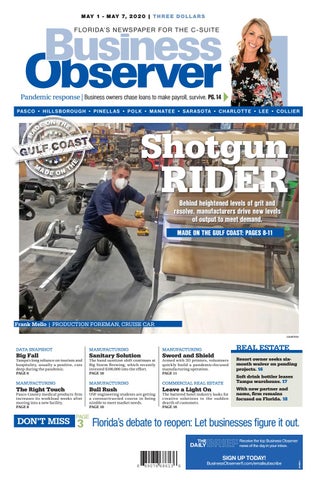
KettleShotgun Mettle RIDER Behind heightened levels of grit and resolve, manufacturers drive new levels of output to meet demand. MADE ON THE GULF COAST: PAGES 8-11
Frank Mello | PRODUCTION FOREMAN, CRUISE CAR COURTESY
DATA SNAPSHOT
MANUFACTURING
MANUFACTURING
Big Fall
Sanitary Solution
Sword and Shield
Tampa’s long reliance on tourism and hospitality, usually a positive, cuts deep during the pandemic. PAGE 6
The hand sanitizer shift continues at Big Storm Brewing, which recently invested $100,000 into the effort. PAGE 10
REAL ESTATE
Armed with 3D printers, volunteers quickly build a pandemic-focused manufacturing operation. PAGE 11
MANUFACTURING
MANUFACTURING
COMMERCIAL REAL ESTATE
The Right Touch
Bull Rush
Leave a Light On
Pasco County medical products firm increases its workload weeks after moving into a new facility. PAGE 8
The battered hotel industry looks for creative solutions to t he sudden dearth of customers. PAGE 16
Soft drink bottler leases Tampa warehouse. 17 With new partner and name, firm remains focused on Florida. 18
PAGE
3 Florida’s debate to reopen: Let businesses figure it out. Receive the top Business Observer news of the day in your inbox.
SIGN UP TODAY!
BusinessObserverfl.com/emailsubscribe
334300-1
DON’T MISS
USF engineering students are getting a coronavirus-led course in being nimble to meet market needs. PAGE 10
Resort owner seeks sixmonth waiver on pending projects. 16
2
BUSINESS OBSERVER | MAY 1, 2020 – MAY 7, 2020
BusinessObserverFL.com
Vol. XXIV, No. 16
A Division of The ObÂservÂer Media Group
BusinessObserverFL.com Founded in 1997, the Business Observer is Southwest and Central Florida’s newspaper for business leaders. With offices in Hillsborough, Pinellas, Polk, Pasco, Manatee, Sarasota, Charlotte, Lee and Collier counties, the Business Observer is the only weekly business newspaper that provides business leaders with a regional perspective. The Business Observer’s mission is to deliver relevant news and information on Southwest and Central Florida’s leading and growing companies, up-and-coming entrepreneurs and economic, industry and government trends affecting business. The Business Observer is also the leading publisher of public notices on the Gulf Coast of Florida.
Editor and Publisher / Matt Walsh, mwalsh@BusinessObserverFL.com Executive Editor / Kat Hughes khughes@BusinessObserverFL.com Managing Editor / Mark Gordon mgordon@BusinessObserverFL.com Commercial Real Estate Editor / Kevin McQuaid kmcquaid@BusinessObserverFL.com Tampa Bay Editor / Brian Hartz bhartz@BusinessObserverFL.com Sarasota-Manatee Editor/ Grier Ferguson gferguson@BusinessObserverFL.com
 Â?  Â? Â? Â? Â? Â?  Â? € ‚ Â? ƒ ƒ  Â?  „ Â… Â? †  Â? ‡ˆ ‚ Â? Â? ‰ Š Â? Â? Â? ƒ Â? Š ‹Â? ƒ ÂŒ
Editorial Design /Jess Eng Contributors / Steven Benna, Beth Luberecki, John Haughey
Associate Publisher / Kathleen O’Hara kohara@YourObserver.com Associate Publisher / Diane Schaefer dschaefer@BusinessObserverFL.com Director of Legal Advertising / Kristen Boothroyd kboothroyd@BusinessObserverFL.com Director of Creative Services / Caleb Stanton, cstanton@YourObserver.com Director of Information Technology / Adam Quinlin, aquinlin@YourObserver.com Chief Financial Officer / Laura Keisacker lkeisacker@YourObserver.com Director of Circulation / Anne Shumate subscriptions@ BusinessObserverFL.com
HOW TO REACH US Hillsborough County
200 S. Hoover Blvd., Suite #135 Tampa, FL 33609 Phone: 941-906-9386 (Legal Notices) Fax: 941-954-8530
Lee County
334126-1
Orange County
661 Garden Commerce Pkwy, Suite 180 Winter Garden, FL 34787 Phone: 941-906-9386 (Legal Notices) Fax: 941-954-8530
Charlotte County
Address: 949 Tamiami Trail, Suite 202 Port Charlotte, FL 33953 Phone: 941-906-9386 (Legal Notices) Fax: 941-954-8530
SELL INVESTMENT PROPERTY
TAX FREE
5570 Gulf of Mexico Dr., Longboat Key, FL 34228 Phone: 941-362-4848 Phone: 941-906-9386 (Legal Notices) Fax: 941-954-8530
Sarasota County
18070 S. Tamiami Trail, Suite 11 Fort Myers, FL 33908 Phone: 239-703-7802; Fax: 941-954-8530
Manatee County
Pinellas County
14004 Roosevelt Blvd. Clearwater, FL 33762 Phone: 941-906-9386 (Legal Notices) Fax: 727-447-3944
Sarasota, FL 34230 1970 Main St., Suite 400, Sarasota, FL 34236 Phone: 941-362-4848 Phone: 941-906-9386 (Legal Notices) Fax: 941-954-8530
Collier County
The French Quarter, 501 Goodlette Road N., #D-100 Naples, FL 34102 Phone: 941-906-9386 (Legal Notices) Fax: 941-954-8530
Pasco County
3030 Starkey Blvd. New Port Richey, FL 34655 Phone: 941-906-9386 (Legal Notices) Fax: 941-954-8530
Polk County
1102 S. Florida Ave. Lakeland, FL 33803 Phone: 941-906-9386 (Legal Notices) Fax: 941-954-8530 To send Legal Notices, email to: legal@BusinessObserverFL.com. Name the county of interest in the subject line and attach notice. Deadline for legal notices is noon Wednesday. For Display Advertising, call (941) 362-4848. Deadline for display advertising space is noon Friday.
Learn about 1031 exchanges
VISIT OUR WEBSITE > www.US1031.com
HOW TO SUBSCRIBE Subscription Price
One-Year Periodical Rate........................................................................................ $75 One-Year First-Class Mail......................................................................................$107
Jefferson F. Riddell
President Phone: (941) 366 -1300 Fax: (941) 366 - 6973 E-mail: jriddell@rlglawfirm.com
Two-Year Periodical Rate.......................................................................................$127 Two-Year First-Class Mail.......................................................................................$180 Three-Year Periodical Rate....................................................................................$185 Three-Year First-Class Mail...................................................................................$239
Board Certified Real Estate Attorney has been facilitating 1031 exchanges for over 30 years. Learn how a 1031 exchange may help you defer taxes, save money and maximize your investment dollars. Visit our website or call for a FREE consultation.
Single copy price: $3 Group rates for five or more corporate subscriptions are available. To subscribe online: www.businessobserverfl.com If you have a question about your subscription or wish to suspend your subscription temporarily, call Anne Shumate, (877) 231-8834 or contact her by email: subscriptions@BusinessObserverFL.com
POSTAL INFORMATION The Business Observer (ISSN#2325-8195) is published weekly on Fridays by the Gulf Coast Review Inc., 5570 Gulf of Mexico Dr., Longboat Key, FL 34228; Periodicals Postage Paid at Sarasota, FL, and at additional mailing offices. The Business Observer is circulated in Charlotte, Collier, Hillsborough, Lee, Manatee, Pasco, Pinellas, Polk and Sarasota counties.
21 CENTURY REAL ESTATE INVESTING ST
U.S. 1031
For information on reprints, visit BusinessObserverFL.com
EXCHANGE SERVICES, INC.
available on Amazon 3400 South Tamiami Trail, Sarasota, Florida 34239 334286-1
POSTMASTER: Please send changes of address to the Business Observer, P.O. Box 15456 North Hollywood, CA 91615-9166.
“The road is cleared,� said Galt. “We are going back to the world.� He raised his hand and over the desolate earth he traced in space the sign of the dollar. Ayn Rand, Atlas Shrugged
MAY 1, 2020 – MAY 7, 2020 | BUSINESS OBSERVER
review and comment BY MATT WALSH | EDITOR AND PUBLISHER
‘You’re not the boss of me’
BusinessObserverFL.com
3
SOME THINGS DON’T CHANGE.
No one really knows what is the best path forward — not President Trump, not Gov. DeSantis. But if businesses are given the option to reopen, they’ll figure out what’s best.
EXPERTS ARE CONFUSED The data is an omelet of confusion. It’s all over the spectrum. For instance, we all watch the COVID-19 incident and death counts. We know that as of Tuesday, Florida had 32,846 cases and 1,171 deaths. Or do we?
A Sarasota physician told us just about anyone who dies with preexisting respiratory issues is automatically being classified as a COVID-19 victim. In a 4,793-word report circulating widely online, entitled, “The Truth (and Lies) about Coronavirus,” Tuscaloosa, Ala., family practice doctor David Williams notes: “On April 2, the National Vital Statistics System, which is part of the CDC, provided new guidance regarding the issuing of death certificates. COVID-19 was to be listed if it was assumed to cause or contribute to a death. For example, if someone dies from pneumonia, respiratory distress or COPD and has exhibited coronavirus symptoms, his certificate will list COVID-19 as a presumed contributing factor. Since shortness of breath, fever, and/or cough will be exhibited in all respiratory illnesses, every such death could potentially be recorded as a COVID-19 fatality. “This certainly appears to be happening across the board. We have never seen any disease handled in this way.” We asked Dr. John Steele, president of the Sarasota-based Intercoastal Medical Group, why America’s doctors haven’t been out front to help allay people’s fears. “All the experts appear to be confused,” he said. Even in his own group of more than 100 physicians, his colleagues disagree on whether to reopen, restart elective surgery or end the lockdowns. And these are the experts. In general, he told us, “People are not rational when it comes to their health.” NO ONE HAS THE ANSWER How can you believe anything you hear and read? You have the official talking points blathered out of Trump’s daily briefing, with Dr. Anthony Fauci describing his depressing Armageddon version of life, and CDC predictions of a second wave in the fall. And we’re supposed to take that as gospel. You have media outlets, such as Axios, an online “news” source (note the quotes), blasting this on its site last Sunday: “The coronavirus crisis is way worse than feared,” followed by more than a dozen bullet points of predictions of death, dread and destruction. And then, you read Avik Roy, a respected health care policy adviser, say in the Wall Street Journal: “States and localities should work as quickly as possible to reopen pre-K and K-12 schools. Children have a very low risk of falling seriously ill due to COVID-19, and the majority can and should return to school this academic year.” Williams, the Alabama physician who borders on being furious about
See COMMENT page 18
As your business adapts to the many changes and challenges caused by the pandemic, it seems there is no more “business as usual”. However, some things do remain the same. During these uncertain times, we are here for you and ready to assist with what your business still needs: • 50% FEMA Rule Appraisals • Insurance Appraisals • Reserve Studies and Life-Cycle Analysis • Cost Segregation Analysis and Pre-Construction Consulting
Patricia Staebler, SRA, RS
State-Certified General Appraiser RZ 2890 CAI Reserve Specialist RS 350
941.705.0123
www.StaeblerAppraisal.com Member of:
334163-1
That simple declarative statement in the headline has long been a part of family lore. The story is told that terse, six-word statement was the response from a precocious 2-year-old whose mother issued a motherly command to the young child. The young girl’s response clearly indicated that, even then, at 2, she had a mind of her own and that she was in charge of herself. Our elected officials should take note at this moment in time. That story comes to mind as all of the U.S., Florida and our local regions and cities begin to enter the next phase of COVID-19. From President Donald Trump, down to Gov. Ron DeSantis, down to all of the mayors, city managers and county commissioners, we’re all watching for the big pronouncements in the next few days that life can resume. Of course, that is not what is going to happen. As of this writing, we were told earlier in the morning the Manatee County Commission was to vote on a June 1 reopening of the county. All through the weekend and much of Tuesday, DeSantis sent thick smoke signals that he wasn’t going to do anything outside the yellow caution lines. “Baby steps.” “Methodical, slow and data-driven.” Uh-huh. But what data? Whose data? New York’s? Sweden’s? Sarasota County’s? Manatee County’s? Wuhan, China’s? Italy’s? All of Florida’s? DeSantis has sent other signals that he recognizes not all of Florida should be categorized as one or lumped in with Dade and Broward counties. Florida has 67 counties, and each one is different in so many ways. Likewise, each city, each neighborhood, each person is different — all 22 million Floridians, each of whom has a brain that makes thousands of decisions a day geared toward satisfying his or her level of happiness or needs to survive. As the famed Austrian economist Ludwig von Mises noted in his seminal book, “Human Action,” trying to answer “the question of whether the interests of society should be subordinated to those of the individual or whether the interests of the individual are to be subordinated to society is fruitless. Action is always action of individual men.” And yet one man has made himself the boss of you, governing your daily life and decisions on the basis of “data.”
4 topstories from BusinessObserverFL.com
BUSINESS OBSERVER | MAY 1, 2020 – MAY 7, 2020
BusinessObserverFL.com
CHARLOTTE-LEE-COLLIER
Hertz lays off 25% of payroll
Rental car giant Hertz Global Holdings continues to struggle to gain traction amid the travel business shutdown caused by the coronavirus pandemic. The latest news: It laid off some 10,000 employees — more than 25% of its worldwide workforce of 38,000 people. The terminations were effective April 14 for non-union employees and April 21 for union employees, according to a public company filing. The company, which posted $9.8 billion in revenue in 2019, adds that it expects to incur an aggregate of about $30 million in costs relating to the layoffs.
Airports land federal funds A pair of Southwest Florida airports are poised to pick up more than $60 million in emergency assistance from the Federal Aviation Administration, funds geared to make up for lost revenue during the COVID-19 pandemic. Southwest Florida International Airport in Fort Myers will receive $36.6 million, while Punta Gorda Airport, in Charlotte County, will receive $23.8 million. In total, the FAA plans to disburse nearly $900 million to 129 airports
quote of theweek It’s hair on fire time for the industry. For many, this is about as bad as it can get. It’s certainly worse than what happened in the aftermath of 9/11.” Nick Plasencia | The Plasencia Group, hotel consultants SEE PAGE 16
statewide struggling to pay salaries and bills with flight traffic down at least 75%. Funds are from the coronavirus relief bill. Other airports in the region to receive money include Tampa International Airport, with $81 million, Sarasota Bradenton International Airport with $23.29 million and St. Pete Clearwater International Airport with $8.7 million. SARASOTA-MANATEE
Manufacturer closes Florida facility Window and door manufacturer PGT Innovations Inc. will consolidate its Florida manufacturing facilities in a move to optimize operations and reduce fixed costs. According to a news release, the Venice-based company expects to cease production at its Orlando facility in June, where its WinDoor and Eze-Breeze products are assembled. It plans to relocate the manufacturing of those products to the company’s Venice and Tampa plants, respectively. Firm officials anticipate the consolidation will reduce the firm’s annualized operating expense by $3.5 to $3.8 million.
TAMPA BAY
Private equity firm buys company Knight Enterprises, a Clearwater firm that installs and services telecommunications network technology, has been acquired by an affiliate of Mill Point Capital, a New Yorkbased private equity firm. According to a news release, Knight Enterprises CEO Jason Welz will continue to lead the company, which was founded in 1982 and specializes in underground and aerial fiber and coaxial cable construction and maintenance. Other terms of the deal were not disclosed. Mill Point focuses its investment strategy on middle-market firms in communications and business services.
Incubator launches relief program Tampa Bay Wave, a business incubator and coworking space in downtown Tampa that supports 60 tech startups, has launched a financial relief program for companies affected by the COVID-19 economic crisis. According to a news release, the Rising Tide Relief Fund will provide short-term, nearly zero-interest micro loans to area startups that need cash quickly to stay in business and avoid layoffs. The loans will be processed quickly, with minimal paperwork required.
BY THE NUMBERS 218,000
Projected job loss in the Tampa Bay region from the pandemic, a 10.6% drop in total employment PAGE 6
$23,000
Top price for the low-speed, light-utility medical carts Sarasota-based Cruise Car is manufacturing PAGE 9
5,000
Face shields for Tampa General Hospital and USF Health made and donated by the university’s school of engineering PAGE 10
1,000
Gallons a day of hand sanitizer manufactured by Clearwater-based Big Storm Brewing PAGE 10
87.5%
Percentage of loans from the first round of the Payment Protection Program that were under $350,000 PAGE 14
Jeff Button | 941-313-1193
Jeff@SarasotaWarehouses.com | www.SarasotaWarehouses.com D AN E E AS L LE R SA R O FO F
E AL S R FO
INDUSTRIAL & OFFICE PROPERTIES FOR SALE OR LEASE KLEIBER BUTTON INC. Lic Real Estate Broker
8072 Fruitville Rd
5.23 Acres at Signalized Intersection of Fruitville Rd & Sarasota Center Blvd In the Path of Progress!
KLEIBER BUTTON MANAGEMENT INC. Lic Real Estate Broker
10,000 SF FOR SALE 5,350 SF FOR LEASE
FOR SALE $1,140,000
CALL FOR PRICING
SE EA L R FO
SE EA L R FO
334288-1
LE SA R FO
2169 10th Street
10,000 SF, Two-Unit building with 3 Phase & Fenced Storage, 1 Unit Leased, 1 Unit For Lease, DTE Zoning
3277 Fruitville Rd Unit D-2
Nicely Finished 1,645 SF Professional Office with 5 Private Offices, Conference Room, Kitchenette, Copier Room, 2 Restrooms plus Attic Storage.
FOR SALE $364,500
7614 15th Street East
6503 19th St East, Bldg 1
5,011 SF Office/Whse with Open Showroom Multiple Private Offices, A/C Warehouse and two overhead doors
27,850 SF Office/Whse & Fenced Yard Plenty of Nicely Finished Office 3 Phase, 6 Drive-In Bays
FOR LEASE CALL FOR PRICING
FOR LEASE CALL FOR PRICING
Richardson Kleiber Walter, a family-owned business celebrating 30+ Years of Excellence in Commercial and Industrial Real Estate
MAY 1, 2020 – MAY 7, 2020 | BUSINESS OBSERVER
BusinessObserverFL.com
CoffeeTalk
5
FOR SALE | 2.6 ACRES FORT MYERS BEACH BOAT YARD
Make lemonade
! D L O S
ailable perties av o r p s s e c ulf Ac Related G e in r a M r othe
PRICE: $5,250,000 • SALE LAND, BUSINESS & BUILDINGS • INCLUDES HOME OF THE TON TRAVEL LIFT • POTENTIAL FOR150RESTAURANT/TIKI BAR •
COURTESY PHOTO
ALEXIS BEALL TAYLOR has created Key Lime Kids, a new cooking video series on YouTube, with her children, MILES TAYLOR, 7; DYLAN TAYLOR, 10; and LUCY TAYLOR, 12.
HURRY, PROPERTIES LIKE THIS RARELY COME AVAILABLE IN OUR LIFETIME!!
the photographer and videographer. The idea for the Bealls product line came soon after the blog. “It seemed like a great symbiotic relationship,” Taylor says. “We have these great recipes and ideas and knowledge and these great tools to go along with the recipe content. One supports the other.” Taylor has done cooking demonstrations at Bealls stores and uses social media to promote Key Lime Lexi. She and her family live in Utah, but she’s in Florida regularly for store visits and meetings with Bealls employees about the products. There are plans to expand the product line, adding grilling items in the summer and holiday-related items later in the year. Taylor is involved in developing every product, testing them and tweaking them to her specifications. With the vegetable peeler, for instance, she said, “This is nice, but let’s make it a little longer.” To tie into Bealls and the Florida lifestyle further, Key Lime Lexi products are coastal blue, and the blog focuses on Florida-inspired ingredients, from mangoes to seafood to citrus. “I like to add a little twist or ingredient,” she says. “There are a billion recipes for chocolate chip cookies. Why should you make my recipe? I want to set mine apart with something unexpected or a flavor you might not have thought of.”
ROBERT W. BEASLEY BROKER/OWNER
239.994.5049
RWBREALESTATE@AOL.COM JASON PADILLA BROKER-ASSOCIATE
239.233.0379
1711 MAIN ST., FORT MYERS BEACH, FL 33931 | www.RWBREALESTATE.COM
Court Appointed Receiver, Property Management and Specialty Oversight
Kenneth P. Saundry, Jr. brings 39+ years of business and real estate management experience to each Court Appointed Receiver assignment.
See COFFEE TALK page 6
Estates • Divorces or Family Disputes Guardianships • Bankruptcy Property Oversight and Supervision Foreclosure, or ‘Workouts’ Litigation Support
Gift shopping made easy during the quarantine…
Mother’s Day
Excellent Experience working with Lenders, Attorneys and Court Supervised Assignments.
GIFT IDEAS
St. Petersburg Asian Home Gifts offers unique and beautiful American and Internationally-inspired styles and décor.
RealEstateAdvisoryServices.co 334290-1
www.AsianHomeProduct.com
333978-1
Shop 24 Hours a Day • Free Shipping
239.348.1114 215 Caribbean Road, Naples, FL 34108-3408
333217-1
People have been spending more time at home during the coronavirus crisis, and for some, that has meant a lot more cooking and baking. Alexis Beall Taylor is seizing on the trend with a new video series on YouTube she’s making with her three children called Key Lime Kids. The videos teach children cooking skills and how to use those skills in a recipe. Taylor, 43, is also chef and founder of the food blog Key Lime Lexi. The blog inspired a new line of kitchen and cookware items that launched at Bealls stores in late November 2019. Products include utensils, cookware, bakeware, gadgets and kitchen accessories. The items are available at all Bealls stores and on the Bealls website. Taylor is no stranger to Bradentonbased Bealls, which posted $1.38 billion in revenue in 2019. Her greatgrandfather founded Bealls in 1915, and her brother is Bealls Inc. CEO Matt Beall. The idea for Key Lime Lexi came from a Beall family gathering when someone suggested Taylor, who previously worked in a bakery and as a personal chef, work on a food blog for Bealls. Taylor, whose background also includes starting a chocolate business, thought, “Oh my gosh, this is something I can do and still be involved in the family business and follow my passion.” Taylor spent months developing the website and recipes, preparing Key Lime Lexi for its launch about a year and a half ago. Her husband, Justin, is
OVER 40+ YEARS • INEASYBUSINESS WATER ACCESS • 5 MINDEEP BOAT IDLE TO GULF • 2.6+- ACRES ZONED: IL, CM, IM •
6
BUSINESS OBSERVER | MAY 1, 2020 – MAY 7, 2020
BusinessObserverFL.com
CoffeeTalk
datasnapshot
FROM PAGE 5
Chew the fat Although some restaurants have successfully shifted to takeout, curbside pickup and delivery service to survive the COVID-19 crisis, the transition has been a struggle for many fine-dining eateries, where ambience and personalized attention help define the experience. A few have even had to shut their doors. Not so for Meat Market, the steakhouse chain co-founded by Sean Brasel, who also serves as executive chef. Brasel, along with business partner David Tornek, launched the first Meat Market in Miami in 2008; the concept has since expanded to Tampa, Palm Beach and San Juan, Puerto Rico. Brasel, who now resides in Tampa after relocating from Miami, tells Coffee Talk that reinvention — not merely adaptation — has been key to Meat Market’s survival. “We basically redid an entire takeout menu,” he says. “And every two weeks we change it to freshen it up.” That gives diners a reason to come back, as does the restaurant’s to-go cocktail program, which provides Meat Market’s signature drinks in plastic jugs that can be taken home. Another success was packaging up full dinners for two, four or six people, Brasel says. That move was a hit over Easter weekend. “We’re always innovating because the environment has changed so much for us,” Brasel says. Brasel’s done all of this without making significant price cuts. Instead, he’s adding new items to the
MARK WEMPLE
Tourism and hospitality has ground to a halt on Beach Drive in downtown St. Petersburg.
Pain in the bay LILA PHOTOGRAPHY
Meat Market co-founder and executive chef SEAN BRASEL. takeout menu — such as sandwiches and gnocchi — that generally cost less and are more suitable for pickup and delivery. “Obviously, when you come into my restaurant, you come for an experience, and that might include a $100 steak,” he says. “But when you’re doing takeout, a $100 steak just doesn’t translate the same.” Brasel has furloughed some staff members, but he’s paying them more than they would receive from unemployment insurance because he doesn’t want them looking for other jobs. He says it would be too expensive to train new workers once Meat Market is able to again operate at full strength. “It could cost $100,000 in training to reopen a restaurant,” he says.
The disastrous financial effects of the COVID-19 crisis are being felt around the globe. But new research from a local agency reveals the economies of Florida and the Tampa Bay region, in particular, will be among the hardest hit. In an April 21 report, the Tampa Bay Regional Planning Council says Florida’s heavy reliance on tourism and hospitality, as well as its dependence on sales tax, will exacerbate the financial impact of the coronavirus pandemic. Economic losses related to COVID-19 deaths, a statewide drop in consumer spending and a national recession are the three main factors that will negatively affect Florida’s economy during and after the pandemic, the council states. A decline in consumer spending will be acutely felt in Tampa Bay,
ROUGH FORECAST
The Tampa Bay Regional Planning Council says the region is for a tough ride. Projected impacts of the pandemic include: Jobs lost: 218,000 GDP decline: 11.7% Loss of personal income: $19.9 billion the report adds, because tourism and hospitality are such powerful economic drivers. Tampa Bay’s total employment base is 2 million, so a loss of 218,000 jobs would be a 10.6% decline, the council reports. Prior to the pandemic, the region’s 2020 GDP was forecast to be $179 billion. An 11.7% drop would represent $20.9 billion in lost GDP. Likewise, before the COVID-19 crisis, the region’s total personal income for 2020 was predicted to be $187 billion. A loss of $19.9 billion equates to a 10.6% drop.
Beautiful
Keep Lee County
Litter is changing its look. Whether it’s the masks and gloves we wear to the grocery store, the hand sanitizer bottle we keep handy, or the disinfecting wipes we use incessantly, these items belong in the trash and not on the ground. You can make a difference! Our Supporters and Volunteers make it possible for us to improve and protect our fragile environment.
For additional information about our organization, to make a donation or to volunteer your time, please contact us.
(239) 334-3488 www.klcb.org
334079-1
The mission of Keep Lee County Beautiful is to inspire, educate, and engage the Lee County community in improving, beautifying, and protecting our environment.
MAY 1, 2020 – MAY 7, 2020 | BUSINESS OBSERVER
bythenumbers | pandemic response |
Anxieties Await A
survey of 562 executives in the region, focusing on Sarasota-Bradenton and Lakeland, reveals, for the most part, these areas mirror the national conversation in two ways: economic carnage and confusing and conflicting views on when to end the shutdown. On the economy, although 38.55% of respondents say they retained all their employees, at least 45%, the survey shows, have done some combination of furloughs, layoffs, pay reductions, hour reductions and benefit cuts. In regard to business results, nearly 6 out of 10 respondents, 58.21%, say monthly sales in March and April declined at least 50%. Another 17.44% say the decline was 21-50%. With sales down and payrolls slashed, a majority of businesses have applied for multiple types of financial relief, the survey shows. That includes 69.38% that applied for a federal Paycheck Protection Program loan and 14.71% that applied for state funds. A few respondents, in the comment section, mentioned the chaotic start to the PPP and other programs, including the muchmaligned Florida unemployment website and program. “Despite having applied for unemployment since March 20, not one employee has received unemployment benefits,” wrote one respondent, through the Greater Sarasota Chamber of Commerce. “This is heartbreaking!” Also, much like the conversations going on all across Florida, and the world, opinions on how to get out of the pandemic-led shutdown vary widely. On the question, for example, “When should your business and your industry sector be allowed to reopen?” 22.98% responded now — the highest among five choices, outside of “other.” Just behind “now,” in a stark opposition at 20.11%, is “when new reported cases of COVID-19 in the region have declined seven consecutive days.” The online survey is co-spon-
UP NEXT? Business owners, even in differing on when to open the government, share many anxieties about what comes next. Several worry about the potential heavy hand of government, such as this comment to the question, “When stay-at-home orders are lifted, and you are able to reopen, rank in order of priority what will be your most immediate concerns.” “The amount of governmental red tape that it will take to effectively run my business going forward. More government involvement rarely equates to greater business success in a free enterprise system except possibly in regulated industries.”
sored by the Business Observer and connected to an ad-hoc group, the Sarasota/Manatee Project Resurrection Task Force.(See sidebar for task force members.) On April 22, the task force sent a letter to Gov. Ron DeSantis; State Sen. President Bill Galvano, R-Bradenton; and State House Speaker Jose Oliva, R-Miami Lakes, outlining recommendations for ending Florida’s safer-at-home order and allowing businesses in the region to reopen by May 11. The survey, meanwhile, was sent to business owners, executives and entrepreneurs April 20-27 through emails and email blasts. Area organizations that sent the survey to its members and reported findings to the Observer Media Group include the Greater Sarasota Chamber of Commerce, the Economic Development Corp. of Sarasota County, the Manatee Chamber of Commerce, the Bradenton Area Economic Development Corp., the Lakewood Ranch Business Alliance, the St. Arma nds Circle A ssociat ion, the Longboat Key Chamber of Commerce and the Lakeland Area Chamber of Commerce. Survey questions about when and how to reopen businesses brought out the most comments, with the majority leaning toward caution — despite the slight, and more silent, majority who answered to open up now. Comments on when to open things up include the following: n From a Longboat Key chamber respondent: “I don’t have a crystal ball. We aren’t going to risk giving or receiving the virus.” n From a Business Observer respondent: “June/July maybe. Base this on data, not politics. A seven-day decline means nothing [without] infrastructure in place. Florida is about to get worse from lack of testing, no tracking of people exposed to this. Ninety-nine percent of people in Manatee County have not been tested, and probably 15% of people are carrying this now based on data from other states. Wake up Florida, please.” n From a Sarasota chamber respondent: “We must be governed by the science, meeting the testing standards and the adv ice of the medical professionals. Certainly not by Trump’s gut feeling.” n From a Longboat Key chamber respondent: “Guidelines require that there be 14 consecutive days of decreasing infections and then only by phasing and maintaining gatherings of no more than 10 and social distancing.” n From a Lakewood Ranch Business Alliance respondent: “Probably not until July. … We expect to continue canceling client trips and hopefully rescheduling. But no income ($0) expected until fall.” n From a Sarasota chamber respondent: “Compl icated question. Need more requirements and protocols in place to ensure responsible, pragmatic, safety precautions.”
7
BusinessObserverFL.com
BY MARK GORDON | MANAGING EDITOR
PROJECT RESURRECTION SURVEY How likely is it your business will survive at current sales and expense levels without SBA relief funds or a loan through May 31?
Which would you prefer for the reopening of the economy?
12% Decision left to each business owner
17.91%
18.62%
Not likely (< 20% probability)
20.07%
47.84%
Decision left to city and county governments
Highly likely (80%+ probability)
33.52%
Governor lifts orders for all of Florida
50%
Somewhat likely (50% probability)
Governor should lift orders county by county based on COVID-19 data Answered: 508
Answered: 510
Since COVID-19 and/or the stay-at-home orders, have you:
STATUS UPDATE On the Business Observer’s COVID-19 survey, sent out April 20-27, one of the questions was ,“What is the status of your business now?” Responses include:
2.44% Reduced benefits
15.26% Other
38.55%
Retained all employees
7.93%
Reduced hours
9%
Reduced pay
10.38%
16.33%
Laid off employees
Furloughed employees
Answered: 655
By what percent have your monthly sales and expenses declined in March and April? SALES 15.82% 0-10%
8.92% 58.21% > 50%
11-20%
17.44% 21-50%
6.62% >50%
21-50%
55.02%
Answered: 272
n From a Bradenton Area Economic Development Corp. respondent: “We had a two-week lull where revenue was down 43%, and we were operating with 50% of our warehouse crew [but still paying them in full]. Since the stimulus package hit, we are busy once again.”
Has your business applied for relief funds and loans? 3.57%
Conventional bank loan
YES
n Dave Bullock, interim CEO of the Economic Development Corp. of Sarasota County
14.71%
State relief funding
n Jaime DiDomenico, owner and president of Sarasota-based Cool Today
34.59%
n Sharon Hillstrom, president and CEO of the Bradenton Area Economic Development Corp.
n Shaun Merriman, executive vice president at CenterState Bank
15.06%
11-20%
Members of the Sarasota/ Manatee Project Resurrection Task Force include:
n From a Business Observer respondent: “Very slow. Usually ship 150 orders per day. We are shipping average of 60 orders per day. Business cut in half.”
SBA loan
0-10%
n Joel Schleicher, executive chairman of Focal Point Data Risk; founder, chairman and CEO of Presido Inc.; and president and COO of Nextel Communications Inc. n Dr. John Steele, president of Sarasota-based Intercoastal Medical Group n Matt Walsh, owner and CEO of Observer Media Group, which publishes the Business Observer
69.38%
Federal PPP funding
n A.G. Lafley, founding CEO of The Bay Park Conservancy and former chairman and CEO of Procter & Gamble
EXPENSES
22.83%
TASK FORCE
n From a Business Observer respondent: “We are not at all sure we will be able to get on our feet when allowed to reopen. Very precariously perched. Zero success with any [government] assistance funding. Staff are independent contractors — no unemployment insurance processed and no help of any kind. We are dying a slow and painful death after 30 stellar years in business on Siesta Key.”
28.03%
Federal PPP funding
NO
65.20%
Conventional bank loan
47.11% SBA loan
68.98%
State relief funding
Answered: 503
8
BUSINESS OBSERVER | MAY 1, 2020 – MAY 7, 2020
BusinessObserverFL.com
infocus |
BY BRIAN HARTZ | TAMPA BAY EDITOR
TouchPoint Medical opened for business at its brand new, $30 million headquarters in Odessa on Feb. 20.
Manufacturer of in-demand medical gear responds swiftly — with smarts TouchPoint Medical also worked its contacts to maintain its supply chain.
T
ouchPoint Medica l, a maker of high-tech carts and medicine-dispensing devices for use in hospitals, and a subsidiary of Concordville, Pa.-based TouchPoint Inc., opened its new headquarters in Odessa, a bedroom community in Pasco County, on Feb. 20. Just a few weeks later, the COVID-19 crisis hit, roiling the global economy and sending manufacturers like TouchPoint into a frenzy as they tried to keep up with off-the-charts demand. “Some of our largest customers are in New York, right in the thick of the battle against COVID-19,” says Jessi Cravens, TouchPoint’s operations and supply chain manager. “In the beginning it was a rat race to bring four months’ worth of demand into three weeks of production. But the team reacted quickly and stayed positive.” Cravens, who served as project manager during the construction of TouchPoint’s $30 million, 142,000-square-foot facility, says the firm, which employs 225 people, didn’t hesitate when it came time to figure out how to cope with the impact of the coronavirus pandemic on its production capacity. “We went to mandatory overtime right away, and mandatory Saturdays,” she says. Thanks to that decision, made March 13, “we have reached a level of sustainability.” It helped that TouchPoint transitioned to its new home about a month ahead of schedule. “We moved in 24 days early,” Cravens says. “It was perfect timing and so beneficial to have our entire operations team under one roof because [the COVID-19 crisis] has been such a fluid situation.” Another key strategic move was the immediate addition of
COURTESY PHOTOS
TouchPoint Medical workflow carts ready to be shipped to hospitals and other health care providers around the country. The carts are in high demand amid the COVID-19 crisis. a second shift and the hiring of 24 employees to help fill the extra hours. Not only did that help TouchPoint meet the rapidly increasing demand for its products, but it also provided flexibility for employees with young children whose home lives were suddenly thrown into disarray by the closure of schools and day care centers. “So now our building is open from 5 a.m. to 11 p.m.,” Cravens says. “Employees who need to switch shifts with a spouse, so they can cover child care during the day have flexibility in their hours. We’ve been very fortunate that most of our employees have been able to continue working their normal shifts, including overtime.
Most of the people who have been impacted by child care concerns are ones who are able to do their work remotely.” Of TouchPoint’s 225 employees, 138 are considered essential for production and work in the building. The company has increased the frequency with which its outsourced janitorial service cleans and sanitizes the facility, while common areas like the cafe and meeting rooms are receiving extra disinfectant work. Also, all onsite employees have been given hand sanitizer “to have on their person at all times,” Cravens says. “We’re taking as many proactive measures as we can to keep employees safe and to protect the families that they’re
going home to.” TouchPoint has also had to go to bat for its supply chain. “We’ve had three suppliers who’ve been shut down by their local governments,” Cravens says. Two of t he suppliers a re based in the U.S., while the other is headquartered in Mexico. Cravens says TouchPoint’s lawyers helped make sure the company’s inventory didn’t fall short at such a crucial time. “Our legal team worked very closely with those suppliers, and we’ve been able to get all three of them back up and running,” Cravens says. “We had to plead with the people who make decisions in their area. We had to make sure they understood the impact on our business, our impact on hospitals, and that we are right in the middle of things.” Businesses can learn another critical crisis lesson from TouchPoint: Communicate early and often. Cravens says she and her team were quick when it came to informing suppliers of the role they had to play. “As soon as we realized that some areas of the country and the world were shutting down, we immediately started drafting supply chain letters to go out to our suppliers,” she says, “to let them know TouchPoint Medical is an essential business in the war against the virus and, therefore, their essential business will keep us up and running.” Another innovation? Expedited order fulfillment, thanks to rapid-response configurations for in-demand workflow carts. “It might not be exactly what customers would order if they had the time to shop and build from scratch,” Cravens says, “but it is something we can get out there in a matter of days and they can start using immediately.”
We’re taking as many proactive measures as we can to keep employees safe and to protect the families that they’re going home to.” Jessi Cravens | Touchpoint Medical
MAY 1, 2020 – MAY 7, 2020 | BUSINESS OBSERVER
infocus |
BusinessObserverFL.com
9
BY GRIER FERGUSON | SARASOTA-MANATEE EDITOR
Competition, motivation on the rise when firm breaks staff into teams Sarasota-based Cruise Car is seeing more demand lately — particularly for medical carts.
D
uring t he pa ndemic, many companies are putting social distancing measures in place, including encouraging employees to work from home and separating employees in manufacturing facilities who usually work side-by-side. Sarasota-based Cruise Car is doing both. Its office employees are working from home whenever possible, and warehouse/manufacturing employees are working 6 feet apart and divided into two teams. The light utility, low-speed vehicle manufacturer, which posted $10 million in revenue in 2018, hasn’t seen a significant decrease in orders and instead has seen an increase in demand lately for its medical carts. Cruise Car offers four models of ambulatory vehicles that hold stretchers and can be customized with features including lights, sirens, PA systems and storage cabinets. “Right about the time the news of the pandemic started happening back in February, we started seeing a lot more requests for these types of vehicles,” Cruise Car President Nathan Kalin says. VA facilities, medical centers, pr isons, u n iversit ies, mu n ic ipa l it ie s a nd ot her gover n ment ent it ies place orders for the medical vehicles, priced between $12,000 and $23,000. The company is making a couple dozen medical carts a month now that are being shipped nationally and internationally. Amid changes to pandemic working procedures, the company is seeing an unexpected impact — there’s friendly com-
OPPORTUNITY TO IMPROVE During the coronavirus crisis, Cruise Car has implemented an enrichment program for employees. Because people tend to have more time at home these days, the program gives employees an opportunity to improve themselves personally and professionally through a variety of resources. The company is providing courses in Excel, self-help books and audiobooks. It’s also organizing times for employees to discuss what they learned. Cruise Car President Nathan Kalin says, “We’re encouraging all of our people to sharpen their skill sets and really keep their minds engaged during this time.”
petition between the two newly created teams, and employees are stepping up and taking ownership of tasks. Also, although it’s hard to prepare completely for a pandemic, during this time Cruise Car has benefited from some forward-thinking actions. Last year, because of tariffs, the company diversified its supply chain. “We backed every supplier two, three, even up to four places,” Cruise Car CEO Adam Sulimirski says. “We had that in motion going into this. And we’re selling globally, so we’re also aware of what’s going on throughout Asia.” Talking to family and friends in ot her a reas a lso helped them guide preparation efforts and draw up an emergency plan. “We were probably a few weeks ahead of everyone,” Sulimirski says. Fortuitously, the company had recently invested in upgrades to electronics, email systems, network platforms, headphones, laptops and more. In advance of the pandemic hitting the area, it set up email addresses for everyone, including warehouse workers who never had email before. And then Cruise Car split employees into t wo teams, w ith warehouse employees working three days on and three days off. Even Sulimirski and Kalin are on different teams. “The teams are split all the way down,” Sulimirski says. “I haven’t seen Nathan in weeks. It’s been fun to watch t he ‘go Team One’ and ‘go Team Two.’” That’s one positive benefit of the current situation — a goodnatured competitive spirit between the production shifts. “Everyone is working a little bit harder trying to outdo the other team,” Kalin says. “It’s something everyone has embraced and is responding well to. It’s a new challenge.” Beyond the competitiveness, employees have stepped up lately, especially in the warehouse. “They recognize how special it is that they still have a job and that we’re paying 100% of their salary even if the work week is split up,” Kalin says. “They’re also contributing to the solution and resolving the crisis situation. I think the combination of all that is really providing some additional motivation and pride in what they’re doing.” Cruise Car was able to create two teams because it previously ensured every role in the company was duplicated. “Having that backup or someone who understands a system is what allowed us to split the teams the way we have,” Kalin says. “That’s been a missioncritical component. We have been striving to make sure everyone’s role is duplicated and
FILE
Cruise Car President NATHAN KALIN and CEO ADAM SULIMIRSKI say Cruise Car was able to create two teams because it previously ensured every role in the company was duplicated.
We have been striving to make sure everyone’s role is duplicated and that someone can always back someone up. Now it’s proving to be invaluable.” Nathan Kalin | Cruise Car
that someone can always back someone up. Now it’s proving to be invaluable.” Customer diversification has also been critical. Although orders from customers in some areas might go down as a result of the pandemic, orders from customers in other industries might stay the same or increase. Sulimirski says, “We’re counting our blessings that we have a whole docket of orders to fill.”
10
BUSINESS OBSERVER | MAY 1, 2020 – MAY 7, 2020
BusinessObserverFL.com
MA
N THE O DE
T S A O C LF
University of South Florida College of Engineering, Tampa
MA
E
GU
DE O
H T N
F
ollowing a well-documented need, the health care manufacturing space in the region has grown dramatically of late. A variety of entities are chipping in — with a hyper-sense of urgency — from colleges to companies to ad-hoc groups. One key to getting products out the door: Find creative ways to be efficient.
Big Storm Brewing, Clearwater Brewery leans into its shift to hand sanitizer, vastly increasing production capacity. The moves are also geared toward future diversification. In late March, Big Storm Brewing in Clearwater had repurposed some of its beermaking resources to manufacture much-needed hand sanitizer — between 50 and 100 gallons per day — that it packaged in spray bottles and sold to the public. The product proved to be popular, necessitating rationing and scheduled pickups, and with beer sales down because of the closure of so many bars and restaurants, Big Storm decided to go with the flow and vastly increase its production capacity for the sanitizer. Co-Owner L.J. Govoni says the brewery invested about $100,000 on a host of new equipment and materials, including a 9,000-gallon storage tank, additional dispensing tanks and raw ingredients that, in normal times, would be used to make vodka, gin and other liquors. Not only has the investment — made possible by a SBA loan — allowed Big Storm to produce up to 1,000 gallons of hand sanitizer per day, but it has also the added benefit of giving Govoni a reason to bring back taproom staff who had been furloughed. He says the company is now back to nearly full employment, with only a few salespeople remaining out of work. The decision to go all-in on hand sanitizer has also helped Big Storm accelerate its plans to add a line of distilled spirits — a diversification strategy in the works prior to the COVID-19 crisis. “I would say within the next four to six months, we should have product that we’ll feel comfortable with, as long as it meets certain standards,” Govoni says. “And if it doesn’t,
Big Storm Brewing co-Owner L.J. GOVONI says the brewery’s switch to hand sanitizer has helped accelerate its plans to launch a line of distilled spirits. the good news is we just keep playing with it and distilling and blending and see where we end up.” Big Storm sells the hand sanitizer for $70 per gallon — discounts are available for bulk orders. It’s also been donating it to agencies including the Pasco County Sheriff’s Office, St. Petersburg Police Department and Clearwater Police Department. The company has also partnered with Metropolitan Ministries, which will help get the brewery’s donated sanitizer to where it’s most needed, leaving the brewery to do what it does best. “Everything we’re selling,” Govoni says, “is allowing us to do more and more donations.” — Brian Hartz
COURTESY PHOTOS
USF College of Engineering volunteers make face shields for frontline workers at USF Health and Tampa General Hospital.
University engineering department shifts from design to manufacturing to meet skyrocketing demand for personal protective equipment. In normal times, the University of South Florida College of Engineering focuses on product design — not manufacturing. But during the COVID-19 pandemic, that has all changed. Now students and staff have been making face shields for medical personnel at Tampa General Hospital and USF Health. The college’s Mini-Circuits Design for X Laboratory — normally a “maker space” where aspiring engineers, architects, artists and other creators can use laser cutters, 3D printers and other high-tech tools to turn their designs into physical products — has been repurposed as a manufacturing facility. Teams of four students and staff members, led by Michael Celestin, the college’s senior research engineer, have been working in two shifts per day on the face shields, which are some of the most in-demand medical products because they extend the usable lifespan of the N95 masks that filter out airborne contagions. Celestin says the singleuse shields would normally sell for $2-$3 apiece on the open market, but because of the pandemic, the cost has jumped to $6-$8. He and his team donate the shields to USF’s emergency management department, which then routes the devices to where they’re needed most. “We want to help in every way possible,” Celestin says. “We want to use the resources that we have in innovation to have a positive impact on the local community and the world.” Celestin obtained the design for the shields from researchers at the University of Wisconsin — which had pub-
MICHAEL CELESTIN, USF College of Engineering’s senior research engineer, is leading a team of students who are producing face shields. lished it as an open-source document — and then modified it based on feedback from local medical personnel. In turn, he plans to publish his version of the shield schematics online for anyone to use, free of charge. Robert Bishop, dean of the USF College of Engineering, says philanthropic funds — about $5,000 — were obtained for the project by the USF Foundation’s Office of Advancement Services. That was enough to pay for plenty of raw materials for the shields, which cost about 49 cents apiece to produce. “We can make about one shield per minute,” he adds. “Our objective was to develop the shields very inexpensively and very quickly.” Celestin says the lab team can produce 500-600 shields per day and, so far, has donated more than 5,000. — Brian Hartz
MAY 1, 2020 – MAY 7, 2020 | BUSINESS OBSERVER
BusinessObserverFL.com
11
MRG 3D, Tampa Beyond helping front-line health care workers, a group of manufacturing volunteers learns key business lessons in efficiency, teamwork. It’s not only companies that are rising to meet manufacturing demands of the coronavirus crisis. Volunteers are doing it too, and some are using businesslike principles, including a focus on efficiency and maximizing production. One such effort in Tampa Bay, dubbed MRG 3D, uses 3D printers to make face shields for area medical professionals and first responders. First, Tampa resident Lorri Brown wanted to use 3D printers to provide medical supplies for people on the front line. Other volunteers quickly joined in to help, including Tim Keeports, president of the Old Seminole Heights Neighborhood Association, and Michael Guinn, a biomedical engineer and subject matter expert in 3D printing for the U.S. Department of Defense. Christ Fellowship Church in Seminole Heights provides volunteers and raises funds. When Guinn heard about the project, he wasted little time. “I said: ‘I’m ready to go. Let’s make this happen,’” he says. “‘If we’re going to do this, time is of the essence.’ We met a couple hours later.” Guinn chose an open-source file for 3D printing a face shield and modified it to reduce
printing time and use less plastic. He also provided 14 3D printers. “By the next morning, I was already setting up printers and printing,” he says. A group of 12 volunteers helps produce the shields. The group is small by design to minimize exposure and includes an undergraduate engineering student, someone planning to attend medical school and a university administrator. Most volunteers come in three or four times a week for at least six to eight hours at a time. As part of the project, Guinn also established a network of 80 3D printers making shields in places including Sarasota, Tampa and Ocala. The network includes Sarasota-based Sweet Sparkman Architecture and Interiors. “To maximize output, we’re helping connect and mobilize as many remote 3D printers as possible,” firm partner Todd Sweet says in a statement. Those volunteers drop off their shield parts and Guinn’s team of volunteers in Seminole Heights handles assembly and packaging. The shields are given for free to medical professionals at area hospitals in Tampa Bay, Sarasota, Manatee, Lakewood Ranch and beyond. The proj-
Our main focus and drive is to make sure the people who are taking care of us are taken care of.” Michael Guinn | MRG 3D
ect relies on donations from the community. So far that has amounted to about $24,000, including in-kind donations, Guinn says. Now it’s been more than a month of printing, going 24/7. That’s the biggest challenge — making as many shields as they can each day. “I’m living at the lab,” Guinn says. “I have a cot in the corner. I telework during the day, but I check the prints and then keep working all night.” At the lab run by Guinn, volunteers make 500 to 600 shields a day. The network of additional volunteers he has assembled makes about 50 shields a day. And demand remains high: They receive more than 6,000 requests for shields a week. Every day, Guinn has worked
to improve the project’s efficiency. The team, for example, is on version nine of his design and settings. At first, it took four-and-a-half hours to print two shields. Now they print two in an hour and a half. It’s not the most cost-effective way to make shields, he says, but it works because it’s done at a local scale and allows medical professionals in the area to get priority. A manufacturer elsewhere, on the other hand, might have to distribute shields to hospitals nationwide. “If we want to help out our own people, we have to do it on our own,” Guinn says. “Our main focus and drive is to make sure the people who are taking care of us are taken care of.” — Grier Ferguson
SPECIALIZING IN EXECUTIVE COMPENSATION AND BENEFITS
309549-1
At Professional Benefits Inc., we offer a range of insurance and executive benefits services. PBI President Taylor T. Collins is the youngest, most highly certified female insurance agent in the state of Florida. Her wealth of knowledge, in combination with her passion for serving people makes her a dynamic force when working for your business and family.
CELEBRATING 50 YEARS in the Insurance Industry!
Taylor Collins,
James Tollerton,
Taylor@ProfessionalBenefits.org
Jim@ProfessionalBenefits.org
CEBS, CLU, RHU
www.benefitsandplanning.com | (941) 957-1310
CLU, ChFC
12
BusinessObserverFL.com
BUSINESS OBSERVER | MAY 1, 2020 – MAY 7, 2020
pandemic response | leadership Executives across the region continue to grapple with strategies and how to run their business during the pandemic. These stories are an ongoing look at different approaches business leaders are taking.
LEARN MORE: To read about how other executives have addressed the crisis, and more stories about how companies are adapting, go to the Business Observer’s coronavirus spotlight page: www. BusinessObserverFL.com/spotlight/ coronavirus.
Amanda Barritt, Henderson Franklin Attorneys at Law EMPLOYEES: 143, including more than 55 attorneys TITLE: Amanda Barritt, stockholder Fort Myers office and chairwoman of firm’s real estate and condominium and homeowners’ association practice group. Working situation: I am fortunate to be able to work from home, which I do on occasion in normal circumstances, so I was already set up to do it. I use a laptop at home, and I love being able to work outside on the lanai or even now and then sitting on my bed. Biggest working from hone challenge: The biggest challenge is mainly that things take a little longer to do in the remote computer system. Our IT department has done an amazing job in a short period of time making necessary upgrades to allow most of our staff and attorneys to work remotely, but now and then there are some things you have to handle a little differently. Most important lesson you’ve learned in the shutdown: I think there are many lessons, so I don’t think I can name just one. A couple of our top managers, Ken Crooks and JoAnn Cherrington, are pretty new to the firm, and I have learned that we are lucky to have them. Their leadership, planning skills and flexibility have been
invaluable to our firm, and so far we have been fortunate to be able to avoid moving to the more drastic phases of the proposed plans. A couple other lessons that have been impressed upon me is we have had all this technology at our fingertips, and I think it has been underutilized. The firm, schools, stores, restaurants and doctor’s offices were all very quickly able to provide a lot of important services through the internet that were available previously but probably used only a fraction of what they are being used now, and this transition happened seemingly in the matter of days. Finally, and maybe this is most important to me, is I am really enjoying life being a lot more slow and quiet. We have been taking drives and bike rides together, doing art projects, cooking meals at home a lot more and watching movies as a family. With all the extra activities and events in our “prior life,” this time was going by the wayside. I have a hard time turning down opportunities, but I think this experience will really make me think harder about how our family should spend our precious time outside of school and the office. Books, articles, TV shows, podcasts and/or audiobooks you’ve focused on: I like to es-
cape with my downtime, and I am a huge podcast listener. My guilty pleasure is reality shows, so naturally, I listen to several comedy podcasts, some of which jokingly recap the reality shows (“Watch What Crappens” and “Rose Pricks”). A few great podcasts, which are still entertaining but a bit more on the meaningful side, are “Heavyweight,” “Science Vs” and “Every Little Thing.” How far out into the future are you looking? As part of the leadership of our firm, we review our finances on a weekly basis, and our managers have a plan through the end of the year depending on how things progress. On a personal level, I am generally an optimist and try to take things one day at a time. I believe you have no choice with the constant changes we are seeing. I live by the adage, “This too shall pass,” and I believe that it won’t be too long before most of us will be able to look back and realize this bizarre moment was life-changing, but most of us made it through, learned lessons, adapted and are stronger for it, just like all of the prior challenges and crises people have faced over the years. How do you keep the team motivated? I think communication is key and being available to address questions
Pat Neal, Neal Communities LOCATIONS: 30 communities from Parrish in north Manatee County to Naples REVENUE: $466.9 million in 2018 TITLE: founder Current work situation: I am working from the office every day starting at about 6:30 a.m. About 30% of our team has elected to stay working at the office. It is pretty quiet in the office. Actually, I would say it is sort of peaceful. I have been surprised how able our team is working remotely. We have not missed a beat to my knowledge, and I think everything is working well. The most fun I have had is learning Zoom and the other teleconferencing facilities. I have had a very complex conference with the investment committee of a huge American religious institution and a number of city council and planning commission meetings by Zoom without any serious mishaps. Biggest challenge with the current working setup: None. It is my home away from home! Most important lesson learned during this time: Listen, listen, listen. Not everyone thinks the same. Not everyone thinks as I do. There is a lot of anxiety about health, the health of loved ones, job
How far out into the future are you looking? Our cash forecast goes to April 30, 2021. Nancy Reynolds, our chief financial officer, has been doing a careful job to assure that we have plenty of
and concerns. Our staff has a pretty good sense of humor, so we meet on a conference call weekly to catch up and try to have a few laughs. I try to provide them with as much information as I can to reassure them that the firm has a plan in place and that drastic measures will only be taken as a last resort. Exercise or stress relief have you’ve turned to during the crisis: Walking the dog, riding bicycles and online Zumba classes. Last trip to out of the house: My last trip was to Publix, but our family took an outing in our Jeep last weekend to drive around Ding Darling National Refuge in Sanibel. That was a nice no-contact escape where we saw a few critters and took in some nature for a couple of hours. — Mark Gordon
land build and land acquisition. This policy pre-dates the current pandemic, though we are using special care to make sure that our cash forecasts are correct and updated in real time. Our strategic plan is for five years and goes through 2025. That, of course, identifies our rate of growth, new markets, geographic locations, accumulation of retained earnings and projected growth in new communities and home sales.
security, the future. We have also learned to communicate. I send the team a weekly four- to- sixminute video of our progress, work in the field, closing our nearly 400 homes in backlog and new sales. It is important for the team to know how we are doing as a company and that their future is strong and safe. I have been blessed and impressed with the response from the team, which is definitely working together. Books, articles, TV shows, podcasts and/or audiobooks you are focused on: Every day I check in online. I look up the University of Washington’s Institute for Health Metrics and Evaluation, the Florida Department of Health’s daily dashboard, The Wall Street Journal and Dr. Scott Gottlieb of the American Enterprise Institute. Lately, I have been following the governor’s task force to reopen Florida. I have to say the best editorial I have read is by Matt Walsh of Observer Media Group, “Economic shutdown: Don’t forget the other 99%.”
COURTESY PHOTO
AMANDA BARRITT
How do you maintain your spirit/morale? Life is a process of rolling with the punches, convincing yourself that you can rise to the next challenge. It is better to have an optimistic attitude. Of course, attitude is everything. Not only does one’s attitude (good or bad) affect the management team, but it also affects the whole organization. Confidence in our organization is a self-fulfilling feedback loop. If you project confidence, people have confidence, act with confidence and work together confidently. FILE
PAT NEAL, founder of Neal Communities, sends his team a weekly four- to- six-minute video about the company’s progress, work in the field, closing its nearly 400 homes in backlog and new sales. cash to operate the business, continue the construction of nine subdivisions now under construction and manage our obligations. Thus, the cash
forecast goes fully a year and takes into account every major cash expense that we have including our operational expenses, build expenses,
What’s your favorite meal to eat at home? Happily, my wife, Charlene, is a wonderful cook. I have enjoyed the family home evenings, being with her and the quietude. She has a salmon dish with some kind of glaze on it that I like very much. — Grier Ferguson
MAY 1, 2020 – MAY 7, 2020 | BUSINESS OBSERVER
BusinessObserverFL.com
13
Port Manatee Commerce Center
31,000-60,000 SF FOR LEASE 2340 S Dock St, Palmetto, FL
60,000 SF Space For Lease
31,000 SF Space For Lease
· Clear span (no poles) · 30’ eave height · 5 loading docks · 5 grade level doors · Two 26’ bi-fold hangar doors · Drive through access · 20’ x 60’ project cargo door
· Rail served by CSX · 200A - 277/480V electric service · Fire sprinklered (NFPA 13 High Hazard) · Convenient to I-75/I-4 (No congestion) · Located outside the security gates of Port Manatee · 24/7 access (No TWIC card required)
Contact Kevin Button for lease terms and conditions.
Kevin@PortManateeCommerceCenter.com · (941) 729-1010 www.PortManateeCommerceCenter.com 330216-1
14
BusinessObserverFL.com
BRIDGE TO SOMEWHERE The Florida Department of Economic Opportunity’s Small Business Emergency Bridge Loans program is another source of funds for businesses wrecked by the coronavirus pandemic. It doesn’t have the seemingly bottomless pockets of the federal Paycheck Protection Program. But, at $50 million, 944 Florida businesses had received a loan through April 15, according to data released by State Rep. Anna Eskamani, D-Orlando. Garrett Kenny with Feltrim Group, a Polk County-based vacation resort firm, says the $150,000 in bridge loans he received, through two LLCs, will keep the lights on and pay his remaining five employees. (He had to let go of some 65 people.) Same for Aaron Corr, who owns TreeUmph! Adventure Course in east Manatee County. His company, which furloughed 25 hourly employees and kept on two managers, received a $100,000 loan. Corr says he will use the money to cover expenses and, with what he hopes is funds from round two of PPP, bring back some employees. At least 20 other businesses connected to the region received a loan from the DEO bridge program. One of those includes Tallahasseebased Kalo Restaurant Group, which operates multiple Jersey Mike’s sub shops in several states, including locations in Dunedin, Seminole, St. Pete and Tarpon Springs. Angelo Crowell, a former NFL linebacker with the Buffalo Bills, owns Kalo, which received loans for nine LLCs, including four separate loans for the Tampa area locations. Kalo’s loans totaled $450,000 — one the largest loans to one business entity in the state.
PANDEMIC RESPONSE
BUSINESS OBSERVER | MAY 1, 2020 – MAY 7, 2020
BY MARK GORDON | MANAGING EDITOR
SEAN DOTSON is seeking around $1 million from the Paycheck Protection Program for his company, RND Automation.
Cash Crunch With confusion at the top of the list, business owners and bankers in the region muddled through the first two weeks of financial relief.
V
acation resort owner Garrett Kenny believed so much in 2020, what he thought was going to be “a very, very good year,” he broke ground on a $3.5 million events and wedding center in 2019. On the grounds of Balmoral Resort in Polk County, the facility was going to complement some other new projects there, including a $5 million sports facility that opened last year.
Through Januar y, 97% of the rooms at Balmoral were booked in March, worth some $1 million in business. Roughly 80% of April was spoken for. But by the second week of April, Kenny says his company, Haines City-based Feltrim Group, which did $32.6 million in revenue in 2019, was “on life-support,” from the impact
FILE
of the coronavirus pandemic. Cancellations boomed. Future bookings cratered. In the hospitality business for 40 years, Kenny trimmed Feltrim’s payroll from 70 to five people. Kenny’s experience with the catastrophic collapse of business isn’t necessarily unique — thousands of Florida companies are seeing a wide range of losses, with few spared in the pandemic’s long reach. Kenny, likewise, joined a big group of business owners in seeking some type of financial relief from the litany of state and federal loan programs. His experience there — one part joy, one part hurry up and wait — shows that, anecdotally, at least, the floodgate of money isn’t a total fix. (Feltrim missed out on $300,000 in the first round of the federal Paycheck Protection Program, but it did get $150,000 in two loans from the state’s $50 million emergency bridge loans fund.) In multiple interviews with business owners and bankers across the region about the bevy of aid and loan programs, particularly PPP, a few other themes emerged. A big
EXECUTIVE SUMMARY Industry. Banking, entrepreneurs Issue. Confusion is a key factor in receiving pandemic crisis loans Trend. Keeping good relationships with bankers is essential.
MAY 1, 2020 – MAY 7, 2020 | BUSINESS OBSERVER
one: confusion reigns. That includes how a company qualifies for the funds; when it gets said funds; and, most notably, why there was such variation in how banks handled the applications. The $350 billion dried up April 16, which leaves tens of thousands of business waiting. The second round of funding — after a week of political haggling in Washington, D.C. — totals $310 billion. “Now that many more banks will know what they are doing, money should reach businesses fairly fast,” says Brooke Mirenda, president and CEO of the Sunshine State Economic Development Corp., a Clearwater-based nonprofit lender that specializes in SBA 504 loans. A for mer ba n ker w it h BankUnited and Florida Capital Bank, among other lenders, Mirenda crystallizes the top complaint many bankers and business owners have about t he loan programs: uncertainty. “There have been so many changes,” Mirenda says. “It seems like it changes every other day.” ‘RIDICULOUSLY FRUSTRATING’ Uncertainty — combined with a dose of anger directed toward his bank — initially crippled Sean Dotson, CEO of Lakewood Ranch-based RND Automation, which engineers, designs and manufacturers robotic, packaging and assembly automation equipment. RND has 46 employees and did $12.38 million in revenue in 2019, up 76.85% from $7 million in 2018. “We had several orders ready to hit,” Dotson says of the company’s pre-pandemic status, “then some of them got pulled.” Dotson applied for several loans, including PPP and an Econom ic Inju r y Disa ster Loan. He says Florida’s emergency bridge loan program, in which Garret Kenny’s Feltrim and 950 or so other businesses received a cumulative $50 million, was too cumbersome to even bother. “This is like having to make a blind decision without all the facts,” Dotson says in April 21 interview, before the second round of PPP money was approved. “It’s ridiculously frustrating.” But Dotson’s real ire was saved for his bank: Chase. He’s been banking there for at least six years, he says, including lines of credit and business deposits. “Chase, our bank, has been awesome for many years,” Dotson wrote in a April 17 LinkedIn post. “Until today.” Dotson applied for the PPP loan, seeking nearly $1 million. He filled out Chase’s online application and was told he was in
BusinessObserverFL.com
BY THE NUMBERS PPP LOANS Sampling of how much PPP loans banks in the region handled during the first round of loans. BANK CenterState Bank First Home Bank Bank of Tampa Pilot Bank First Citrus Bank Sanibel Captiva Community Bank Sabal Palm Bank Gulfside Bank Achieva Credit Union
HEADQUARTERS Davenport St. Petersburg Tampa Tampa Tampa Sanibel Sarasota Sarasota Dunedin
TOTAL LOANS 6,780 2,600 1,458 420 661 250 300 70 135
DOLLAR VALUE $1.1 billion $630 million $312 million $71 million $64 million $40 million $38 million $13.5 million $10.58 million
TOP FIVE STATES
TOP FIVE INDUSTRIES
STATE California Texas New York Florida Illinois
INDUSTRY % OF LOANS Construction 13.12% Professional, scientific 12.65% and technical services Manufacturing 11.96% Health care 12.65% Accommodation, food services 8.9%
TOTAL PPP LOAN VALUE $33.4 billion $28.5 billion $20.3 billion $17.9 billion $16 billion
PPP LOAN DISTRIBUTION SIZE OF LOAN OVERALL PERCENTAGE Less than $150,000 74.03% $150,000-$350,000 13.49% $350,000 to $1 million 8.44% $1 million to $2 million 2.48% $2 million to $5 million 1.3% $5 million and greater 0.27%
NOTE: Data is for the first round of the Payment Protection Program. Source: SBA
the queue. Days passed, and despite repeated calls, the money dried up before he got the loan. “I told our banker, who I like, that ‘your bank screwed up,’” Dotson says. “They had no idea what they were doing, in my mind, and that might have cost 46 people their jobs.” One silver lining: On April 20 Dotson, now working with ServisFirst Bank, applied for the second round of PPP loans. As of April 22, he was told by bankers there he was approved for funding — once round two is open.
Now that many more banks will know what they are doing, money should reach businesses fairly fast.” Brooke Mirenda | Sunshine State Economic Development Corp.
FORTUNATE TIMING In his LinkedIn Post, Dotson counters some national PPP headlines, where the focus has been on the multiple big businesses and publicly traded companies t hat got multimillion-dollar interestfree loans. That list includes 15 companies with a market cap of over $100 million. But Dotson, in talking with other business owners and assessing his own situation, says he thinks Chase and other big banks chose smaller amounts “to limit their exposure.” Data backs up that theory, that the bulk of the funds of the first round of PPP loans went to small businesses — despite the outliers and national media coverage. The overall average loan size was $206,000, according to SBA documents. Also, 74% of all loans were un-
der $150,000, and 87.5% were under $350,000. Out of the 1.66 million in total loans under PPP, 0.27% exceeded $5 million, the data shows. Although Dotson’s experience was sour, Sarah Laroque, president and CEO of North Port-based ecosystem restoration firm EarthBalance, reports the opposite. Working with BBVA’s Southwest Florida office, and its market president Nick Roberts and others, Laroque says, was a breeze. Her company, with four offices statewide, about 100 employees and some $15 million a year in revenue, does mitigation land banking, environmental consulting and related services. The bulk of EarthBalance’s clients are municipalities. That gives the company a cushion until June, when the fiscal year usually flips for governments. That cushion is also Laroque’s biggest anxiety — worrying that the third and fourth quarters will be brutal. “We are on the edge of seats,” waiting to see how deep government cuts will be, she says. “I’m not sure killing weeds in the woods will be a top priority.” That’s why she appreciates the flexibility of the PPP loan. And also why she appreciates Roberts and his team. “I want to keep all our employees’ families fed,” Laroque says. “I feel very fortunate BBVA worked so hard to get us the full amount.”
15
FOLLOW THROUGH Examples like what Dotson and Laroque experienced leave both an opening and affirmation for one the sectors that’s thrived amid the coronavirus chaos: community banks. Community banks in the region handled thousands of PPP loans worth billions of dollars, with many bankers logging weekends and nights to get applications moving. That was the case at Gulfside Bank — the newest bank in the region, having opened in late 2018. Gulfside President and CEO Dennis Murphy says he and the team worked 15 days in a row, only taking a break for Easter Sunday. The bank handled 70 loans worth $13.5 million — normally three months of work crammed into two weeks, Murphy says. A series of PPP loans Gulfside worked on was for the four Sarasota area restaurants run by the Caragiulo family, including Caragiulos and Shore Diner. Co-Owner Paul Caragiulo cites the efficiency and, above all else, direct and quick communication with Gulfside as a key to staying sane when awaiting PPP information. The company ultimately received PPP loans for all four locations. “They did everything they said they would do,” he says. The 2020 chairman of the Greater Sarasota Chamber of Commerce, Caragiulo adds that in his conversations with business owners, the banking theme holds: Community banks came through for the most part while big banks not so much. “It’s really become an advantage to be a small market community bank,” he says. On that theme, at least 15 of the 70 PPP loans at Gulfside, Murphy says, were new clients. Also, the bank’s work led to a pipeline of nearly 20 new clients seeking about $4.2 million in PPP loans for round two. “We’ve heard from a lot of clients who weren’t happy with the experience at some of the larger regional and national banks,” Murphy says. “But at times like these you have to step up. This is why you do it. You want to be able to help people through good times and bad times.” W hile Murphy and other bankers prepare their banks for more PPP work, executives, like Dotson, Laroque and Kenny, the Polk County resort owner, prepare for a new, post-pandemic world. “I’m going to keep my head up,” Kenny says. “I’m not going to quit. But this world is going to be a much different place when this is over.”
RELATIONSHIPS FIRST One of the key provisions in the Paycheck Protection Program is it applies not only to for-profit businesses, but 501(c)(3) nonprofits. JFCS of the Suncoast, Jewish Family and Children’s Services, based in Sarasota, sought funds soon after the program was announced. But the organization, a nondenominational mental health and human
services agency, didn’t get much traction with its bank, JFCS Chairman Dean Miller says. He reasoned that was mostly because JFCS uses its bank for donor services and endowments, not credit lines. So Miller and JFCS executives worked their network — starting with John Hart, CEO of Sarasota Private Trust Co. One of the owners of the
wealth management firm is the Milstein family, which also owns Emigrant Bank, a New York-based institution with $5.95 billion in assets. Hart connected JFCS with Emigrant, and the agency was able to get a PPP loan through the New York bank, which Miller says “jumped through a lot of hoops for us.” Although JFCS hasn’t had
to shrink its staff of about 100 people, Miller is thinking ahead to when donations could dry up due to a pandemic-induced recession. “This is a critical enabler for us to get a bridge through troubled times,” Miller says. “Now I won’t have to look over our shoulder and worry about how we will support our mission.”
Miller emphasizes the key to getting the PPP loan is to have and maintain good relationships. “I’m not convinced we would’ve gotten this with our regular bank,” he says. “Having a relationship with John Harts of the world is so important.” — Mark Gordon
commercial real estate
16
BUSINESS OBSERVER | MAY 1, 2020 – MAY 7, 2020
BusinessObserverFL.com
Fort Myers resort debt heads to special servicer
K.L. MCQUAID The owner of the Sanibel Harbour Marriott Resort & Spa is asking debt holders for a six-month waiver to requirements that it fund fixtures, furniture and equipment and other reserves amid the COVID-19 pandemic. Columbia Sussex Corp., of Crestview Hills, Ky., made the request after the loan tied to the Fort Myers resort was being sent to “special servicing,” typically an indication that a property is underperforming or failing to meet requirements to satisfy its debt. Columbia Sussex, which acquired the 11-story resort in August 2007 for $125.1 million from Liberty Mutual Insurance, borrowed $73.6 million via a commercial mortgage-back securities issuance through Wells Fargo N.A. in May 2014, according to real estate researcher Trepp and Lee County property records. Marriott International Inc. attached its brand to the resort in 2009. The resort, which was valued at $134 million in late 2013, is apparently generating more than enough cash flow to cover its debt, according to special servicer notes pertaining to the property. Average occupancy last year came in at 59%. Columbia Sussex is seeking a waiver of six months of fixtures, furniture and equipment reserves and a delay of the same time frame on funding seasonal working capital reserves. Company officials did not return telephone calls for comment on the debt or its move to a special servicer. Sanibel Harbour Marriott, which sits on an 85-acre peninsula in San Carlos Bay, opened in 1988 and was renovated in 2014, according to property records and Trepp. The 347-room resort, which also contains 30,100 square feet of meeting space, features such amenities as on-site restaurants, swimming pools, a fitness center and its spa. The 17260 Harbour Point Drive resort is one of 49 lodging properties in 21 states that Columbia Sussex owns, including the Marriott Hilton Head Resort & Spa and the Marriott Myrtle Beach Resort & Grande Dunes in South Carolina; the Marriott Boston Quincy; the JW See COLUMN page 17
COURTESY PHOTOS
The 26-story JW Marriott Hotel in downtown Tampa is preparing for a fourth-quarter opening in downtown Tampa despite the coronavirus.
‘HAIR ON FIRE’ TIME Hotel industry around the Gulf Coast gets creative to combat COVID-19 pandemic.
A
mid one of the steepest declines since the Great Depression brought about by the COVID-19 pandemic, the hospitality industry along the Gulf Coast and nationwide is grappling with ways to generate revenue and position itself for eventual recovery. To that end, many owners and operators are turning to creative ways to keep their doors open in the belief that Gulf Coast properties will bounce back faster than in many parts of the country. The figures are stark. For the first week of April, average occupancy nationwide and throughout Florida had fallen by 68%, according to Smith Travel Research, a subsidiary of commercial real estate research giant CoStar Group. Many properties’ occupancy — especially convention-oriented hotels that rely heavily on group and business meetings — now stands in the single digits. To reach break even, most hotels need to generate occupancy of 60% or more, says Kent Schwarz, an executive vice president with commercial real estate brokerage firm Colliers International who specializes in the hospitality industry. Revenue per ava i lable
room, a key lodging industry metric, plummeted even farther — by 81.6% year-overyear, STR reports. The sudden downturn has resulted in massive layoffs, furloughs and partial property closures. “It’s hair on fire time for the industry,” says Nick Plasencia, a managing director with The Plasencia Group, a Tampabased hotel advisory firm with clients nationwide. “For many, this is about as bad as it can get,” Plasencia adds. “It’s certainly worse that what happened in the aftermath of 9/11.” For now, Plasencia, Schwarz and others say they are advising hotel owners and operators to apply for any government assistance available, proactively reach out to lenders for loan forbearance, work with their brands to limit capital requirements and increase marketing, shutter amenities, and operate with skeleton crews. Plasencia is advising clients in Florida, especially, to close down individual hotel floors, set air conditioning levels higher and lock entrances wherever possible, among other measures. At Berkadia Hotels & Hospitality, a lodging brokerage and finance company, executives are advising hotels to think creatively by offering special deals for future business, including coupons costing $100 that can be traded in for $150 in future bookings or services, says Wyatt Krapf, a Berkadia senior director. Adv isers there are also advocating owners and operators reach out to lenders
to loosen up mortgage payments and seek bridge loans in some cases. Those same clients should also contact their brands to minimize or postpone capital improvement requirements stipulated in operating contracts. “Some owners are asking lenders to convert their loans to interest-only for a time, while others are asking to be able to tap into [furniture, fixture and equipment] reserves, says Preston Reid, a Berkadia managing director in Tampa. “Generally what we’re finding is that lenders that can be cooperative are,” he adds. Plasencia agrees. “Lenders are being overwhelmingly understanding at present,” he says. “In some cases they’re deferring mortgage payments any where from three to six months to alleviate the present cashflow strain.” Schwarz says the level of cooperation stems, in part, from lender reluctance to take possession of most hotels unless necessary. “I don’t foresee a lot of lenders or special servicers taking back a lot of properties,” he says. “That’s because hotels have operating complexities associated with them, and they’re very labor intensive. Lenders don’t want to have to deal with an operating business like that.” Instead, he expects loan modifications and extensions, or waivers on debtservice coverage ratios, to become the norm. That might not hold true for See HOTELS page 17
MAY 1, 2020 – MAY 7, 2020 | BUSINESS OBSERVER
HOTELS from page 16 hotels owing hundreds of millions of dollars in debt through commercial mortgage-backed securities, however. Over the next six months, CMBS loans on 14 Tampa-area and St. Petersburg-area hotels are set to mature, along with debt on six lodging properties in the Fort Myers area and one in Sarasota. Already, technical default rates on such loans tied to hotels nationally have leapt up to unprecedented levels. “The CMBS market in Florida will be very interesting over the balance of the year,” Schwarz says. New supply that isn’t already under construction and transaction volume almost certainly will be impacted for the balance of 2020, the experts say, and deals that are done will likely be underwritten with less debt. Still, Gulf Coast hotels should fare better than most places when recovery does take hold thanks to its weather, predominance of leisure travel and many “drive-to” markets. “The Gulf Coast has a leg up, certainly,” Plasencia says. “That’s because leisure travel tends to come back more quickly than any other type, and this area is well positioned for that with its many attractions and beaches. I think you’ll see a pretty steep uptick in occupancy rates in Florida and nationally when the tide turns with the virus.”
Krapf and Reid note, too, that future vacationers might not want to travel by airplane to Europe or other locales but that pent-up demand will push them to seek closer destinations. “Clearly, I think we’ll see a lot of pent-up demand to get out of the house,” Krapf says. “And I think that the family that normally might have headed to Europe for a summer trip will now pivot to the Keys or another Florida beach.” Schwarz concurs and expects business travel will be the last to rebound as companies become increasingly accustomed to videoconferencing. “I think it’ll be some time before 5,000 or 10,000 people feel comfortable being crammed together in a convention-type setting,” he says. New hotels, too, will be long in coming now, as lenders and underwriters wait to see how much, or whether, demand picks back up. At least one major new hotel in Tampa is moving forward, however, despite the pandemic. The 26-story JW Marriott, under construction now in the $3 billion Water Street Tampa development in dow ntow n Tampa, is slated to open before the end of the year. “Bookings are strong there,” says Chris Adkins, director of sales and marketing at the nearby Tampa Marriott Waterside, also a part of Water Street Tampa. “We have several groups booking now for December.”
transactions | DEEDS/MORTGAGES The following real estate transactions more than $1 million were filed in Charlotte, Collier, Hillsborough, Lee, Manatee, Pasco, Pinellas, Polk and Sarasota county courthouses. The information lists the seller, buyer, amount of sale, previous price and date, mortgage and lender, if available, address and book and page of the document. CHARLOTTE Buyer: Southern Marinas Palm Harbour LLC Seller: AMP VII Palm Harbour LLC Address: 2070 Gasparilla Drive, Placida Property Type: Vacant commercial land Price: $10,140,000 COLLIER Buyer: GalleriaMG LLC Seller: NBF Galleria LLC Address: 913 Galleria Court, Naples Property Type: Condominium units Price: $9,435,000 Buyer: Golden Paws Assistance Dogs Inc. Seller: TMCFM Inc. Address: 3645 Gateway Lane, Naples Property Type: Commercial building Price: $6,350,000 Previous Price: $7,250,000 HILLSBOROUGH Buyer: Nine15 Venture LLC Seller: 915 Franklin Street Project Owner LLC Address: 915 N. Franklin St., Tampa Property Type: Apartment units Price: $120,000,000 Previous Price: $6,400,000, September 2015
BusinessObserverFL.com
Refresco Beverages US Inc. leased the property at 5210 S. 16th Ave.
COLUMN from page 16 Marriott Santa Monica Le Merigot; and the Hyatt Regency Indianapolis, according to the company’s website. In Florida, Columbia Sussex also owns the Marriott Orlando Airport Lakeside; the Marriott Hutchinson Island Beach Resort, Golf & Marina in Stuart; the Marriott Tampa Westshore; the Marriott Jacksonville Hotel; and the Hilton Clearwater Beach Resort & Spa, its website states.
Refresco inks large Tampa industrial deal Refresco Beverages US Inc., a North American subsidiary
of a Netherlands-based soft drink bottler and distributor, has signed a 364,082-squarefoot lease for an entire Tampa warehouse building. The company’s deal for 5210 S. 16th Ave., a former Southern Glazer Wine & Spirits distribution center, represents one of the largest new industrial leases in the Tampa market since 2014. “This shows that distribution users in Tampa are generally getting larger in size,” says Ryan Vaught, a, executive managing director at commercial real estate brokerage firm Colliers International, in Tampa, who together with Robyn Hurrell, a Colliers managing director, represented landlord RealOp Investments LLC in
17
COURTESY PHOTO
the transaction. “And it makes a lot of sense for another beverage distributor to open and operate there.” For Refresco, the 10-year lease valued at more than $18 million will grow its footprint in Tampa by about 50%. Greenville, S.C.-based RealOp bought the Tampa industrial project on 31 acres last July for $16.5 million, according to Hillsborough County property records. Southern Glazer relocated its operations to Lakeland a few years ago. In the wake of its purchase, RealOp indicated it planned improvements to the 31-yearold building’s lighting, HVAC systems and dock doors.
BY STEVEN BENNA | CONTRIBUTOR
Buyer: WP Crossings SR-FL Owner LLC Seller: CHP II Riverview FL Owner LLC Address: 8441 S. 301 Highway, Riverview Property Type: Assisted living facility Price: $23,850,000 Previous Price: $24,250,000, August 2018
LEE Buyer: Cargo Court Properties LLC Seller: Landreth Properties Bonita Springs LLC Address: 28741 South Cargo Court, Bonita Springs Property Type: Warehouse Price: $3,750,000 Previous Price: $2,300,000, August 2017
Buyer: Adamo Owner LLC Seller: Not Entitled IV LLC and EBK Investments I LLC Address: 5300 E. Adamo Drive, Tampa Property Type: Warehouse Price: $15,925,000 Previous Price: $9,000,000, December 2018
LEE Buyer: RMadruga DelPrado LLC and CMadruga DelPrado LLC Seller: Demari LLC Address: 1109/1119 Del Pardo Blvd. S., Cape Coral Property Type: Community shopping center Price: $3,825,000 Previous Price: $2,650,000, June 2016
Buyer: Sitex Properties USA Inc. Seller: Shell Point Ruskin LLC Address: Ruskin Property Type: Vacant Land Price: $6,720,000 Buyer: AREPIII AP Tampa LLC Seller: Avistone Tampa Flex H LLC, Avistone Tampa Flex S LLC, Tampa Flex 1 LLC, Tampa Flex 2 LLC, Tampa Flex 3 LLC and Tampa Flex 4 LLC Address: 6702 Benjamin Road, Tampa Property Type: Warehouse Price: $9,800,000 Previous Price: $6,692,000, August 2017 Buyer: Lennar Homes LLC Seller: Shell Point Ruskin LLC Address: Ruskin Property Type: Vacant land Price: $5,198,000 Buyer: Plato Holdings LLC Seller: First Baptist Church of Citrus Park Address: 7705 Gunn Highway, Tampa Property Type: Church Price: $4,200,000
Buyer: Yachtworks Ft Myers Beach LLC Seller: Gulf Marine Ways and Supply Inc. Address: 1148 Main St., Fort Myers Beach Property Type: Airport and piers Price: $2,500,000 Buyer: Highway 17 Industrial LLC Seller: SFI Eagles Land LLC Address: Cape Coral Property Type: Vacant commercial land Price: $2,500,000 MANATEE Buyer: Janice Morger Seller: B F Ft Myers Inc. Address: 6600 State Road 64 E., Bradenton Property Type: Restaurant Price: $2,679,612 Previous Price: $2,859,000, August 2000
PASCO NONE PINELLAS Buyer: AREPIII AP Tampa LLC Seller: Avistone Tampa Flex H LLC, Avistone Tampa Flex S LLC, Tampa Flex 1 LLC, Tampa Flex 2 LLC, Tampa Flex 3 LLC and Tampa Flex 4 LLC Address: 2840 Scherer Drive N., Pinellas Park Property Type: Business park Price: $13,865,000 Previous Price: $9,405,000, August 2017 Buyer: Pinellas Park Square LLC and Vermont Ave LLC Seller: Pinellas Park LLC Address: 11001 U.S. Highway 19 N., Pinellas Park Property Type: Restaurant Price: $9,150,000 Previous Price: $350,000, March 2016 Buyer: Ibis Walk Retail I LLC and Ibis Walk Retail II LLCS Seller: Ibis Walk Retail LLC Address: Ibis Walk Place N., St. Petersburg Property Type: Park land Price: $7,600,000 Previous Price: $6,457,000, December 2017 Buyer: Treasure Islands Seller: T.H.E. Insurance Co. Address: 105th Ave., Treasure Island Property Type: Vacant commercial land Price: $6,350,000 Previous Price: $3,025,000, December 1996
POLK Buyer: DG Industrial Portfolio I Property Owner LP Seller: Galil Realty ADA Compliant LP Address: 750 42nd St. N.W., Winter Haven Property Type: Warehouse Price: $11,600,000 Previous Price: $13,354,500, December 2017 Buyer: DG Industrial Portfolio I Property Owner LP Seller: Galil Realty ADA Compliant LP Address: 4150 S. Pipkin Road, Lakeland Property Type: Warehouse Price: $7,900,000 Previous Price: $6,554,000, December 2017 Buyer: Terravet Lake Wales LLC Seller: Paws One LLC Address: 520 Mountain Lake Cut Off Road, Lake Wales Property Type: Veterinary hospital Price: $2,887,500 Previous Price: $250,000, August 2002 SARASOTA Buyer: Venice Property Owner LLC Seller: Commerce Drive 6 LLC Address: 770 Commerce Drive, Venice Property Type: Vacant industrial land Price: $6,500,000 Buyer: EB Country Place LLC Seller: 1 Health Place LLC Address: 1440 Main St., Sarasota Property Type: Office building Price: $5,800,000 Buyer: D.R. Horton Inc. Seller: Forestar (USA) Real Estate Group Inc. Address: Sarasota Property Type: Vacant land Price: $2,371,400
18
BUSINESS OBSERVER | MAY 1, 2020 – MAY 7, 2020
BusinessObserverFL.com
commercial real estate
BY K.L. MCQUAID | COMMERCIAL REAL ESTATE EDITOR
Back to Square Two Steelbridge Capital has reshuffled its partners and changed its name. But its real estate focus remains firmly in Florida.
W
hen for mer Cushma n & Wa kef ield alum Jay Caplin and LaSalle Investment Management executive Gavin Campbell came together in 2008 to form Steelbridge Capital, their mission was straightforward: Acquire undervalued office assets poised to recover from that decade’s economic recession. The institutional investment advisory company’s operating platform, however, was less clear. Caplin was based in Miami, Campbell in Chicago. For several years, the dualheadquarters concept worked. Together, and w ith a third partner, Mike Manno, they acquired 14 properties containing roughly 2 million square feet between 2009 and 2018, including office buildings in Tampa, Naples and Clearwater. But as the economic recovery solidified, Campbell’s geographic center increasingly became the Midwest. Caplin and Manno, conversely, wanted to double down on Florida. “Our collective focus just changed over time,” Caplin says. At the close of last year, the trio parted ways, and Caplin and Manno formed Square Two Capital. “The idea was we weren’t looking back; we weren’t going back to square one,” Caplin says. Amid all the change, what has
COMMENT from page 3 the way the virus has been overblown, wrote: “If you love your children, enjoy sports or know anyone who owns or is employed by a small business, you should be angry. Very angry. We can absolutely take steps to protect the elderly and vulnerable, but everything should reopen immediately. … Absolutely NONE of [this] was or is necessary.” We could fill pages of this newspaper with facts, data and expert opinions that go back and forth on what we should do or not do, whether to reopen the economy full-hog or in baby steps or not at all. All of which should lead us to conclude: No one knows. No one really knows. They’re making their best guesses — best guesses on the data … the scientific data and the political data. The science of public opinion. KEY WORD: OPTIONALITY That brings us back to that 2-year-old and the Austrian economist. “You’re not the boss of me.” And, as von Mises noted, it’s futile and arrogant for anyone to think he or she knows better than
remained constant, Manno and Caplin say, is their commitment to acquiring commercial properties in select Florida markets, such as Fort Myers, Naples, Tampa, Miami, Fort Lauderdale and Orlando. As part of t he split w it h Campbell, Square Two retained ownership of 10 Florida buildings totaling about 1.5 million square feet, including the Pelican Bay Executive Center in Naples, a pair of six-story office buildings and a 242-space parking garage that Steelbridge bought for $33.65 million in
For us, this is simply a recommitment to focus on what the original intent of the company was from the beginning. Our focus then, as now, is Floridabased.” Jay Caplin
22 million individuals how to boss their lives than they themselves. Within those 22 million people, there are millions of opinions and beliefs on how best to go forward for themselves. That point was explicitly evident in an online survey conducted by our sister paper, the Business Observer, last week. It asked business owners from Tampa down to Naples 15 questions about the state of their businesses. One question: When should your business or industry sector be allowed to reopen? The respondents had these choices: n Now; n When new reported COVID-19 cases dropped seven consecutive days; n No later than when a new vaccine is available; n Between May 1-15; n No later than May 31; and n Other. “Other” recorded the greatest number of responses. Fifty-five respondents submitted 50 different options. And that, dear reader, is the point: Optionality. In von Mises’ “Human Action,” he wrote: “The ultimate goal of human action is always the satisfaction of the acting man’s desire.”
September 2014. “For us, this is simply a recommitment to focus on what the original intent of the company was from the beginning,” says Caplin, a one-time Cushman & Wakefield executive director who co-founded the commercial real estate brokerage firm’s capital markets group in Florida and was involved in sales and financings in excess of $7 billion. “Our focus then, as now, is Florida based.” The focus also remains solidly fixed on enhancing each property’s attractiveness to investors. “Our DNA is in value add,” says Ma nno, who prior to Steelbridge oversaw Uccello Immobilien GmbH’s 1 millionsquare-foot U.S. real estate portfolio in Florida and Texas for the German company and ran Max Property Management Inc. in Miami. But with more investment firms than ever before scouring Florida for similar deals, Square Two is expanding both its geographic reach and its desired property focus to include retail as well as office and industrial — so-called “flex” buildings. “We’ve added retail to our criteria because a lot of retail properties are changing or being converted to offices,” Manno says. “So that’s an area where we believe we can provide some value or be part of a value-add equation because we’re able to see something through a bit of a different lens.” At the same time, the company intends to consider properties in St. Petersburg and
Sarasota and further drill down into such markets as Tampa as never before. “We love those markets,” Caplin says. “The question is, can we buy at a price that lends itself to a value-oriented opportunity?” Caplin and Manno acknowledge that heightened investment competition – combined with organic appreciation from rising occupancies and rental rates – have made acquisitions more difficult. “Many of the Florida markets that we’re focused on have become pretty priced out over the past five years,” Caplin says. “And we certainly understand it; there’s been a lot of solid job growth, the state has a very positive tax environment, and because of those things and a lot of other factors, a lot of other people have discovered Florida.” But Caplin and Manno say their collective experience, combined with the relationships they’ve forged over the past three decades, give them an edge. It has before. In July 2015, Steelbridge sold the seven-story SunTrust Bank Building in Naples for $23.6 million, a 90% return after only a year of ownership. And in April 2018, the company sold the last of four buildings in the Park Place Office & Promenade, in Clearwater, generating a collective $27.8 million – a 26.3% return in less than three years. “Our very granular view of things, we think, gives us an advantage,” Caplin says. “We don’t want to chase everything under the sun. When you’re
JAY CAPLIN and his business partner have formed Square Two Capital, the successor to Steelbridge Capital.
COURTESY PHOTOS
MIKE MANNO and his business partner have formed Square Two Capital, the successor to Steelbridge Capital new to Florida, it’s tempting to fall into a trap and look at things as though the landscape is a mile wide but only an inch deep. “We, however, know these markets so well,” Caplin says. “We’re hoping that once the dust settles, there will be an opportunity for us to really dig in again.”
CHURCHILL, WHERE ARE YOU? In times of crisis, people in leadership roles look for guidance. And those they lead look to them for hope and courage. It’s no surprise, then, that countless articles have coursed through the ether these past three months on what leaders should do in a crisis. For inspiration, there are few historical figures who can measure up to Winston Churchill, the man who carried Great Britain through the German Blitz through the force of his will. Indeed, this would be a good time for some of our elected leaders to read one of the current best-sellers, “The Splendid and the Vile, a Saga of Churchill, Family and Defiance during the Blitz,” by Erik Larson. A few relevant excerpts: n “Recognizing that confidence and fearlessness were attitudes that could be adopted and taught by example, Churchill issued a directive to all ministers to put on a strong, positive front. We are all driven to reach a level of happiness. For businesses, that happiness level is achieved when the business satisfies customers and
‘In these dark days the prime minister would be grateful if all his colleagues in the government, as well as high officials, would maintain a high morale in their circles, not minimizing the gravity of events but showing confidence in our ability and inflexible resolve to continue the war till we have broken the will of the enemy to bring all Europe under his domination.’” n “Churchill demonstrated a striking trait: his knack for making people feel loftier, stronger and, above all, more courageous. John Martin, one of his private secretaries, believed that he ‘gave forth a confidence and invincible employees. Business owners don’t need governors to boss them when or how to do that. Give them the option to reopen. They
will that called out everything that was brave and strong.’ Under his leadership, Martin wrote, Britons began to see themselves as ‘protagonists on a vaster scene and as champions of a high and invincible cause, for which the starts in their courses were fighting.’” n And lastly, we like this onesentence Churchill comment because it’s apropos to our nation’s economic shutdowns. On the last day of the famous evacuation from Dunkirk, Churchill appeared before the House of Commons. This was the rousing speech in which Churchill delivered his famous exhortation “we shall never surrender.” At the start of the speech, he applauded the efforts at Dunkirk. But he “added a sober reminder: ‘Wars are not won by evacuations.’” Think about that.
— MW
will figure out what’s best for them, their employees — and by extension, the community.
MAY 1, 2020 – MAY 7, 2020 | BUSINESS OBSERVER
BusinessObserverFL.com
bottom-line behavior
BY DENISE FEDERER | CONTRIBUTING COLUMNIST
Challenges, Opportunities and Change in the Time of the Coronavirus Find ways to come out of the pandemic a better business leader.
I
t hardly needs to be said at this point, but we are living in strange times — and trying to navigate completely uncharted water. With a true global pandemic on the loose, the entire world has essentially been shut down, and with it, large parts of the structure of our society —most notably our economy. This is a difficult time for both business owners and employees, and information is a bit murky on what happens next. Businesses are learning to operate while everyone is working from home, and many are suffering from a loss of profit. Unfortunately, we can’t control what’s going on right now. But business owners can find opportunity amid the calamity.
You’ve heard about how to balance working on your business with working in your business — and you know how hard it can be to tilt from “in” to “on.” Well, this is your chance. We will get back to normal life eventually, and the economy will rebound. Now is the time to make sure your business is ready to lead when it does. Use this time as an opportunity not only to make the improvements that have been on your plate for some time, but to take a closer look at your team and how it is structured. This can be a very revealing time for your team. How are they handling adverse circumstances? Are those in leadership positions leading effectively? Are there unlikely employees emerging as leaders in a time of crisis? See who stacks up when the chips are down, and use that information to reconstruct your team and ensure everyone is
in the right role. On the strategy side, take this time to lay out a vision for your company in a postCOVID-19 world. Make the changes you’ve been meaning to make and get a fresh perspective that will guide you forward. Once you’ve decided on the way forward, it’s time to put the plan into action. Whether that means right away or whenever we’re “back to normal,” you must lead your team through the change — and you must have a change management plan to do so. Change management is as much emotional as it is informational. Successful change management requires leaders who are willing to learn and engage. Research in the field of the psychology of change management suggests four basic conditions have to be met before employees will positively embrace change in their thinking and behavior:
SALON INCLUDING REAL ESTATE PROPERTY FOR SALE
Denise P. Federer, Ph.D. is founder and principal of Federer Performance Management Group. She has 27 years of experience working with key executives, business leaders and Fortune 500 companies as a behavioral psychologist, consultant, coach and trainer. Contact her at DFederer@FPMG.info.
A COMPELLING STORY People must see the point of change. Make sure you communicate why changes are being made, and do it in an inspiring manner. Tell a great story! The aim isn’t just to get your team ready — it’s to get them excited. ROLE MODELING Changes in your business mean changes in behavior from your employees. Whatever that looks like in your business, you must show, not tell, employees what the new expectations are. People learn by seeing others do the same. Make sure they see colleagues they admire modeling the desired behavior. REINFORCEMENT SYSTEMS Your employees won’t realistically pick up new processes and behaviors after a couple meetings. It takes practice, practice, practice. Implement
surrounding structures, systems, processes and incentives that reinforce the new way of doing things. SKILLS REQUIRED FOR CHANGE Your employees must possess the skills to do what is required of them. Resiliency is a key personality trait here. If some of your employees are struggling with change, consider bringing in an outside change management specialist. An effective change management program must incorporate all these behavioral principles to successfully redefine the scope and responsibilities necessary during this transformational process. You must authentically embrace the necessary changes and incorporate behavioral principles that will drive success for your change management plan. There’s no denying that both people and businesses are struggling right now. There’s not much you can do about that. What you can do is prepare your business and your employees to come out the other side ready to win. No one truly knows how long this will last — but figuring out what your company will be when it does end should be your first priority.
Women's Money Empowerment Financial Friday Webinar Series
Turnkey High-End Salon in Sarasota, FL
Women’s Money Empowerment is a new program to help women build financial security by:
• Excellent Signage and Visibility • Superior Standards & Reputation • Upscale Savvy Clientele
• Planning for the future: children, college, retirement, preparing for the life you desire •Navigating through transition such as, divorce, death, a significant move, graduation, retirement, or inheritance • Building Wealth
• Room to Expand • Sarasota Experiencing Unprecedented Growth • Loyal Long-Term Professionally Trained Stylists
MARCIA CUTTLER, Agent/Associate
333973-1
19
7750 S Tamiami Trail, Sarasota, FL 34231 941.923.0535 x308 marcia@americanpropertygroup.com www.americanpropertygroup.com
FEATURED PROPERTY
FOR LEASE 23,000-30,000 SF WAREHOUSE FOR LEASE
May 1st, 2020 • 1-2pm
Financial Transitions: Money Empowerment During Uncertain Times
6407 PARKLAND DR •LOCATED NEAR US301/SR70/ UNIVERSITY PKWY
June 5th, 2020 • 1-2pm
•LOADING DOCK
Ten Steps to Claiming Your Financial Power
•3 PHASE POWER
July 5th, 2020 • 1-2pm Taking Your Next Step
•NEWLY RENOVATED OFFICE •READY FALL 2020
CALL FOR PRICING
Please call (941) 256-9721 to register for FREE!
334269-1
334292-1
For information call Jon Kleiber at 941-780-4623 Email: jkleiber@high.net • www.WarehouseBroker.com
For more information, visit: MyWRC.org/WomensMoneyEmpowerment
20
BusinessObserverFL.com
BUSINESS OBSERVER | MAY 1, 2020 – MAY 7, 2020
Mark A. Nieds Intellectual Property Law
We Use Our Cumulative Legal Experience to Protect Our Client’s Best Creative Ideas. Intellectual Property (IP) laws protect property developed through a creative process – and Mark Nieds should be part of that process. For 25 years, he has concentrated his practice on IP with specific emphasis on trademarks, copyright, trade secret protection, franchising, Internet matters, privacy and data protection. Mark develops innovative solutions and strategies based on the specific needs of his clients – just as we’ve done since 1924.
Adapting. Changing. Moving forward. www.henlaw.com • 239.344.1100 Fort Myers • Bonita Springs • Naples
©2020 Henderson Franklin Starnes & Holt, P.A.
326356-1
B U S I N E S S & TA X • B U S I N E S S L I T I G AT I O N • C O N S T R U C T I O N • D I V O R C E , M A R I TA L & F A M I LY • E M P L OY M E N T H E A LT H C A R E • I N T E L L E C T UA L P R O P E RT Y • L A N D U S E , ZO N I N G & E N V I R O N M E N TA L • M E R G E R S & ACQ U I S I T I O N S R E A L E S TAT E • T O R T & I N S U R A N C E • W I L L S , T R U S T & E S TAT E P L A N N I N G • W O R K E R S ’ C O M P E N S AT I O N