
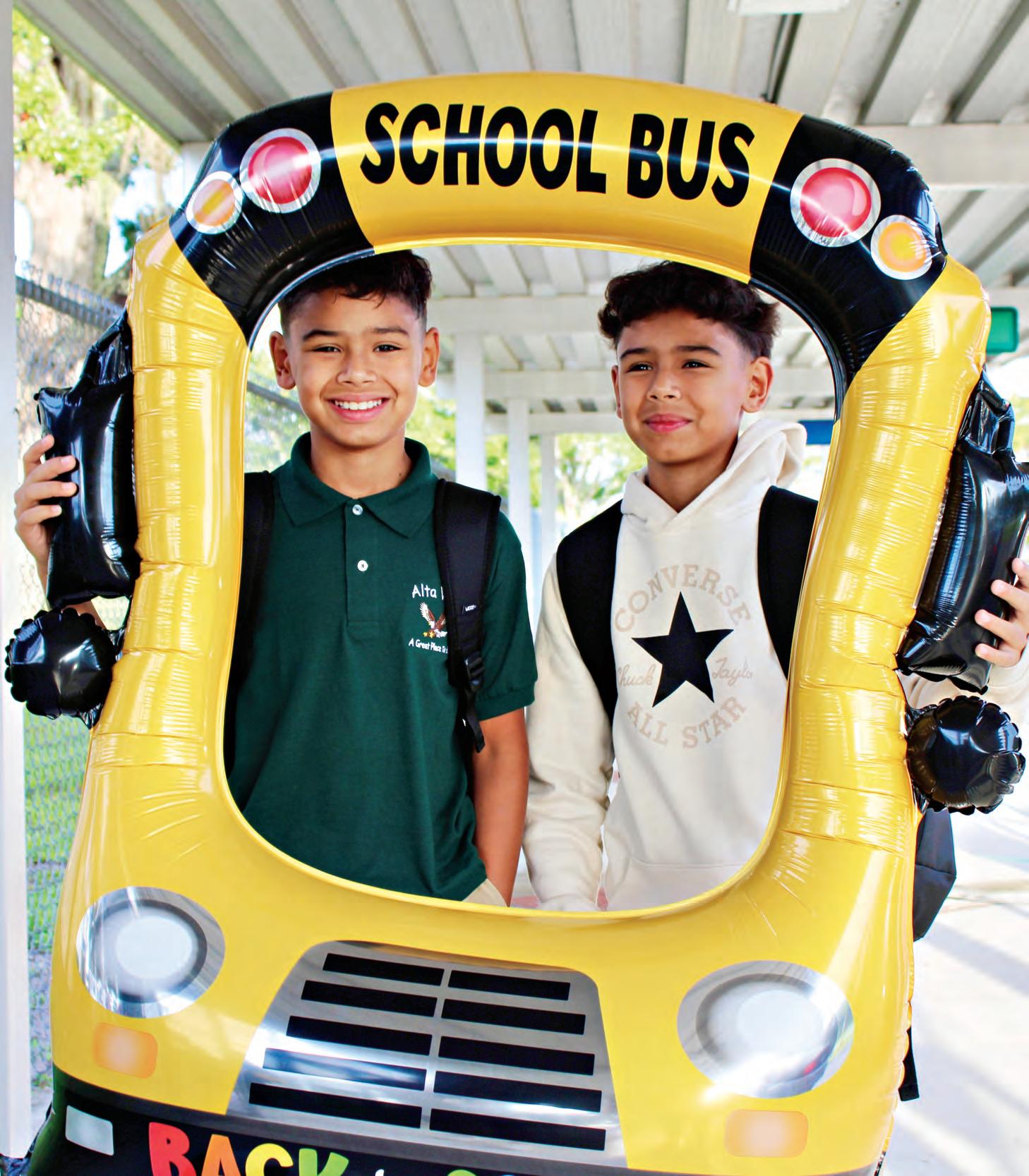
Back to School
SARASOTA
|
INFANTS - PRESCHOOL
INFANTS - PRESCHOOL

Educational child care for ages 6 weeks - 12 years
Educational child care for ages 6 weeks - 12 years
Educational child care for ages 6 weeks - 12 years
th
AFTER SCHOOL PROGRAMS
AFTER SCHOOL PROGRAMS
INFANTS - PRESCHOOL
INFANTS - PRESCHOOL
We offer Infant, Toddler, Beginner, Early Preschool and Preschool programs for ages 6 weeks to 4 years of age.
INFANTS - PRESCHOOL
We offer Infant, Toddler, Beginner, Early Preschool and Preschool programs for ages 6 weeks to 4 years of age.
We offer Infant, Toddler, Beginner, Early Preschool and Preschool programs for ages 6 weeks to 4 years of age.
We offer Infant, Toddler, Beginner, Early Preschool and Preschool programs for ages 6 weeks to 4 years of age.
VPK
VPK

We offer Infant, Toddler, Beginner, Early Preschool and Preschool programs for ages 6 weeks to 4 years of age.
VPK
VPK
VPK
Our VPK and Frogstreet curriculum will prepare your child with the skills needed for success! Our teachers provide your child with an active & engaging curriculum each day! Child must turn 4 before 9/1/24. Classes start August 11!
Our VPK and Frogstreet curriculum will prepare your child with the skills needed for success! Our teachers provide your child with an active & engaging curriculum each day! Child must turn 4 before 9/1/26 6. Classes start August 10!
AFTER SCHOOL PROGRAMS
AFTER SCHOOL PROGRAMS
Our VPK and Frogstreet curriculum will prepare your child with the skills needed for success! Our teachers provide your child with an active & engaging curriculum each day!
Child must turn 4 before 9/1/24. Classes start August 11!
Our VPK and Frogstreet curriculum will prepare your child with the skills needed for success! Our teachers provide your child with an active & engaging curriculum each day! Child must turn 4 before 9/1/26. Classes start August 11!
After Care School programs for grades K-6. We will drop your child off to their school & pick them up after school (including early dismissal). JR VPK
After Care School programs for grades K-6. We will drop your child off to their school & pick them up after school (including early dismissal). JR VPK
JR VPK
JR VPK
After Care School programs for grades K-6. We will drop your child off to their school & pick them up after school (including early dismissal).
After Care School programs for grades K-6. We will drop your child off to their school & pick them up after school (including early dismissal).
AFTER SCHOOL PROGRAMS
SCHOOL AGE PROGRAMS
Call and schedule a tour today to learn about this newly designed to mirror VPK for children that miss the VPK cutoff.
Call and schedule a tour today to learn about this newly designed to mirror VPK for children that miss the VPK cutoff.
Call and schedule a tour today to learn about this newly designed to mirror VPK for children that miss the VPK cutoff.
Call and schedule a tour today to learn about this newly designed to mirror VPK for children that miss the VPK cutoff.
SCHOOL AGE PROGRAMS
SCHOOL AGE PROGRAMS
Thanksgiving Camp (Nov.)
Thanksgiving Camp (Nov.)
Christmas & New Year Camp (Dec.) Spring Break Camp (March)
Thanksgiving Camp (Nov.) Christmas & New Year Camp (Dec.) Spring Break Camp (March) Drop-in Days during school district closures SCHOOL AGE PROGRAMS
Christmas & New Year Camp (Dec.) Spring Break Camp (March)
After Care School programs for grades K-6. We will drop your child off to their school & pick them up after school (including early dismissal). JR VPK
Drop-in Days during school district closures
Drop-in Days during school district closures
Call and schedule a tour today to learn about this newly designed to mirror VPK for children that miss the VPK cutoff.
SUMMER CAMP (MAY-AUGUST)
Thanksgiving Camp (Nov.) Christmas & New Year Camp (Dec.) Spring Break Camp (March) Drop-in Days during school district closures
SUMMER CAMP (MAY-AUGUST)
SCHOOL AGE PROGRAMS
SUMMER CAMP (MAY-AUGUST)
Our VPK and Frogstreet curriculum will prepare your child with the skills needed for success! Our teachers provide your child with an active & engaging curriculum each day! Child must turn 4 before 9 9/1/26. Classes start August 11!
SUMMER CAMP (MAY-AUGUST)
Thanksgiving Camp (Nov.)
Field Trips
10 week camp with a different theme each week
10 week camp with a different theme each week Field Trips 3 meals provided
10 week camp with a different theme each week Field Trips
10 week camp with a different theme each week Field Trips
Christmas & New Year Camp (Dec.)
3 meals provided
PROPRIETARY CONNECTIONS CURRICULUM
3 meals provided
Spring Break Camp (March) Drop-in Days during school district closures
BEFOREAND AFTER SCHOOLPROGRAMS
BEFOREAND AFTER SCHOOLPROGRAMS
SCHOOL YEAR BEGINS AUGUST 10, 2026
PROPRIETARY CONNECTIONS CURRICULUM
BEFOREAND AFTER SCHOOLPROGRAMS
CHILDREN AND FAMILY EVENTS
CHILDREN AND FAMILY EVENTS
CHILDREN AND FAMILY EVENTS
CHILDREN AND FAMILY EVENTS
3 meals provided SCHOOL YEAR BEGINS AUGUST 10, 2026 Enroll Today!
PROCARE,PARENTENGAGEMENTAPP
PROCARE,PARENTENGAGEMENTAPP
PROCARE,PARENTENGAGEMENTAPP
SUMMER CAMP (MAY-AUGUST)
PROPRIETARY CONNECTIONS CURRICULUM EARLY LEARNING ASSESSMENTS
10 week camp with a different theme each week Field Trips
EXECUTIVE CHEF- 3 MEALS PROVIDEDDAILY
EXECUTIVE CHEF- 3 MEALLSPROVIDEDDAILY
PROCARE,PARENTENGAGEMENTAPP BEFOREAND AFTER SCHOOLPROGRAMS EXECUTIVE CHEF- 3 MEALS PROVIDEDDAILY
EARLY LEARNING ASSESSMENTS
PROPRIETARY CONNECTIONS CURRICULUM EARLY LEARNING ASSESSMENTS
AdditionalExtra CurriculumActivitiesWeOffer: 941.200.4250 |
EXECUTIVE CHEF- 3 MEALS PROVIDEDDAILY AdditionalExtra CurriculumActivitiesWeOffer:
3 meals provided SCHOOL YEAR BEGINS AUGUST 10, 2026









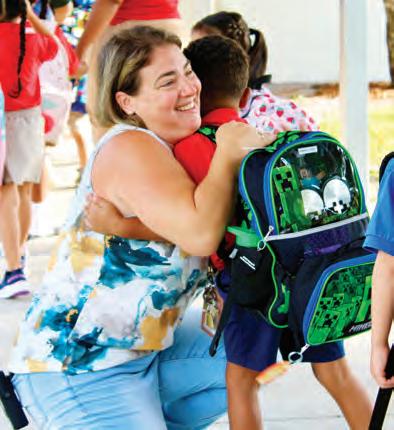

Dana Kampa
Laura Busenburg, math science coach at Alta Vista Elementary School, greets returning students at the first
2025.

We Take Your Child’s Vision Seriously
We are following CDC guidelines for your safety. Schedule an appointment today!

SCHOOL YEAR AT A GLANCE
2026-2027 Sarasota County Schools key dates
AUGUST 2026
10 First day for students
SEPTEMBER 2026
7 Labor Day; no school
OCTOBER 2026
9 End of first grading period
12 Professional Day; no school
NOVEMBER 2026
23-27 Thanksgiving Break; no school
DECEMBER 2026
18 End of second grading period
21-31 Winter Break; no school
JANUARY 2027
1 Winter Break; no school
4 Professional Day; no school
18 Martin Luther King Jr. Day; no school
FEBRUARY 2027
15 Presidents Day; no school
MARCH 2027
11 End of third grading period
12 Professional Day; no school
15-19 Spring Break; no school
26 Mini Break; no school
APRIL 2027
16 Mini break; no school
MAY 2027
26 Final day for students
Ian Swaby
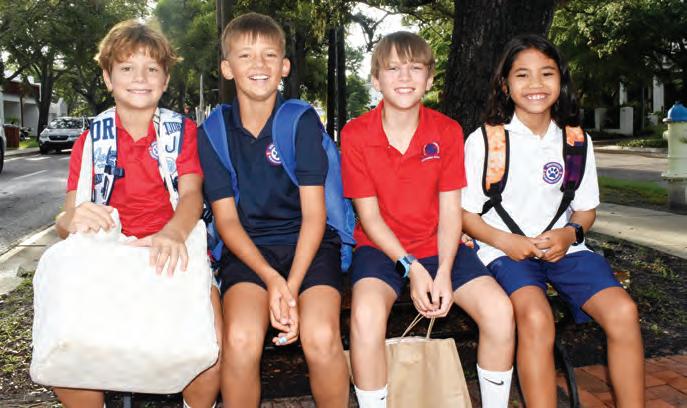
Fifth graders Ryland Esposito, Andreas Kobajlo, Joseph Cool and Charles Pimintel
Dana Kampa
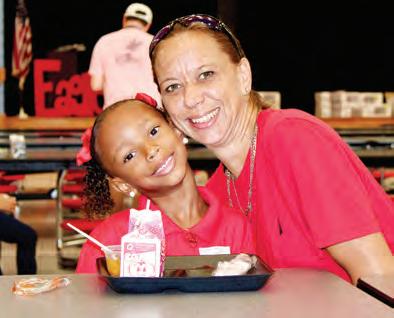
Amanda Swatek has breakfast with her daughter, Malia McCullough. Malia said she is most excited for physical education class on her first day of kindergarten.
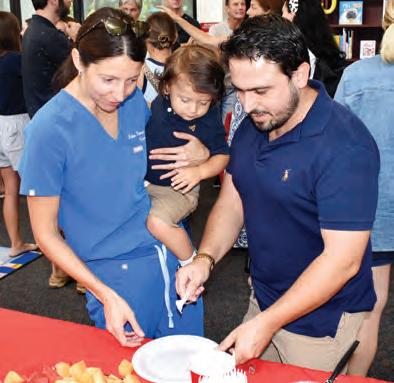
Ian Swaby Nadia Polimeni, her 1-year-old son, Luca Polimeni, and her husband, Dan Polimeni, enjoy a first day breakfast. Their son Leo is attending kindergarten at Southside.
•



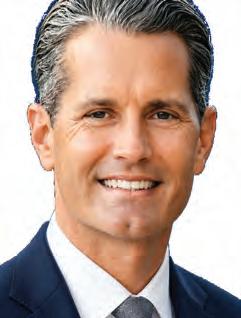
MESSAGE FROM THE SUPERINTENDENT TERRY CONNOR

At the time I am writing this letter, the school district is awaiting our official end of year assessment results from the Florida Department of Education. We monitor academic progress throughout each school year to ensure that our students are on track. Any time we receive thirdparty updates related to our work, we take advantage of the opportunity to improve
and grow. Provided that our independent tracking is correct, we can expect to see great gains for our students and school communities throughout the district.
All of the school district’s accolades are the result of hard work and maximum effort at every level, from our students deciding to attend school each day and completing their assignments, to our families choosing to participate in their school communities and stay involved in their child’s education.
It helps every time a teacher or staff member goes the extra mile to help a student, family or fellow team member, or when a local business or community group steps up to fulfill a need for a school. Each conscious choice to pursue excellence leads to the betterment of our teaching and learning environments districtwide.
Sarasota County Schools
has embraced recent challenges to better position itself for the future. As our students’ goals and aspirations have changed with the emergence of new technologies and areas of work, so has the school district’s program offerings. These have taken shape as the Future Focused Strategic Initiative (FFSI).
For those who might not be aware, the FFSI is a long-range plan designed to strengthen our neighborhood schools, expand educational opportunities for students, and preserve local control of our school campuses. Our leadership and school-based teams have spent months poring over plan details to ensure that these innovative programs become a reality.
The FFSI focuses on making smarter use of our existing school environments while introducing new, engaging programs that align with the district’s mission to foster
Orthopedic Care for Every Body, Every Movement.

excellence in education. Some of these changes include transitioning several elementary school campuses into K-8 schools; implementing 3DE by Junior Achievement at Riverview High School and Wellen Park High School; creating a Junior Achievement BizTown site at Emma E. Booker Elementary School, as well as a Junior Achievement Finance Park site at Booker Middle School; and opening the Gulf Coast Academy of Innovation & Technology at Brookside. As we continue to move through phases of the FFSI over the years, I know our students, families and school communities will thrive and grow exponentially. After much planning and a tremendous amount of hard work from our trade partners and district team members, we are excited to officially open Wellen Park High School on the first day of school this year. Wellen Park High School
is a state-of-the-art campus built to inspire excellence. Wellen Park High School’s signature programs include the Cambridge AICE Magnet Program, the SOAR STEM Research Magnet Program, innovative Career & Technical Education (CTE) pathways, high-level Fine and Performing Arts, a Comprehensive Agriculture Program, a Marine JROTC Program and more. Sarasota County Schools is fortunate to be a part of a community that prioritizes and values education. Our teachers, staff members and school leaders are committed to providing the absolute best educational experience for all students. I am immensely proud of the work we have done to support our students and families over the past year — thank you for your continued trust and partnership as we all work together to uplift every student, every day.

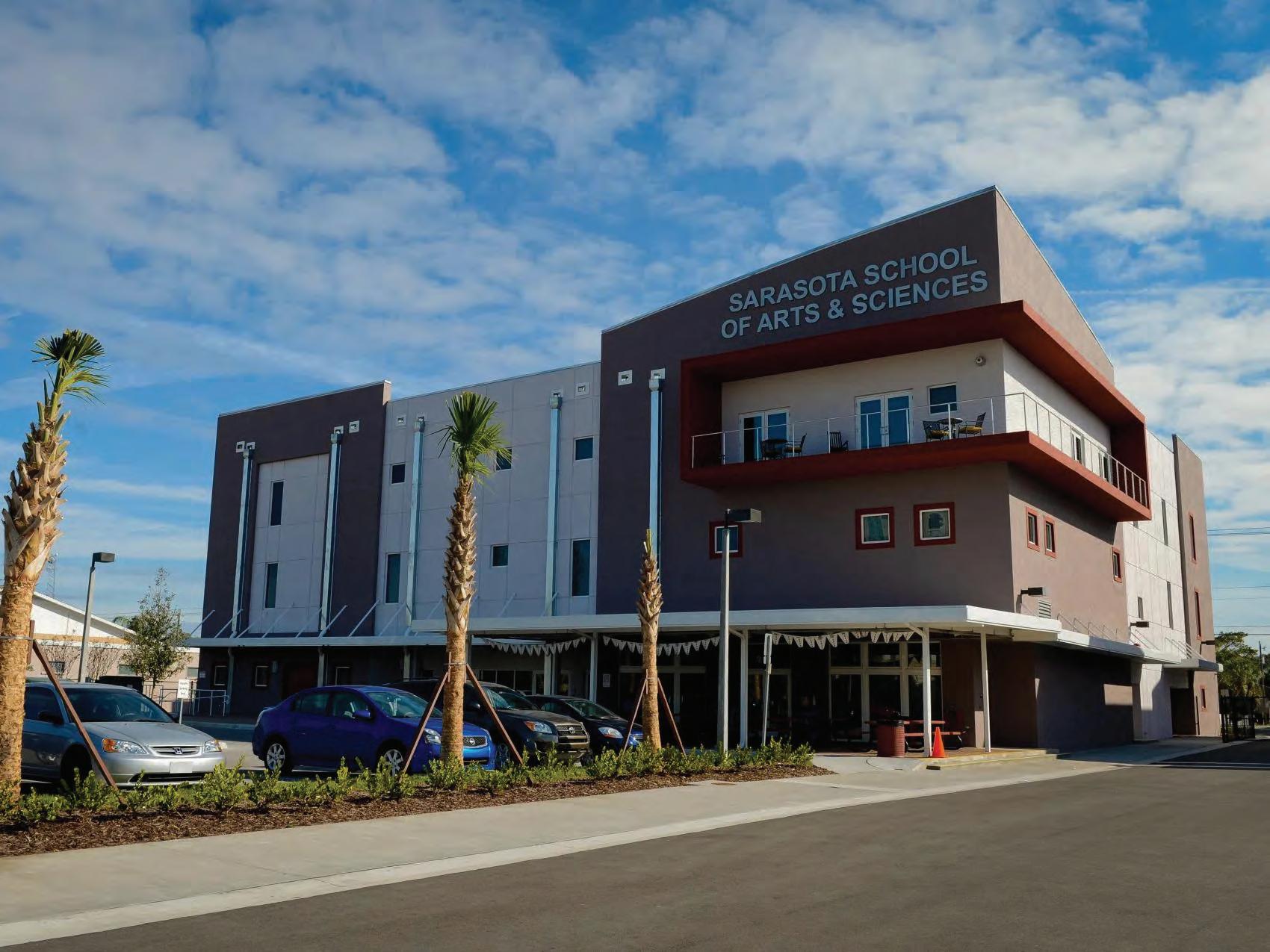
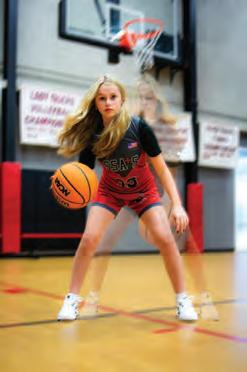
Sarasota School of Arts & Sciences
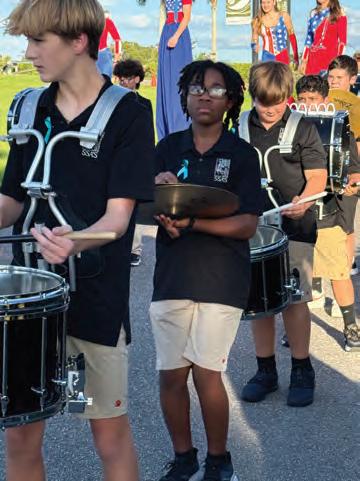
The Original Charter, 1997 A-rated School Since 2003
Future arrives this school year on Sarasota campuses
THE OF THE ROSEMARY DISTRICT
An effort to reinvent campuses begins to take shape this academic year.
ERIC GARWOOD DIGITAL NEWS EDITOR
Sarasota County Schools calls a plan to reinvent several of its campuses a “Future Focused Initiative,” and while some of it truly takes place years from now, a significant portion will take shape this academic year.

Proud to be downtown Sarasota’s original public charter school!
Enrollement Window opens August 1 through December 1. st st
Thank you Sarasota and Bradenton for entrusting us with your middle schoolers all of these years.

Built as a proactive and multipronged approach to face changes in enrollment trends, the proposal includes elements such as a technologycentered magnet school for middle schoolers, conversion of several elementary campuses into K-8 facilities and an ambitious project to build a pair of business- and financelearning centers with the help of a national partner.
“It’s a very, very robust plan how we as a school district can maximize the utilization of some of our schools that are under-enrolled as well as be innovative in our offerings to be competitive to make sure we are the premier educational provider in this county,” Superintendent Terry Connor said.
Developed last year as a response to private-school vouchers with no income restrictions, home-schooling options and Florida’s Schools of Hope provisions that would allow charter schools to occupy unused seats in under-capacity schools, the wide-ranging set of proposals was approved in November.
Earlier this year, Sarasota County schools reported about 4,800 students in the county are using Florida’s Empowerment Scholarships, about 37% of them leaving public schools to do so. About $45 million disappeared from the school dis-
trict’s reach as a result, playing a role in potential staff cuts. Here’s what’s coming for the 2026-27 school year and what lies ahead in the future.
JUNIOR ACHIEVEMENT HIGH SCHOOL CLASSES
Riverview High and Wellen Park High, the county’s newest high school, will roll out the first phase of a partnership between the school district and Junior Achievement, a century-old national nonprofit that focuses on youth financial literacy and entrepreneurship.
Estimated to cost about $2.1 million for years two to four, the first year is funded through an $840,000 grant from the Barancik Foundation. A campaign to raise the remainder is underway, and subsequent years will cost far less, said Rachel O’Dea, a deputy superintendent and the district’s chief academic officer.
In ninth grade, students may choose to take a JA-linked personal finance class, then progress through additional choices such as business and entrepreneurial principles in 10th grade, accounting applications in 11th and legal aspects of business in 12th.
Launch teachers Andrea Abeigon at Riverview and Cesar Poulus are undergoing specialized training in July to be ready for the new school year.
Courtesy image
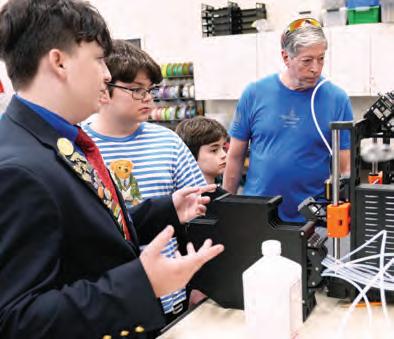
The school district has partnered with University of South Florida in order to create the new offerings at Gulf Coast Academy of Innovation & Technology at Brookside.
GULF COAST ACADEMY OF INNOVATION AND TECH
Sixth-graders accepted to the Gulf Coast Academy of Innovation and Technology’s techfocused curriculum will begin this coming school year in a three-year program that’s a first for the Sarasota district.
Seventh- and eighth-graders enrolled in the former Brookside Middle School will continue with a more traditional pathway of studies. A new cohort of sixth-graders will be brought in to matriculate through to high school in the specialized programs.
The school will emphasize four main topics:
■ Machine learning and robotics
■ Artificial intelligence
■ Game design and esports
■ Marine science and agriscience
“We’re really coupling with what Brookside currently has,” said Megan Green, the school district’s chief of high schools.
Gulf Coast Academy is teaming up with experts at The Florida Center for Cybersecurity at the University of South Florida and Sunshine State eSports League to develop curriculum. Green said beyond game design, students would also develop business plans and approaches to bringing a game idea to market.
Academy students would be expected to work as a team on a project, navigate measurable skills challenges and be exposed to field experiences in aligned industries. Green said those expectations for grades 6-8 would serve students well.
“This sets them up beautifully for what they choose to go into for high school, so whether they pursue an IB program, AICE, AP/dual enrollment or any of our career-technical pathways, having this experience in the middle school years, working as a team, working through project-based learning, critical thinking skills, all of those things are really going to help to refine their learning and understanding before they get into high school,” she said.
Enrollments of sixth graders at the school stood at around 100 in the spring, and Connor said a total of about 150 would be seen as a complete success.
“This is a leap of faith for
many of our families,” he said. “It’s our first inaugural class.”
K-8 CONVERSIONS
Four elementary schools in the Sarasota area, each with flagging enrollment over the last few school years, will become K-8 schools over the next three academic years, beginning with 2026-27 when sixth graders will be enrolled.
Alta Vista, Brentwood, Gulf Gate and Wilkinson will gradually shift through the 202829 school year. The move is in large part designed to reverse declining capacity percentages and head off potential Schools of Hope co-location requests on the campuses.
Wilkinson, which had faced a proposal to close altogether, will retain its science, technology, engineering, arts and mathematics specialty.
BIZ TOWN AND FINANCE PARK
Essentially the second and third phases of the threephase partnership with Junior Achievement USA, building out a pair of regional centers for elementary school and middle school students to learn about entrepreneurship and finance, is at least a school year away.
Fundraising, coordinated locally through JA’s national organization, is underway to build Biz Town at Emma Booker Elementary, repurposing two buildings on campus. The campaign is aimed at $18 million for construction and four years of operation with a goal of reaching 80% by December 2027. Once reached, an eightmonth construction project would allow for the opening of a combined Biz Town and Finance Park for the 2028-29 school year.
From there, a campaign to build the Booker Middle School facility, again from two existing buildings, would launch to raise a similar amount by 2030, for opening in the 2030-31 school year. At that point, Finance Park would move to Booker Middle and operate as a second site.
Brandon Johnson, the district’s director of strategic innovation, said these two facilities would attract students from not only Sarasota, but also surrounding counties.
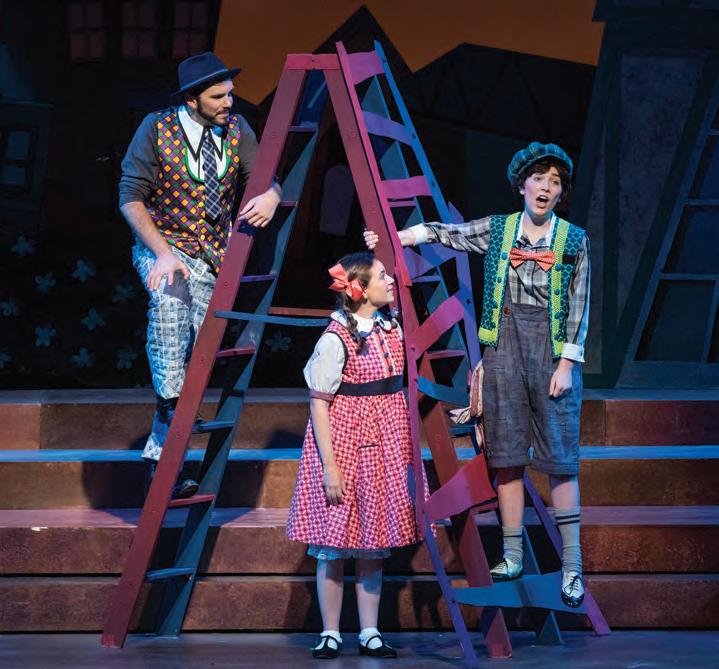
Sarasota Youth Opera is thrilled to present Rachel J. Peter’s Rootabaga Country
This fully staged production features professional sets, costumes, and orchestra, with our Youth Opera members performing lead roles and chorus.
Financial Assistance Available
SarasotaOpera.org fb.com/SYOpera youthopera@sarasotaopera.org (941) 328-1329


Over 50 Programs
• Most complete in a year or less
• FAFSA & Many Scholarships Available
• Allied Health, Health Science, Law, Public Safety & Security
• Automotive, Marine, Construction, Manufacturing, Culinary, Education, IT, Business, Creative & Salon Services
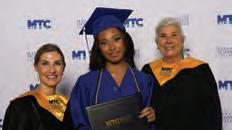
Preparing students for academic and personal success by receiving instruction to help them pass the GED test and earn a State of Florida High School Diploma.
English language learners work toward language proficiency, transitioning to postsecondary education, and gaining employment.


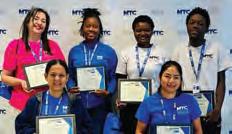
Apprenticeship
Enables employers to develop industry-standard training for apprentices through on-the-job training, related technical instruction, and structured wages.
Allows junior and senior high school students from Manatee County to take post-secondary courses either full-time or part-time while completing academics at their high school.

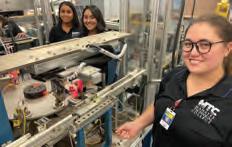
Ready for the stage
Visual and Performing Arts Director Courtney Smith says its unique approach keeps it on the cutting edge.
DANA KAMPA STAFF WRITER
Booker High School was a trendsetter when it came to the creative arts, establishing its well-regarded Visual and Performing Arts teachings as a magnet educational program in the 1970s. But just because it was early in the game doesn’t mean the school remains traditional in its approach.
Especially with a newly renovated theater at its disposal, VPA Director Courtney Smith said the creative team continues to innovate to prepare students for a career in the performing arts.
No one knows the program better than Smith, who enrolled in it herself before graduating from Booker High School in 2001.
Smith then set out to jumpstart her dance career at the University of Florida. She trained in a variety of genres and specialized in contemporary dance.
Like many instructors with the school’s VPA program, she brought that experience back to her alma mater, using it to inspire new students. Now the VPA director, Dance Depart -

ment chair, and instructor for the past 20 years, she leads artistic curricula that aim to teach the “whole student” and set the young artists on an accelerated path to their potential careers.
Smith said the magic behind the program’s success is how teachers give pupils space to develop their drive and creativity.
Smith, who was named a Teacher of the Year for Sarasota County Schools in 2022, said this is especially interesting to watch in high schoolers, who have a chance to re-examine their identities via the arts.
“When they get into a new artistic and creative space, they’re discovering themselves all over again,” she said.
VPA’S EARLY BEGINNINGS
The high school is named after Emma E. Booker, who taught at the Sarasota Grammar School in the 1910s and later became its principal. She championed equal access to education.
Our Award-winning
Booker High School’s Visual and Performing Arts program gives students hands-on experience in their field of choice, from theater to dance and beyond.
4028 Cattlemen Road, Sarasota, FL 34233
(941) 713-7449 childrensartclasses.com
year, Curriculum-based art program Homeschool - Step Up for Students Scholarship Accepted for Eligible Students Special Events Your little artist wants to change the world. Let’s get them ready.
Image courtesy of Booker High School
Amid the tumult of schools beginning to integrate, the school closed in the 1960s and reopened in the 1970s, when the VPA program launched.
Smith said the VPA program may have a longstanding history, but it’s remained strong because it continues to change to meet today’s demands.
In 2024, the school completed a major renovation of the theater, which she said has been a game-changer. Although the 1990’s-era theater was revolutionary in its time, she said the update was needed to keep up with competing schools.
From expanded hanging space for visual art to a second black-box theater space, the renovation has opened the floodgates of creativity.
“The students are learning how to create exhibition spaces and all about lighting, which affects how patrons come in and understand their artwork,” she said.
Included in the VPA program are the disciplines of art; music; dance; production and design; film and animation;
and theater.
While typical high school programs might allot one or two art periods split up throughout the day, VPA has three consecutive periods designated for the special programming.
“That’s really important because, for example, in a 45-minute dance class, you barely get going in that amount of time,” she said.
Along with updated facilities, the program benefits from current knowledge of creative industries by employing working professionals, Smith said.
Like an elite athletic or traditional academic magnet program, VPA aims to draw talent from afar and foster local talent.
“The scope of the program is designed to be four years,” she said. “We ask, ‘How do we get you prepared if you want to walk into a professional space out of high school?’ If you want to go to college or a university conservatory, you’re prepared. If you want to take these skill sets and take them into another field, you’re prepared.”
Nurturing the whole child. Naturally.
2026-27 BOOKER HIGH SCHOOL VISUAL AND PERFORMING ARTS SEASON
Booker High School’s upcoming season has a packed schedule for art appreciators of all ages. The school is located at 3201 N. Orange Ave., Sarasota. To buy tickets and confirm performance times, visit BookerVPA.com.
“Once Upon a One More Time” Musical: Oct. 15-17 and Oct. 18 at VPA Center mainstage.
“Roaring 20s” Jazz Concert: 7 p.m. Oct. 24 at VPA Center mainstage.
Print Party & Exhibition: 5:30-7 p.m. Oct. 28 at the VPA Center lobby.
“Carnevil” Haunted House: 5-9 p.m. Oct. 30-31 and 1-5 p.m. Nov. 1 at the VPA Center studio theatre.
“A Musical Gathering” Classical Concert: 7 p.m. Nov. 6 at the VPA Center mainstage.
“Grunge and Graffiti” Modern Band Concert: 7 p.m. Nov. 13 at the VPA Center mainstage.
“Namesake” Dance Concert: 7 p.m. Nov. 19-20 at the VPA Center mainstage.
“Little Women” Play: 7 p.m. Dec. 10-12 and 2 p.m. Dec. 13 at the VPA Center Mainstage.
“Death by Chocolate” Music Ensemble: 7 p.m. Jan. 19 at the VPA Center theatre lobby and mainstage.
“All Access” Sound Stage Event: 7 p.m. Jan. 29 at the VPA Center studio theatre.
“Dimensions of Space” Visual Art Exhibition: 5:30-7 p.m. Feb. 10 at the VPA Center lobby.
“Theatrefest” Green Rooms and Solo Plays: 7 p.m. Feb. 18-20 at the VPA Center studio theatre.
“Student Choreography” Dance Showcase: 6:30 p.m. Feb. 26 at the VPA Center studio theatre.
“Organized Chaos” Gallery Show: 5:30-7 p.m. March 10 at all levels of the VPA Visual Arts Department.
“Live & Loud” Modern Band Concert: 7 p.m. March 11 at the VPA Center mainstage.
“Playing the Fool” Dance and Jazz Collaboration: 7 p.m. April 1-3 at the VPA Center mainstage.
“A Chorus Line Teen Edition” Musical: 7 p.m. April 22-24 and 2 p.m. April 25 at the VPA Center mainstage.
“Press Play” Classical Music Concert: 7 p.m. April 30 at the VPA Center Mainstage. VPA Senior Showcase: 7 p.m. Ma 12-14 at the VPA Center mainstage.
“Sight Sound” Film and Animation Showcase: 7 p.m. May 18 at Lakewood Ranch Cinemas.

Micro movement grows
Microschools are reaching Sarasota as they grow throughout the state of Florida

IAN SWABY STAFF WRITER
Exercise at the start of the day, mindfulness before lessons, and recess every hour are some of the features that mark the experience at Star Lab.
The private school, which emphasizes letting students learn at their own pace, opened its doors in Sarasota’s Newtown community in 2024, and it represents a growing trend in the state of Florida.
As a microschool, a concept often described as a modern version of the one-room schoolhouse, it represents one of the departures from the traditional education system that have risen in popularity in
recent years.
According to information from an April presentation by Sarasota Schools Superintendent Terry Connor, the number of registered microschools in Florida rose from one in 2020, to 250 in 2024.
According to the National Microschooling Center, there are more than 1 million students in microschools in all 50 states. Yet at the forefront of their growth, for years, has been Florida, according to Don Soifer, CEO of the center. Soifer attributes the growth of microschools to the era of pandemic shutdowns, when he said families from across the income spectrum became more involved in their children’s education.
tunity to explore other options.
Microschools operate alongside traditional public schools, which still remain the dominant option for families, although tuition costs are covered by the state’s voucher program; the average rate of tuition, Soifer said, is between $5,000 and $10,000 per year.
Detractors point out that these are dollars that would otherwise be in the public school system. Soifer said microschools compete by personalizing education in a way that is more responsive to the families they serve.
had originally expected to remain within the public school system.
A teacher for 15 years and an administrator for seven, she said she found that the people she talked to most often were those whose children were not succeeding academically or behaviorally.
Increases reading levels up to 4 years in only 60 hours! Science based program improves cognative skills for students ages six to adult. Train the brain. Get smarter. Guaranteed. We make learning fun!
5 to Adult -
reading levels up to 4 years in only 60 hours
He said while traditional schools were not unique in struggling during those circumstances, the “closeup view” parents received prompted them to reevaluate the education systems they were relying on, while the availability of school choice in Florida gave them the oppor-
In addition to Star Lab, Sarasota includes organizations like The Village Community School of Sarasota, a K-9 homeschool enrichment program designed in the style of a microschool that opened in 2022. Roots Nature & Leadership Academy, an outdoor Montessoriinspired K-8, which opened in 2022, currently targets a total of 75 to 80 students.
CHARTING A NEW PATH
Star Lab founder Alison Rini
“I just thought, ‘There has to be a better way,’ and I originally thought my path would be to work in the district and try to work my way up to a principal job in the district, but I realized that somebody needs to start this alternative, and maybe it just should be me,” Rini said.
A grant from The Drexel Fund helped her to establish the school, which is currently a K-3, and set to add a grade each year and become a K-5 for the 2027-28 school year. The school’s board president, Jimmy Glover, is a current District 1 school board candidate who has advocated on behalf of the needs of Newtown.
Located directly across the parking lot from the Janie’s Garden pubic housing com -
Ian Swaby
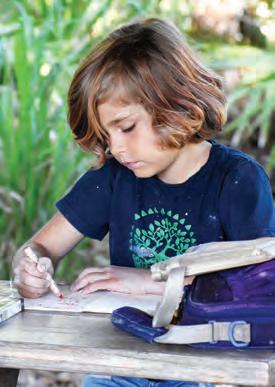
Third grader Henley Kennedy works on an assignment at Mangrove School of Sarasota.
plex, the school serves many of the students whose families live there, which Rini said gives parents the opportunity to visit.
She said parents choose the school for a variety of reasons, which include their students being sent home for behavioral reasons, not trusting the content of public school curricula or simply wanting a smallschool experience.
Many of the students have had behavioral challenges in past schools, but she said the small size of the school, with groups that contain just a few students, a teacher and an assistant, make it easier to address conflicts.
Rini also said the practice of holding a 15-minute recess every hour, an idea that comes from the model of Finland, which is known for its high test scores on international assessments, helps to reset the learning environment.
“It helps them then go back in to learn and be productive,” she said. “It also completely diffuses power struggles. If a
It’s just a really fascinating thing to see kids happy to come to school and learn, and I think that’s what we really look for.”
Kevin Klein, a board member and parent
kid is getting in trouble and teacher’s like, ‘You need to sit over there,’ and they’re in trouble, they have an opportunity to disengage, so when the teacher said, ‘OK, now you can go out and play,’ the kid is no longer locked in that behavior conflict with the teacher.”
Content is broken down in to learning objectives. Rini said mastery of skills is the target, stating that any student can receive an “A” grade if they attempt a skill for long enough. She said the school has an emphasis on flexibility and allowing students to learn at their level.
Rini said the majority of second graders last year entered unable to read. She said
although initially the school didn’t see improvements in the data, it began performing interventions and small groups in the afternoons. All students are now either reading on grade level or experiencing “an 85th percentile level of growth.”
“At Star Lab, you learn at your own pace...” said student Landry Shorb, a second grader who was spending her first year at Star Lab after moving from another private school.
She calls herself “more into math than anything else,” although there is one item on the schedule she’s less enthusiastic about: recess.
“I’m not really like a runny and play person,” she said. “I’m more like calm, and a kid that really wants to learn more stuff.”
Shorb also said she “definitely” prefers Star Lab to her previous school, and that while some kids may say school is the worst, she said that school is “the best.”
Another institution that shares qualities with microschools is Mangrove School of
Sarasota, a Waldorf methodinspired K-8.
The school began as a play group in 2001 and later began adding grades. It eventually transitioned to a full-time outdoor setup before moving from an area near Siesta Key, to Church of the Trinity MCC in August.
Director Erin Melia describes the school, which operates mainly in nature through outdoor cabanas, as bringing kids “back to those ancestral roots of what humans always experience,” and describes it as having qualities of microschools, although it is larger in size.
Melia said the school strives for a peak of 10 to 12 students per grade.
ing thing to see kids happy to come to school and learn, and I think that’s what we really look for,” he said. “We were definitely trying to avoid the mainstream tablets in schools, bright lights, square boxes, where everybody’s following the same path, and that’s just not here at all. And it’s such a beautiful thing.”
He also praised the community of the school, which he said allowed parents to become highly involved.
What’s next for the growing movement of microschools?

“(Microschools) are creating their niche area of how they feel is the best way to educate children, and I feel like that was definitely part of the impulse of what created this school,” Melisa said.
Kevin Klein, a board member and parent, said he was drawn to the school for its setup.
“It’s just a really fascinat -
Rini said maybe Star Lab could branch out to operate schools in classrooms within the system, giving public schools the chance to observe its model and see whether it works for them. She said her goal isn’t to compete with the public school system, but to supplement it and work with it.
“We don’t want to take that right away from them,” she said. “We want them to have a free publicly funded education, but we just want to do it differently.”

Discover a wave of learning
Mote SEA has hosted over 290 field trips working with 16,500 students since opening in October.
doors, students in Manatee and Sarasota counties have used the new resource.
Sharon Itts, a science teacher at Braden River High School, began her career not as an educator but as a scientist.
She teaches marine biology and does as many hands-on activities with her students as she can in her classroom.

“We’re here in Florida, so this passion is real easy to harness, and my hope is for the students to feel some of that enthusiasm,” Itts said. “I hope they will learn how to embrace the environmental resources while still having fun doing the activities that they’ve grown up doing. I want them to be more mindful of little nuances or differences that they can (experience). For example, go fishing, but only keep what you’re going to eat.”
Itts now can take her students on field trips to the Mote Science Education Aquarium, which opened in October adjacent to Nathan Benderson Park. Since Mote SEA opened its
Brad Tanner, manager of school programs at Mote SEA, said in the first 10 months the aquarium has hosted approximately 300 field trips and worked with more than 16,500 students. He said each day during the school year, between one and five schools have taken advantage of the facility, working in the labs and exploring the aquarium.
“I love to see a little spark in their eyes when they learn something new,” Tanner said.
“I’ve seen the students will actually share with their parents something they learned. That’s always a fun moment.”
Patti Folino, the principal at Tuttle Elementary School, said 13 of her school’s students attended Mote SEA during the Sarasota County STEM Fair Feb. 13. She said she enjoyed hearing the stories from students and their families about seeing the sharks and stingrays. She called the aquarium the
MADISON BIERL STAFF WRITER
Madison Bierl
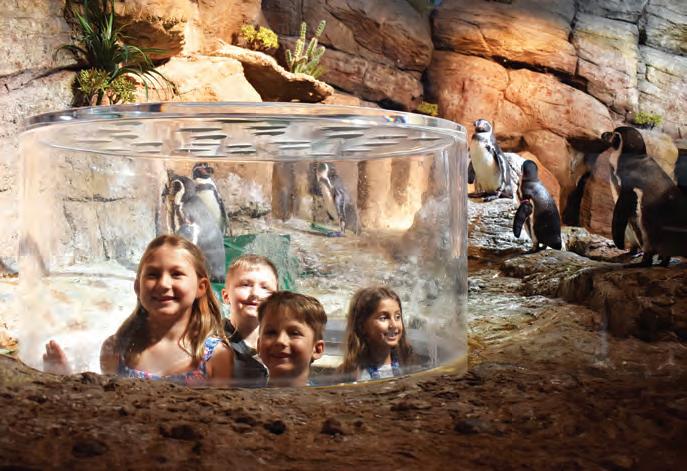
Lakeview Elementary first graders Ava Gardner, Wesley Rigdon, Edward Bullard and Luiza Martins get up close and personal with the penguins May 7 at Mote SEA.
“main hub of everything.”
Although there hasn’t been an official field trip to Mote SEA for Tuttle students just yet, Folino is excited for the future.
As a Title 1 school, Folino said she wants her students to have the experience without having to pay for it. Mote SEA has provided 8,280 passes to Sarasota County students and 15,300 to Manatee County students in Title 1 schools that are good for up to six guests per student.
“It’s so crazy,” Folino said. “The ocean is our backyard, but (the students) don’t ever get to go there and they don’t always get to experience what lives in our gulf.”
Folino said learning about biology and the life cycle is one thing, but being able to see that cycle through a sea-life lens is impactful and makes it that much more real to the students.
Tiffany Spradling, director of secondary curriculum for the School District of Manatee County, said 6,211 students and teachers from Manatee County have participated in teaching lab lessons since October 2025.
The three learning labs focus on marine ecology, biomedical and immunology, and ocean technology. Amber Platowski, the secondary science coordinator for the School District of Manatee County, said ecology – the scientific study of how living organisms interact with one another and with their physical environment – repeats from kindergarten all the way through the senior year.
“They’re learning about food chains, food webs and human impact on the environment,” Platowski said. “That’s a relevant one, especially because we’re here in Manatee County. They’re identifying not only the problems, but they’re letting kids work through solutions. That is the forwardthinking, problem-solving skill set that we want to develop in our learners.”
Once time and date is confirmed for a field trip, each teacher is given the opportunity to let Tanner and the Mote staff know if there is a focal point so the students can directly relate to their current lessons in class.
“Although we provide time for that in our curriculum, being able to reinforce that in an
LEARNING LABS
MARINE ECOLOGY
■ In the Marine Ecology STEM Teaching Lab, students explore habitats that showcase mangrove shorelines, seagrass meadows, and coral reefs. These living systems highlight the ecosystem connections that support ocean health.
BIOMEDICAL AND IMMUNOLOGY
■ The Biomedical and Immunology STEM Teaching Lab introduces students to the science of marine life health and the surprising ways it connects to human medicine. In this space, they explore how scientists study the immune systems of sharks, skates, and rays; investigate the health of threatened species; and discover how microscopic marine life can produce natural products with medical potential.
OCEAN TECHNOLOGY
■ In the Ocean Technology STEM Teaching Lab, students discover the tools scientists use to explore and understand marine environments. They learn about autonomous and remotely operated systems that move through the water, across the surface, and along the seafloor; electronic tags that track fish after release; artificial intelligence that improves the efficiency and accuracy of research; and citizen science apps that allow the public to contribute to valuable data. This space shows how technology and science work together to unlock the secrets of the sea.
To learn more, visit Mote.org/ Education/
engaging setting helps solidify that learning,” Platowski said.
First grade students at Lake Manatee K-8 were learning about land turtles and sea turtles prior to their May 11 field trip. Rebecca Garcia, a first grade teacher at Lake Manatee, said she appreciated that Mote offered different classes based on the level of the students. Garcia said her students loved the hands-on touch tanks. They couldn’t get over the cold temperature of the water and how smooth some animals and coral felt.
Jaime Pirillo, the mother of Lake Manatee student Jaxon



FROM PAGE 17
Pirillo, attended the field trip as a chaperone. She said it was a beautifully designed aquarium that makes for a great family day. For Jaxon, his favorite part was seeing the otters swim, which reminded him of his school as the otter is the mascot.
“My hope is that children continue to want to learn about sea life and the importance of our ecosystem,” Garcia said.
Sylwia Konopko, a first grade teacher at Lakeview Elementary in Sarasota County, said the first grade field trip to Mote further expanded on topics the students were learning — marine ecosystems, animal adaptations, conservation and environmental stewardship.
She is passionate about connecting classroom learning with real-world experiences, which is why she finds field trips such as the one she attended on May 7 so valuable.
and the importance of protecting our environment.”
Jennifer Shelly, also a first grade teacher at Lakeview Elementary, said seeing the eyes of her students light up as they learned was rewarding. She said the students asked thoughtful questions and were genuinely curious about the animals and their habitats.
She enjoyed hearing students talk about wanting to protect the ocean and marine animals. For her, it shined a light on how powerful real world experiences can be.
“As a child, I would have been fascinated by the opportunity to see marine life up close, interact with exhibits, and learn directly from experts,” Shelly said. “I believe experiences like Mote SEA help students develop curiosity, ask questions and see themselves as part of the learning process.”
14, and Kingston, 8, attended as students of the Out-ofDoor Academy. They came back excited about the handson exhibits, touch tanks and the opportunity to learn about marine life up close.
She hopes the students at Innovation will experience the same in the future.
“I want them to develop curiosity, make real world connections, and see science come to life beyond the classroom,” Jenkins said. “My hope is that students leave Mote with a greater appreciation for our oceans, a better understanding of conservation, and a sense of wonder that inspires them to keep learning long after their visit.”
seeing the animal swim around, maybe harmed, or probably just living in the aquarium, compared to it being endangered out in the open ocean or lakes.”
Although she loved her experience, Magee said the aquarium experience is probably better for younger kids, as they would want to learn more or volunteer in the future. She felt as though teenagers might not be quite as involved or interested, but instead might want to post.
She hopes that as elementary students grow, they will be able to connect with visits to the aquarium. She said the volunteers and staff at Mote SEA are passionate and outgoing when presenting information.
“Experiences like this help students develop a deeper understanding of the topics they study while encouraging them to ask questions and think critically,” Konopko said.
“I hope they leave with a greater appreciation for marine life

Fayth Jenkins, the head of school at Innovation Academy SRQ, said students at Innovation have yet to attend the new Mote SEA for a field trip. However, her own children, Elijah,

Kaylynn Magee, a 2026 graduate of Braden River High School, attended Mote SEA as part of her marine science class with Itts. She especially enjoyed seeing the turtles, jellyfish and octopus up close.
“One thing I like about the aquarium is you’re not looking in a book, you’re not reading,” Magee said. “You’re physically
Spradling said Willis Elementary School has become Mote’s first partner school. This means Willis will integrate Mote research and citizen science into its classrooms, specifically its science classes. Platowski said citizen science is when everyday people are able to contribute to scientific research.

Madison Bierl
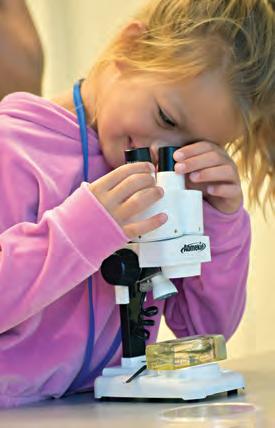
Lakeview Elementary first grader Ida Torko said she was excited to look through a microscope, but she was even more excited to see the penguins and jellyfish.


Test time
Here
IAN SWABY STAFF WRITER
As the school year resumes, families look ahead at one familiar reality they might not be keen to think about — standardized testing.
The testing landscape includes several major milestones throughout a student’s academic career, with highstakes exams that begin as early as the third grade. However, local principals told the Observer that students are well-equipped to handle these assignments, although they can use some extra support from their parents. Here is an overview of the major tests students must complete in the state of Florida, and how families can help students navigate the pressure and help them be prepared.
CHECKPOINT EXAMS
McHenry Lerebours, principal of McIntosh Middle, brings 22 years of experience in education, and said the state now features more measures aimed at academic accountability than it did in the past.
BACK SCHOOL starts
There are a lot more tests that they have to master and pass, so the pressure has definitely gotten to be a lot more, and the accountability measures are higher.”
grade, representing the Benchmarks for Excellent Student Thinking (BEST).
Part of a federal program but specific to Florida, these tests involve three progress-monitoring tests over the course of the year. The first test, PM1, administered at the start of the year, serves as the baseline for measuring students’ progress. It is followed by PM2 and concludes with PM3, the test that determines the school’s grade.
“There are a lot more tests that they have to master and pass, so the pressure has definitely gotten to be a lot more, and the accountability measures are higher. With that, there are more resources available for students,” he said.
Testing begins with students attending VPK, who take the Florida Assessment of Student Thinking (FAST) Star Early Literacy test.
However, the first tests that can be considered high-stakes begin with the third grade FAST tests, which cover English language arts and mathematics, and continue through the 10th
Third grade reading scores remain a critical milestone in the district. Of all elementary school assessments, third grade English language arts carries the most significant consequences. Under Florida law, students who are not able to read at grade level could be retained in third grade, unless they quality for specific exemptions or show sufficient progress through the district’s remediation efforts.
As students move into middle school, the standardized


McHenry Lerebours, principal of McIntosh Middle
Ian Swaby
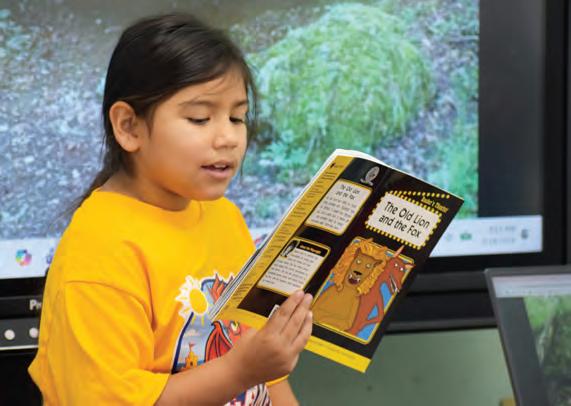
Rising third grader Letizia Martinez reads aloud during a performance at Dreamers Academy’s summer school. The program helps prevent the “summer slide” that can affect students in areas that include testing.

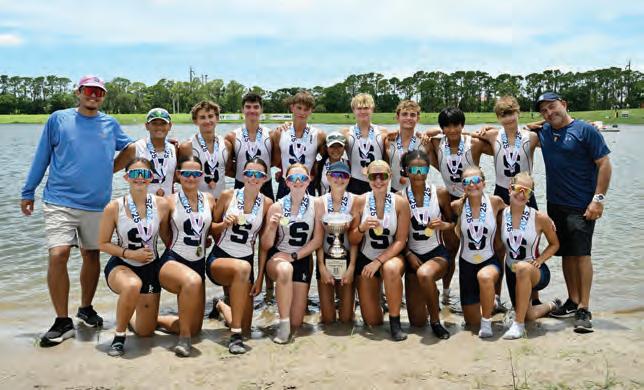
+ Positive Environment
+ Experienced Coaches
+ 15x FL State Champions (2011-26)
+ 2021 & 2022 U19 World Champions
+ 2024 USA Olympic Medalists (Rower and Coach)
Learning from the pros
Coaches’ careers bring a unique perspective to their training repertoire at the high school level.
JACK NELSON SPORTS REPORTER
An “oh crap” moment of realization hit Mike Rostampour after his first practice overseas as a professional basketball player. He was on his own. He had to find the right foods to take care of his nutrition. He had to find a gym to take care of his body. And he had to keep his mental health in check so he could excel on the court.
There was no support system for him to lean on that night, and rarely was there ever that off-the-court support from 2015-21 while competing in Slovakia, Canada, Mexico, El Salvador and Iran. That journey taught him a
lesson he eventually would pass down to his Lakewood Ranch Prep boys basketball players. It was a lesson he considered the most important of all.
“If you want to be the best, you’re on your own,” Rostampour said.
Rostampour said while high school athletics might serve the players well in their overall development — as players, as students, as citizens — those who want to go above and beyond need to take ownership of that task.
Such is the wisdom of retired professional athletes. They have a wealth of knowledge and experience other coaches can’t match.
Some former pros might keep that knowledge and experience
close to the vest, but others feel a responsibility to share it with the next generation.
Both Sarasota and East County area teams are home to retired pros who now coach high school athletic programs. They have chosen to give back after their playing days.
Molding their respective approaches to coaching from their experiences as pro athletes took time, though. They had to learn the challenges of working with high school athletes.
Barry Cheesman, who’s entering his third year as the Sarasota High boys golf coach, made 82 cuts in 220 tournaments on the PGA Tour. He also has two Korn Ferry Tour wins to his name.
He became a PGA Teaching Professional in 2008, and had instructed high school-aged golfers one-on-one before joining the Sailors, helping
them toward their goals. Leading a team of golfers with differing individual goals is not the same.







“They don’t know the time and effort they need to succeed at what they’re trying to do,” Cheesman said. “Not every kid
wants to go to college and play golf, and not every kid is going to go to college and play golf. I try to convince them that they can.”
Former pros understand that there might be a heightened expectation when they take

Jack Nelson
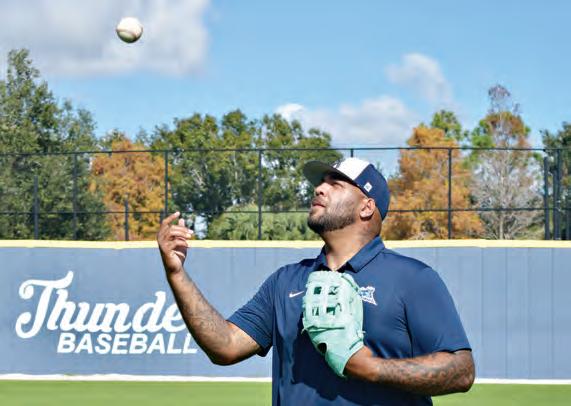
This past season was Jordan Guerrero’s first as The Out-of-Door Academy baseball coach. Guerrero, who pitched in the San Diego Padres organization from 2015-23, guided the Thunder to an 8-12 record.
It’s definitely fun to try to piece together a puzzle of how guys can find out who they are individually.”
over as a high school coach.
Jordan Guerrero, who was a first-year coach for Out-ofDoor Academy baseball last season, encourages his players to set lofty goals. But he does remind them of reality.
A 2014 Braden River High graduate, he pitched in the San Diego Padres organization from 2015-23, getting as far as the Triple-A El Paso Chihuahuas.
He knows that only a select few make it to the minors, and even fewer, Major League Baseball. Everyone’s path is different. Guerrero identifies each of his athletes’ paths and shows them how to follow it.
“It would be easy for me to say, ‘Hey, if you work hard, you’re going to reach your dreams.’ The real world, unfor-
tunately, just doesn’t work like that,” Guerrero said. “I go back to, ‘Hey, realistically, what is your path?’ It’s definitely fun to try to piece together a puzzle of how guys can find out who they are individually.”
Former pros command a certain unspoken respect from high school athletes.
But that’s not always the case.
Ovation
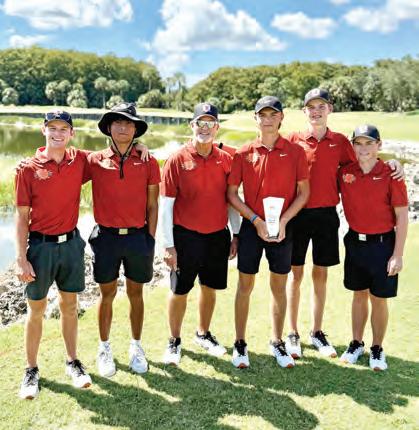
Barry Cheesman (third from left) guided Sarasota High boys golf to a sixth-place tie at the 2025 FHSAA Class 3A state championship. Then-senior Jake MacDonald (fourth from left) was the Sailors’ top individual finisher in T-19th place.
Rostamour said he has found few —if any — athletes, who care much about his own success.
His players know he played for the Iran men’s national basketball team in the 2020 Tokyo Olympics. They’re more interested in how they can reach their goals.
“This isn’t the Bob Knight era of 20, 30 years ago. This is an
era where kids don’t care what you did in the past, they want to know what you can do for them now,” Rostampour said. “How are you treating them? Are you fair? Are you direct? Are you upfront?”
Do the former pros have an edge in the high school coaching world? One area might be the mental part of the game.
Regardless of their sport, they each faced considerable challenges to reach that level.
Golf is no exception. Cheesman teaches his athletes to strengthen themselves mentally as often as he teaches them to strengthen their skills on the green.
“The way they practice, the way they approach their matches, the way they approach their rounds of golf — we’re constantly talking about stuff,” Cheesman said. “It’s more of the mental aspects that they encounter when they’re playing golf that can be really difficult for them.”
Guerrero had a conversation with one of his players a couple months ago. He said the con-
versation reminded him how important it is to coach the mental side of baseball.
This athlete was struggling and frustrated. Guerrero tried reassuring him that struggles are not few and far between in the sport.
“I’m like, ‘Hey man, who cares if you’re struggling? Everyone goes through it,’” Guerrero said. “And he looked me in the face and said, ‘I care if I’m struggling.’ At that point, I’m like, ‘OK, this is tough. This is ingrained in this guy’s mind. How can we get it out of him?’”
Both Cheesman and Rostampour recommended that fellow retired pros consider high school coaching. Guerrero said his experience has been positive, but also said he would only recommend it to those whose hearts are truly in it.
Those who do make the transition bring a unique perspective that can be valuable.
“I feel like I have a doctoral degree in basketball,” Rostampour said. “For me to keep all that knowledge to myself would seem selfish.”


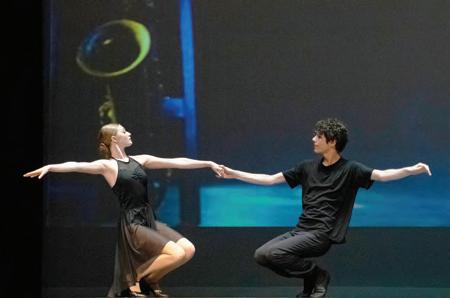
Image courtesy of Barry Cheesman
Jordan Guerrero, The Out-ofDoor Academy
Are you smarter than a fifth grader?






IAN SWABY STAFF WRITER
The following are questions sourced from Florida Department of Education sample tests for science and mathmatics, and are designed to match the knowledge and reasoning skills of a fifth grader.
Read each question carefully and see how you perform!
1Ariana uses balloons to investigate static electricity. Which of the following best explains what will happen when she brings two positively charged balloons close to each other?
☐ A. The balloons will move apart.
☐ B. One balloon will lose its charge.
☐ C. The balloons will come together.
☐ D. One balloon will gain a negative charge.
2
Caitlyn set a goal to swim 675 laps in her pool during summer vacation. She will swim 12 laps each day. What is the least whole number of days Caitlyn will swim to reach her goal?
3
Erosion and weathering can both cause changes to the surface of Earth. Which of the following happens only because of erosion?
☐ A. Rocks form deep underground.
☐ B. Rocks become smooth and round.
HOMESCHOOL
THURSDAYS
Members: $20/Session | All others: $25/Session Reduced Museum admission for Homeschool Families
JUNIOR EXPLORERS (K-3rd grade, ages 5-8) 10AM-NOON & 1-3 PM
DISCOVERY RANGERS (4th-6th grade, ages 9-11) 1-3 PM

☐ C. Rocks are broken apart into small pieces.
☐ D. Rocks are moved from one place to another.
4
In two days, David and James sold the same number of tickets to a Caribbean dinner. David sold 17 tickets on Monday and 30 tickets on Tuesday. James sold 22 tickets on Tuesday. The equation below can be used to find s, the number of tickets James sold on Monday.
17 + 30 = s + 22
How many tickets did James sell on Monday?
5
Roger collected four rock samples and wrote a description of how each was formed. Which of the following rocks that Roger collected is a metamorphic rock?
☐ A. Formed from magma that cooled slowly
☐ B. Formed by pressure and heat over time
☐ C. Formed from lava that cooled quickly
☐ D. Formed by pieces of rock cemented together
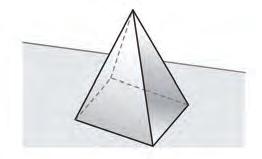
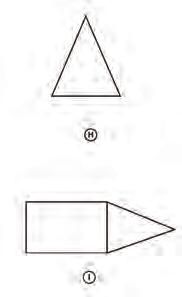
6Kayla received a special award at the end of the school year. Her award, shown below, is a rectangular pyramid. Which of the following could be a top view of Kayla’s award?


7
Astronomers study many different kinds of objects in our solar system. Which of the following best describes a difference between comets and asteroids?
☐ A. Comets orbit planets, and most asteroids orbit the Sun.
☐ B. Comets are hot balls of gas, and asteroids are made mostly of ice.
☐ C. Comets are made mostly of ice, and asteroids are made mostly of rocks.
☐ D. Comets orbit the Sun between Mars and Jupiter, and asteroids form patterns in the sky.
8
The three Gibbons brothers are all 3 years apart in age. The total of their ages equals 33 years. What is the age of the oldest brother?
9Jenny measures the outside temperature as 16 degrees Celsius (°C), 61 degrees Fahrenheit (°F). She observes precipitation falling from the clouds in a solid form. What type of precipitation is Jenny most likely observing?
☐ A. hail
☐ B. rain
☐ C. sleet
☐ D. snow
10
Several sources have recorded the lowest temperature in Florida as -2 degrees Fahrenheit (°F) on February 13, 1899. However, according to one website, the lowest recorded temperature in Florida was actually 4° warmer.
What temperature would this website have shown for Florida’s lowest recorded temperature?
11
Rebekah makes a quilt using red, blue, and purple fabric. She uses 3 1/2 total yards of fabric. She uses exactly 2 3/5 yards of purple fabric.
What are possible lengths, in yards, of red and blue fabric that Rebekah could use?
12Christy wanted to find the surface area of a
square pyramid. She wrote the expression shown below. (24 i 5) ÷ 2 + 62
What is the value of the above expression?
13
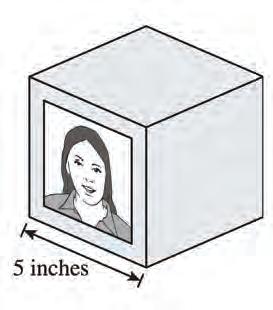
Carole has a cubeshaped photo frame with the dimension shown below. Which expression should Carole use to find the surface area, in square inches, of her cube-shaped photo frame?
ANSWER KEY
1-A
2-To find the least whole number of days, divide 675 by 12. Because the quotient is 56, with a remainder of 3, swimming for 56 days will only give her 672 laps; therefore, an extra day is needed to account for the remainder. She needs to swim 57 days to reach her goal.
3-D
4-25 Tickets
5-B
6-G
7-C
8-The correct answer is 14.
Because the brothers are all three years apart, think about which numbers can be changed but will still equal the sum (33). If 3 is subtracted from the first number (11 − 3 = 8) and 3 is added to the third number (11 + 3 = 14), the three ages would still equal 33, but each would be 3 years apart. 8 + 11 + 14 = 33 ; therefore, the oldest brother’s age is 14.
9-A
10- 2°F (2 degrees Fahrenheit)
11- Red: 3/10 and Blue: 6/10
12- 96
13-D 5 x 5 x 6

testing landscape expands to include Statewide Science Assessments in grades 5 and 8. While these tests provide an overview of the students’ grasp of scientific concepts, passing is not necessary to advance to the next grade.
Middle schoolers also face the Civics End-of-Course (EOC) Assessment, which can be taken from grades 6 through 8, constituting 30% of the final course grade, but allowing retakes.
To receive a high school diploma, students need to earn 24 course credits, including credits for specific required courses. However, there are two subjects for which passing the end-of-course (EOC) exam is required for graduation.
These are the statewide FAST English language arts exam, and the Algebra 1 EOC, which accounts for 30% of that course grade. Both are typically taken in the 10th grade.
These tests can be reat -
tempted throughout high school. Higher-level courses like Algebra 1 can also be taken during middle school for high school credit.
There are other avenues as well, for students can receive a score on tests like the SAT or ACT that can be counted as a passing score for some tests.
Students have been taking the ELA test every year since the third grade, notes Dorlinda Carlson, assistant principal of curriculum and academics at Lakewood Ranch High School.

“When they get to 10th grade, they’ll know what it is that they need to do to pass the test, and they’ll be proficient,” she said.
“At Lakewood, I have to say, the vast majority of the time, they are proficient. We have other schools in the county where that is not the case.”
looking to attend college, high school testing stands along side college entrance exams in importance, so students should look at combination of both.
TESTING TIPS
As kids navigate the landscape, what can parents do to help?
Patti Folino, principal of Tuttle Elementary, said the school sees a correlation between support outside of school student success, while she notes that the school also has its own built-in supports including after- hours offerings and intervention time.
Geri Chaffee, co-founder of Dreamers Academy, a duallanguage charter school, finds that when students are younger, more parental involvement takes place, but as they move into middle school, parental engagement drops.
“I don’t know that parents should necessarily under
or attending awards ceremonies and sporting events, as well as communicating with teachers.
He also said one of the easiest ways to prevent the “summer slide,” the loss of learning during the summer, is by reading to kids, and suggests doing so for at least 20 minutes per day.
“Because they have lost some instructional time over the summer, they forget a lot of the skills that they’ve learned in the previous year,” he said.
Folino said nothing can match a board game night.
“You’re learning social skills like how to take turns, how to lose, you’re adding and subtracting, you’re problem solving, thinking ahead — most of






Swaby



SCHOOL
Sports
Well
Vision
Preventative
Immunizations
Weekend
Convenient
Beneva